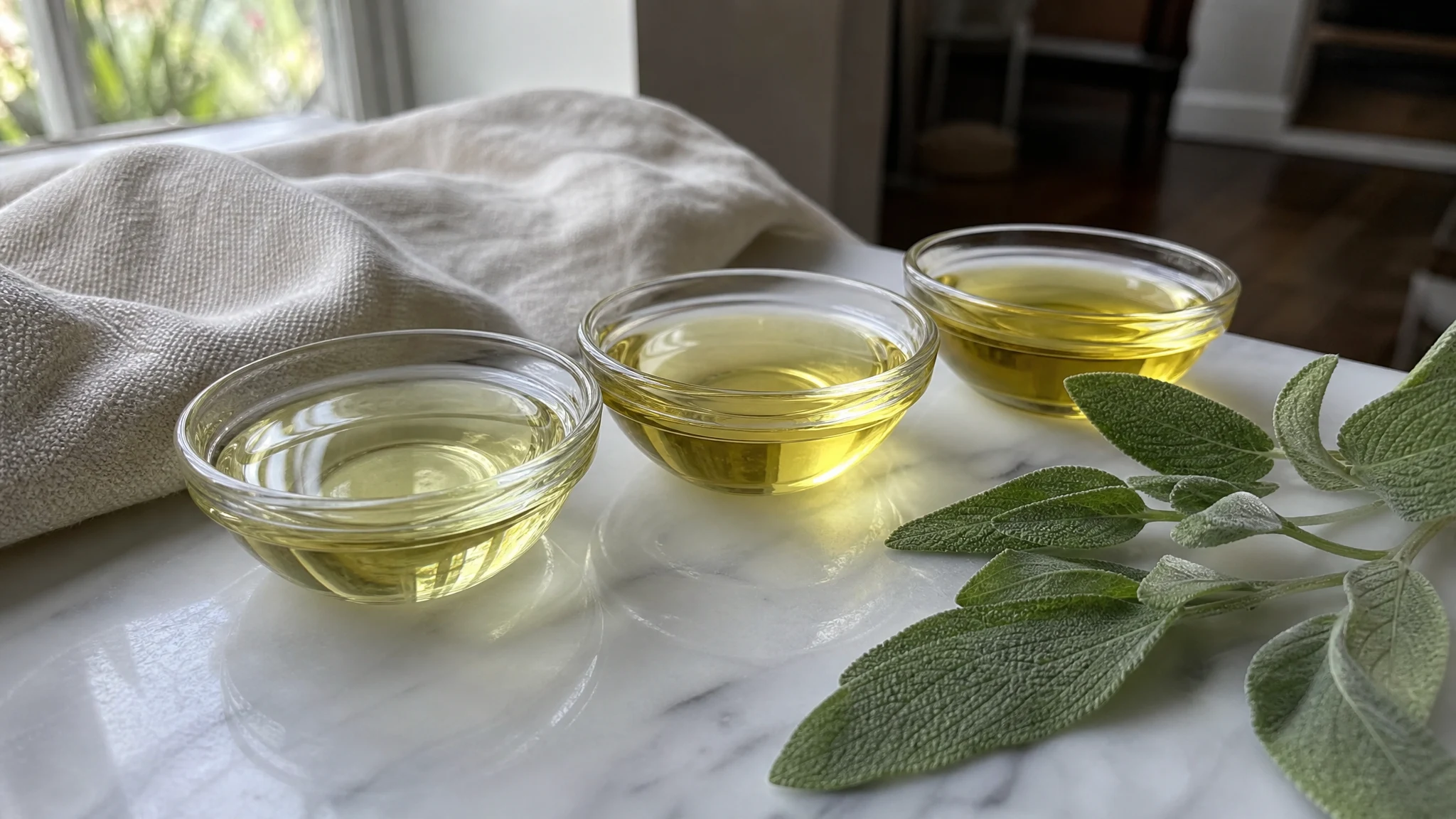
Can You Diffuse Sage Oil? Three Questions First
Sage is not an oil to tip into a diffuser on impulse. No authority has published a safe amount to diffuse, so the sensible route is a short sequence of questions: who shares the air, which machine you are using, and how small a share the sage should take. If the first answer has a yes in it, the blend simply never gets made.
First question: who shares the air, and who can reach the bottle?
Our process page is direct about this. Avoid sage oil entirely during pregnancy and breastfeeding, do not use it on or around children, and if you have a seizure disorder, leave this oil alone. It adds that diffusing needs a lighter hand than you would use with a mint or a citrus.
The wider literature points the same way. The National Capital Poison Center says swallowing more than a very small amount of sage oil has caused seizures in children, which makes the bottle, more than the diffuser, the thing to keep out of reach. A 2011 report described a newborn and a toddler who had generalized tonic-clonic seizures after accidental sage oil exposure, both with good outcomes. EFSA advises treating sage oil as a skin and eye irritant and a dermal and respiratory sensitiser, so anyone with asthma should ask a physician first. Our articles on children, pets and pregnancy and breastfeeding go into each. If anyone in the household fits, the answer is not to diffuse sage.
Second question: is there a rule for a diffuser at all?
Not a numeric one. IFRA's guidance puts aromatherapy applications outside the scope of its standards, and its thujone standard is a table of limits for product categories, not for ultrasonic or heat diffusers. The European Medicines Agency's assessment report adds that sage oil is reported to be a moderate skin irritant and is not recommended for use in aromatherapy, citing two reference books from 2002 and 2007. That is secondhand guidance inside a report about the herb, not a diffusing study.
For scale, a drop is about 0.05 ml, which weighs about 0.046 g at the 0.915 relative density printed on the Certificate of Analysis we publish for one batch. If thujone is 30.56% of the oil, the average EFSA found across five batches of one sage oil, a drop holds about 14 mg. The EMA limits thujone in sage leaf preparations taken by mouth to 6.0 mg per person per day. That is a different route, so it is not a diffuser limit, but it shows a single drop carries a meaningful amount. How much a person breathes from a room has not been measured in anything we read, and our article on air studies explains what diffusion research did measure.
Third question: which machine?
One machine type has a published number. IFRA puts reed diffuser liquid in category 10A, with a thujone limit of 0.13%. At 30.56% thujone that is about 0.425% sage oil in the liquid: 0.425 ml in 100 ml, around 8 to 9 drops. If thujone is at the 96% end of the range, the figure drops to about 0.135%, around 3 drops. The Poison Center also notes that reed diffuser liquid is essential oil dissolved in isopropyl (rubbing) alcohol and must be kept out of the reach of children.
For ultrasonic, nebulizing and heat diffusers there is no category and no number. Your machine's manual sets the drop count, and our diffuser drops article compares what three manuals print. The setup article covers run time and room size. Diffusers and reed sticks come from a home or craft shop, because we sell only the sage.
Making the blend: sage as the minority
With no sourced limit, the rule we suggest is a reasoning choice, not a finding: let sage be the smallest share of the drops, keep the total at the low end of the manual's range, and use a timer instead of an all-day run. For example, one drop of sage for every four or five drops of partners in a small tank. Partners bring different notes:
- A citrus peel oil. PubChem gives limonene's odour as "pleasant lemon-like", a lively contrast to camphor, which it describes as "fragrant and penetrating".
- Lavender. Linalyl acetate is described as floral-fruity and linalool as "floral, spicy, wood". EFSA reported no thujones detected in the lavender oil it assessed, so lavender adds sweetness without adding to the thujone total.
- Pine-like and woody notes. We describe our Purity listing as having soft camphor and pine undertones, and PubChem gives alpha-pinene's odour as "characteristic odor of pine".
The counting shows why the minority rule matters. In a five-drop blend with one drop of sage, the sage contributes about 14 mg of thujone at the EFSA average and about 44 mg at the 96% end. Two drops of sage double both. If anyone notices a headache, a cough or irritated eyes, stop and ventilate the room. For skin blends the arithmetic is different, and our pairings article works it out.
One more habit worth having: before you start a machine, sniff the bottle and ask whether even this much sage is what you want in the room. Open a window, use a timer so it does not run all day, and write the date and number of drops on a note beside the machine, so you remember what went in.
If the first question stopped you, there are lovely scents to choose instead, bought from a shop that sells them, since sage is all we sell.
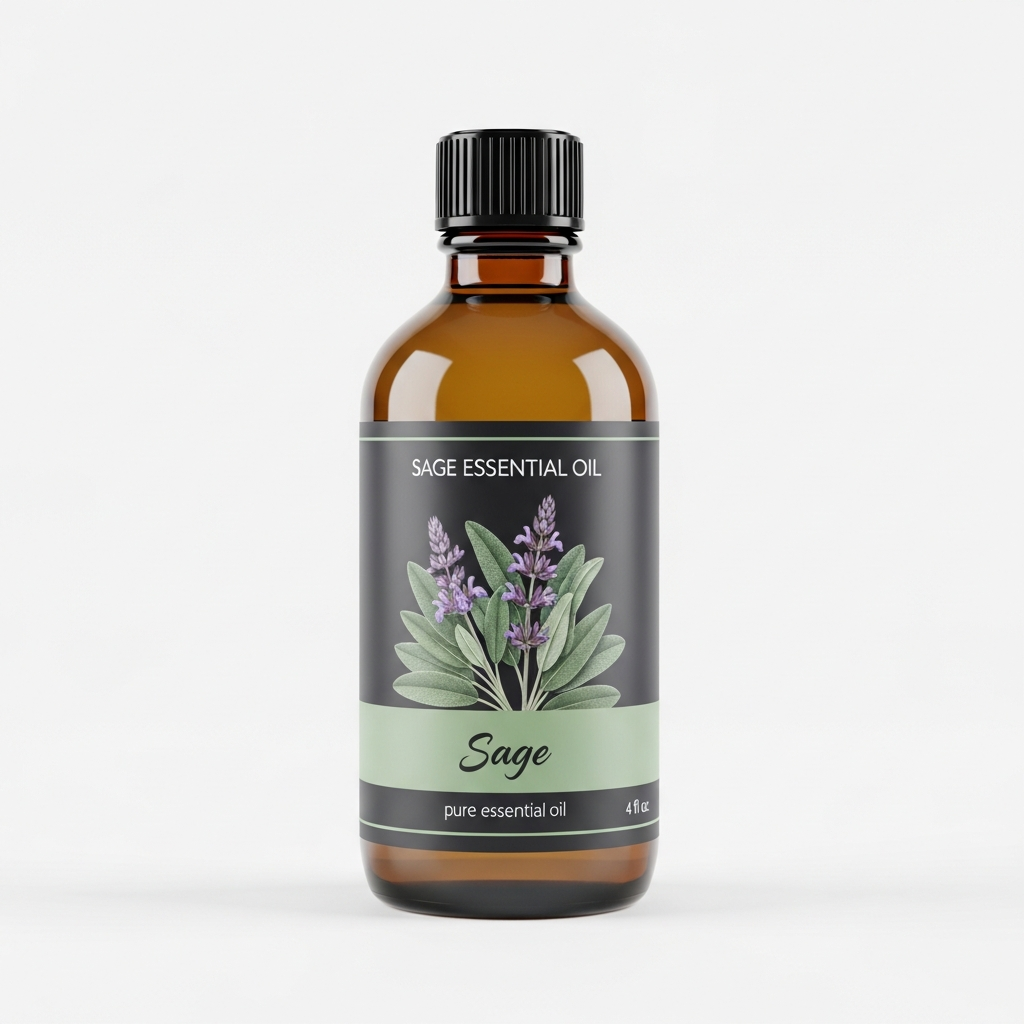
Sage Essential Oil
Sage Essential Oil from our own shop, in sizes from 0.5 oz to bulk.
From $13.99
Shop Now →Sources & Further Reading
- National Capital Poison Center (Poison Control), Essential oils: Poisonous when misused. poison.org/articles/essential-oils
- Halicioglu O et al., 2011. Toxicity of Salvia officinalis in a newborn and a child: an alarming report. Pediatr Neurol. Europe PMC 21907890
- EFSA FEEDAP Panel, 2024. Safety and efficacy of a feed additive consisting of an essential oil derived from the leaves of Salvia officinalis L. (sage oil) for use in all animal species (FEFANA asbl). EFSA Journal. PMC11656093
- EFSA FEEDAP Panel, 2024. Safety and efficacy of a feed additive consisting of an essential oil derived from the flowering tops of Lavandula angustifolia Mill. (lavender oil) for use in all animal species (FEFANA asbl). EFSA Journal. PMC11513610
- IFRA, Thujone, IFRA Standard, Amendment 49 (2020). ifrafragrance.org/standards/IFRA_STD_102.pdf
- IFRA, Guidance for the use of IFRA Standards, 51st Amendment (30 June 2023). IFRA guidance PDF
- EMA/HMPC, 2016. Assessment report on Salvia officinalis L., folium and Salvia officinalis L., aetheroleum (EMA/HMPC/150801/2015). ema.europa.eu
- PubChem, Odor sections for limonene (CID 22311), Camphor (CID 2537), Linalyl Acetate (CID 8294), Linalool (CID 6549) and (+-)-alpha-Pinene (CID 6654). pubchem.ncbi.nlm.nih.gov