Sage Oil and Children: Why We Say Keep It Away
Most of what we write about sage oil is about how to enjoy it. This article is the exception, because the right answer here is short: we do not use sage oil on children, and we do not use it in the air they breathe. Our process page says the same, and the published record explains why we hold the line without exceptions.
Why there is no children's dilution
For adults we give a skin range. For children we cannot, and the reason is that regulators have not been able to set one for sage either. The European Medicines Agency's statement on thujone, the main neuroactive compound in sage oil, says there are no studies that allow a reliable assessment for sensitive groups such as pregnant women and children, and that use of thujone-containing products in these groups should be minimised (EMA/HMPC, 2012). When the people who set the limits say the data to set one do not exist, the honest figure for us is zero, so we do not publish an age-based chart.
What has happened to children
The case literature is small and almost entirely about swallowing, which is exactly why parents should know it.
- A 2011 report in Pediatric Neurology described a newborn and a toddler who had generalised tonic-clonic seizures after accidental exposure to sage oil. The toddler had a single seizure, the newborn several, and both did well afterwards (Halicioglu and colleagues).
- A 1999 Swiss series described seizures in two adults and one child after plant essential oils were taken for therapeutic purposes. The authors listed oils from eleven plants, sage among them, as powerful convulsants, and the child's course was less favourable than the adults' (Burkhard and colleagues).
- Poison Control's page on essential oils lists sage oil and says that swallowing more than a very small amount has caused seizures in children. It adds that children have thin skin and immature livers, which might make them more susceptible than adults.
Nothing here says a drop on a shelf is dangerous. It says that a small bottle of a concentrated oil is a poor thing to have within a toddler's reach.
Camphor adds to the picture
Sage oil carries camphor as well as thujone. EFSA's analysis of five batches of commercial sage oil averaged about 19% camphor (EFSA FEEDAP, 2024). Camphor has its own history with small children: a New York cluster of three toddlers aged 15 to 36 months had camphor-related seizures, two from swallowing it and one from camphor rubbed repeatedly on her skin, and the same paper notes that the FDA restricted camphor to under 11% in some medicinal products after a series of accidental ingestions (Khine and colleagues, 2009). Those were camphor products, not sage oil, so we draw only a modest conclusion: sage oil is in the same family of aromatic concentrates that paediatric toxicologists treat with care.
Storage matters more than the cap
Children under 15 accounted for 63 percent of essential oil exposure calls to the NSW Poisons Information Centre in a Medical Journal of Australia review summarised by the University of Sydney, and most were accidents. The Tisserand Institute advises keeping oils where young children cannot reach them, and Poison Control says bottles must be locked up, out of sight and reach of children and pets. We would go a step further than a cap: a high cupboard or a lockable box, lid on tight, and never a bathroom counter, a nightstand or an open diffuser bag.
Diffusing with children at home
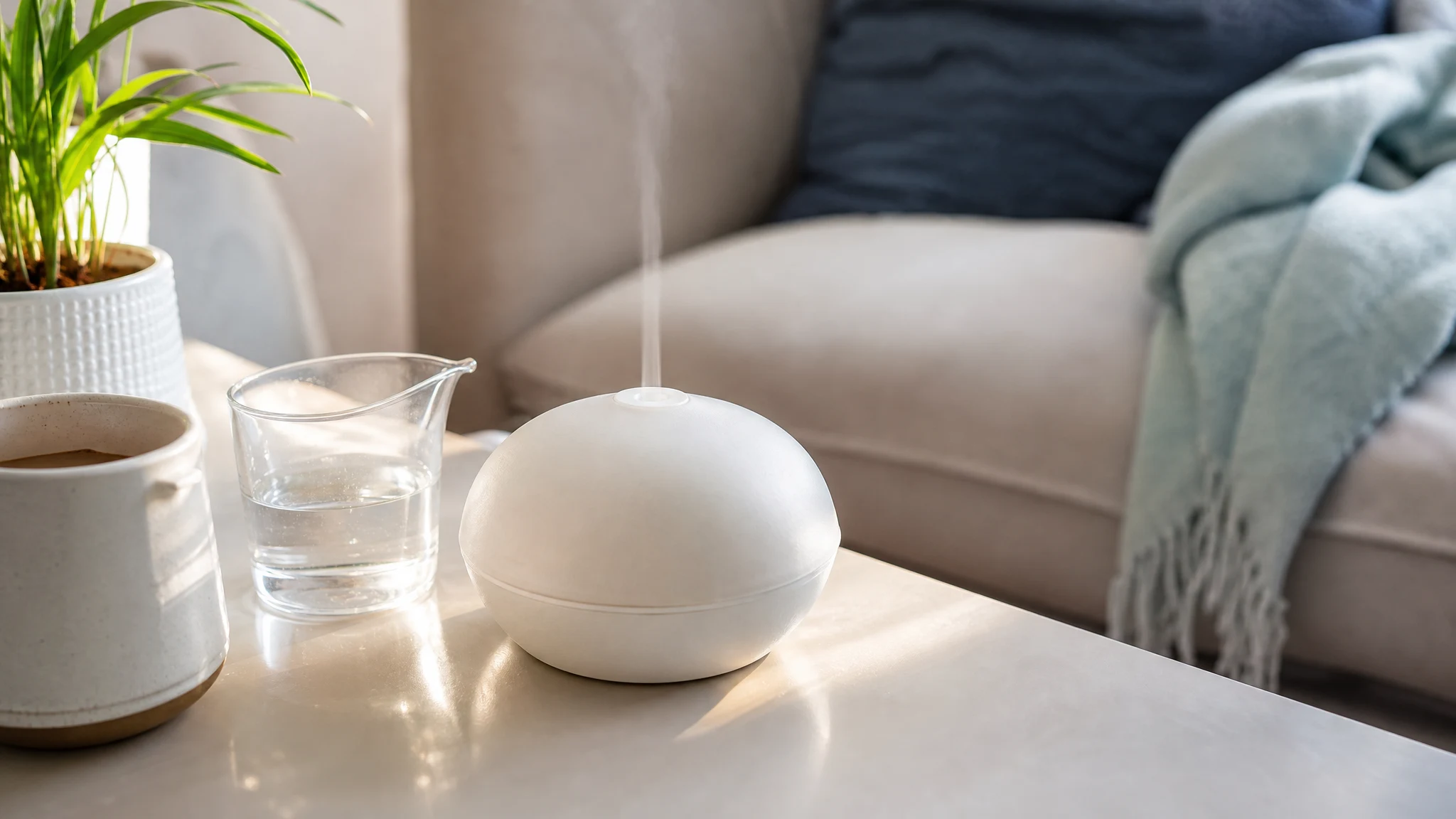
We found no study of sage oil vapour in rooms where children spend time, and that gap is the reason for our rule. If children live in your home, pick another scent for the diffuser or skip it. Our article on diffusing covers how the air changes when a unit runs, and our thujone article explains the compound behind the caution.
Small habits for a home with a bottle in it
Most accidents happen in ordinary moments: a guest's bag on the floor, a bottle left out after a project. A few habits make those moments safer.
- Put the bottle back in its box and the box back on the high shelf every time, even if you are only stepping out for a minute.
- Check that the cap is on tight before it goes back.
- If friends or relatives visit with children, put the bottle away before they arrive rather than after.
None of this takes long, and it becomes automatic after a couple of weeks.
If a child is exposed
- Seizure, unresponsiveness or trouble breathing: call emergency services straight away.
- Swallowed or possibly swallowed: call Poison Help at 1-800-222-1222, or use the online tool at poison.org. Poison Control notes that aspirating an essential oil can cause pneumonia, so take the call before deciding what to do.
- Oil on the skin: Poison Control suggests washing off the remaining oil with soap and water.
- Questions about scenting a child's room or products: your paediatrician or pharmacist is the right person, since we sell only an external-use cosmetic sage oil and nothing designed for children.
Pets share a lot of this logic; our pets article picks it up, and our patch testing article covers everyday handling for adults.
If you came here looking for a child-safe way to use sage oil, the kindest answer we can give is that there is not one, and that plenty of other fragrances suit a family home better.
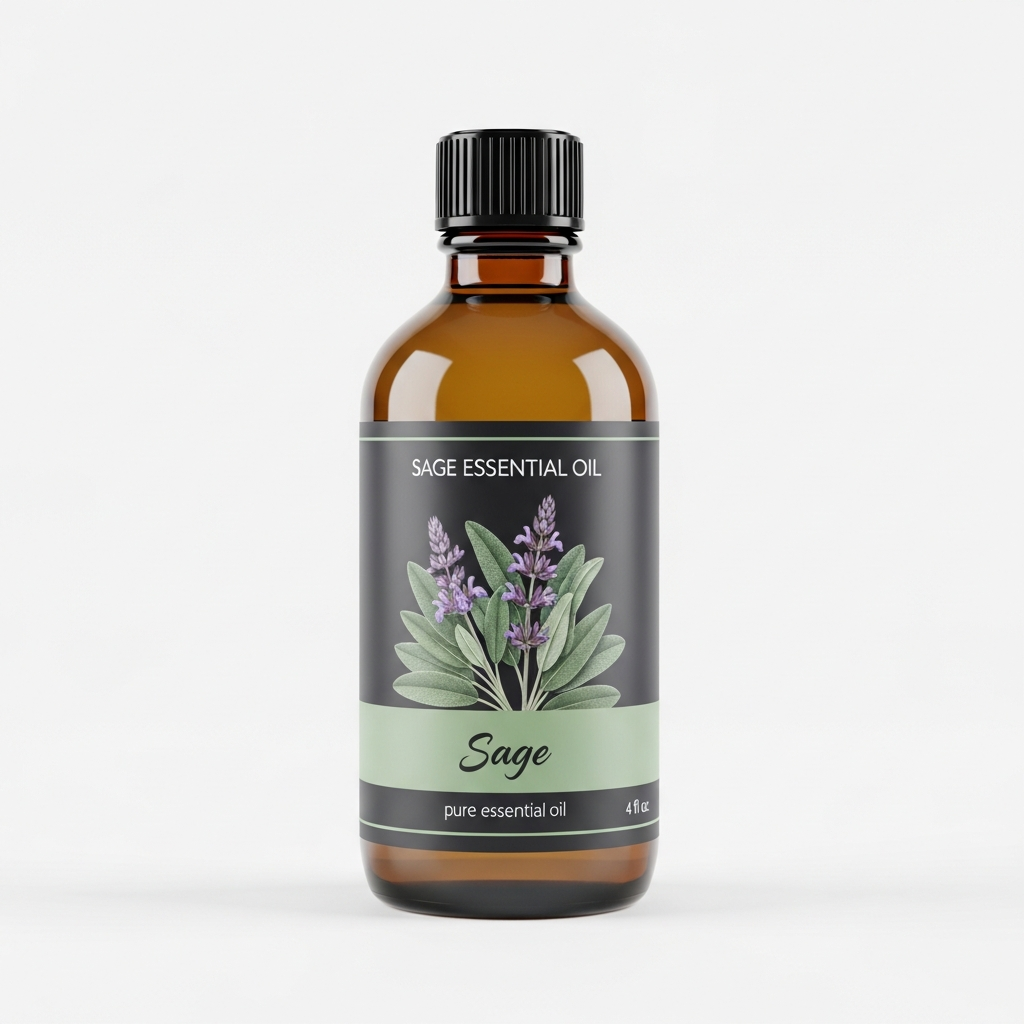
Sage Essential Oil
Sage Essential Oil from our own shop, in sizes from 0.5 oz to bulk.
From $13.99
Shop Now →Sources & Further Reading
- EMA/HMPC, 2012. Public statement on the use of herbal medicinal products containing thujone. ema.europa.eu
- Halicioglu O et al., 2011. Toxicity of Salvia officinalis in a newborn and a child: an alarming report. Pediatr Neurol. PubMed 21907890
- Burkhard PR et al., 1999. Plant-induced seizures: reappearance of an old problem. J Neurol. PubMed 10460442
- Khine H et al., 2009. A cluster of children with seizures caused by camphor poisoning. Pediatrics. PubMed 19403490
- Poison Control. Essential oils: Poisonous when misused. poison.org
- EFSA FEEDAP Panel, 2024. Safety and efficacy of a feed additive consisting of an essential oil derived from the leaves of Salvia officinalis L. (sage oil) for use in all animal species (FEFANA asbl). EFSA J. PMC11656093
- University of Sydney, 2019. Essential oil poisoning calls on the rise, children most affected. sydney.edu.au
- Tisserand Institute. Safety Guidelines - Tisserand Institute. tisserandinstitute.org