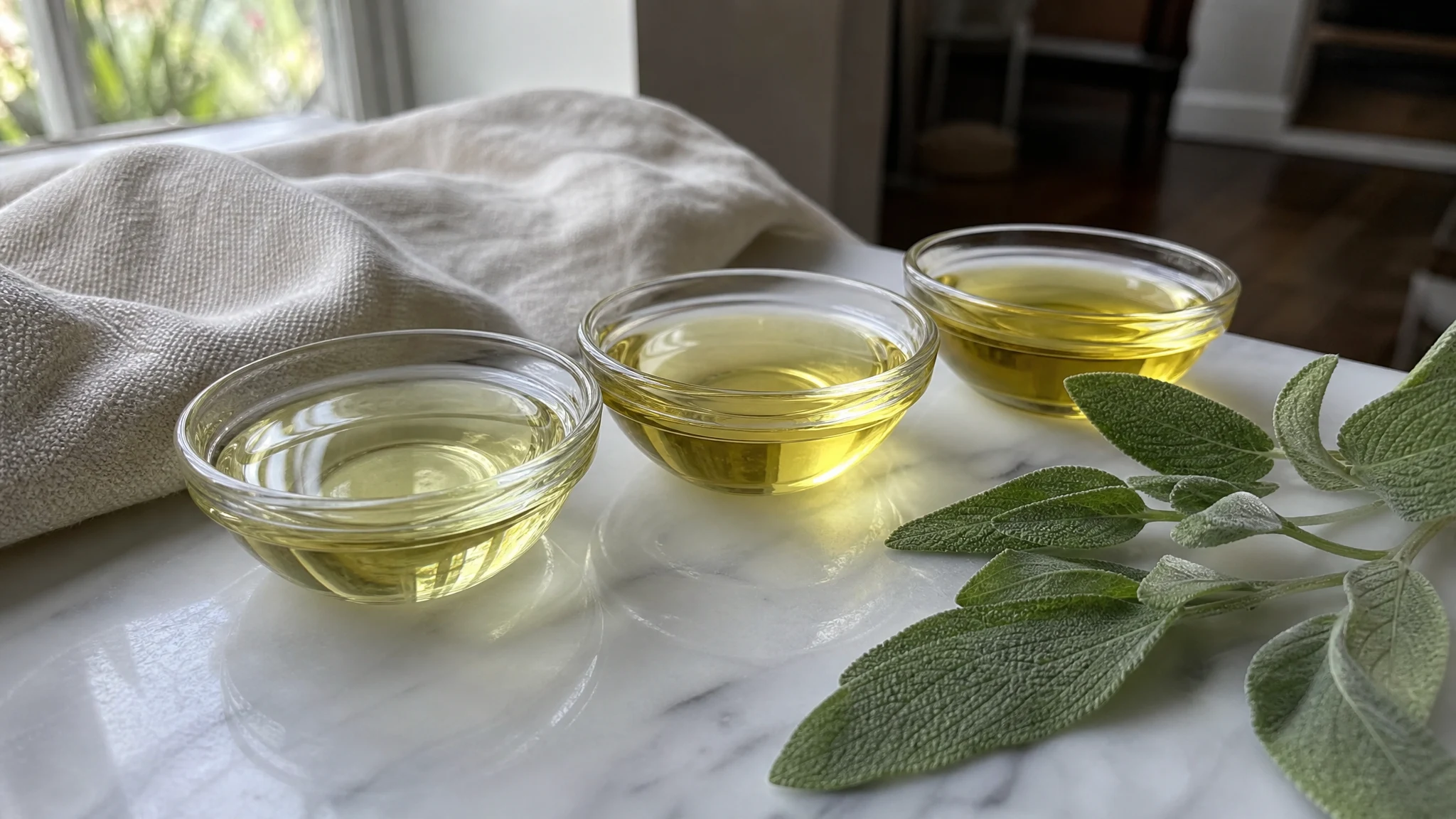
Carrier Oils Compared: Composition, Shelf Life and Allergens
Pick a carrier oil by how long it keeps and whether anyone using it has a nut allergy, and only then by how it feels. A carrier is almost the entire volume of a blend, so it is also the ingredient most likely to go off first: at the amounts we recommend for sage, about one drop in an ounce, the oil is the smaller part of the shelf-life problem and the carrier is the larger. We sell no carriers; this is how to choose one at a supply shop and what to ask for.
What the oils are made of
The table gives fatty acid totals in grams per 100 g. The first seven rows are USDA FoodData Central records for food-grade oils (SR Legacy data); cosmetic-grade oils vary by cultivar and pressing. Jojoba is different in kind: a 2026 paper reports the supplier-provided profile and says jojoba oil is mainly wax esters, about 98%, not triglycerides. Fractionated coconut oil is separate from coconut oil: one supplier's certificate of analysis for a food-grade batch lists caprylic acid (C8) at 64.2% and capric acid (C10) at 35.2%, and calls the material 100% saturated.
| Carrier | Saturated | Monounsaturated | Polyunsaturated |
|---|---|---|---|
| Sweet almond | 8.2 | 69.9 | 17.4 |
| Olive | 13.8 | 73.0 | 10.5 |
| Sunflower, high oleic | 9.9 | 83.7 | 3.8 |
| Sunflower, linoleic type | 10.3 | 19.5 | 65.7 |
| Grapeseed | 9.6 | 16.1 | 69.9 |
| Apricot kernel | 6.3 | 60.0 | 29.3 |
| Coconut (not fractionated) | 82.5 | 6.3 | 1.7 |
| Jojoba (percent, manufacturer data) | 2.0 | 97.0 | 1.0 |
Read the last column first. Polyunsaturated fat is where oxidation starts.
Why that column decides shelf life
Fagoaga and colleagues (Antioxidants, 2026) heated four oils to 100 C in a Rancimat test and measured how long each resisted oxidation: jojoba 39.8 hours, olive 27.5, sunflower 10.4 and rosehip 4.45. Their conclusion is that stability tracks unsaturation, and they credit jojoba's wax-ester structure. Treat the numbers with care. The test is accelerated, it covered four oils, and the paper's own kinetic estimates, extrapolated between temperatures, do not rank them the same way, so it supports an ordering, not a month count. Applying it, with the table above, is our reasoning: a linoleic sunflower or grapeseed oil with 65 to 70% polyunsaturated fat should be bought in small bottles and used fast, while jojoba and high-oleic oils are the lower-risk picks for a blend that will sit in a drawer.
What a good data sheet shows, using the fractionated coconut certificate as the example: batch number, a best-before date (October 2025 on the one we read), peroxide value (0.0 meq O2/kg for that batch against a limit of under 5.0), and a fatty acid profile. Peroxide value is the oxidation measure on that certificate. Ask a supplier for these three items before you buy. No source we read gives a number of months a carrier keeps once opened, so we give none: write the opening date on the bottle, and discard and replace any oil that smells off.
Allergens, and what the sources do not cover
FDA's January 2025 food allergen guidance (Edition 5) reduced the list of tree nuts treated as major food allergens and removed coconut; Food Allergy Research and Education reports almond remains on the list and, of the removed nuts, that FDA "has not indicated that they are no longer recognized food allergens." That is a food labelling rule. It does not govern what is written on a bottle of massage oil, and nothing we fetched says how a person allergic to almond reacts to almond oil on skin. So the practical rule is ours: anyone in the household with a tree-nut, peanut or seed allergy asks their allergist before using a nut or seed carrier, and everyone patch tests. The American Academy of Dermatology (2021) says to apply the product to a quarter-sized spot on the inner arm or elbow bend twice daily for seven to ten days, and to wash it off and stop if a reaction appears.
Decision table
| Use | Carrier to consider | Why, from the sources above |
|---|---|---|
| Roller bottle that sits in a bag | Jojoba or fractionated coconut | Longest oxidation resistance (jojoba); fully saturated, peroxide value 0.0 on the example sheet (fractionated coconut) |
| Body massage, used within weeks | High-oleic sunflower, olive, sweet almond | Low polyunsaturated share; almond only without nut allergy |
| Bath | Disperse first; a carrier alone floats | Tisserand Institute: vegetable oils float and make the bath "slippery, greasy"; fractionated coconut or jojoba are slightly less greasy |
| Face | Not for sage | See below |
We give no comedogenicity ratings; we did not fetch a primary source for them.
The dilution arithmetic
One ounce is 29.57 mL, and a drop is about 0.05 mL (20 drops per mL; droppers vary, so weigh when you can). One drop per ounce is therefore 0.169% by volume.
| Drops of sage in 1 oz | Percent of blend | Where it sits |
|---|---|---|
| 1 | 0.17% | our recommended ceiling for adult body use |
| 3 | 0.51% | bottom of the shop's 0.5% to 2% copy |
| 12 | 2.03% | top of the shop's copy |
The shop copy says 0.5% to 2% for skin. We recommend the bottom of that range or lower, and below it for sage, because thujone limits are lower. The IFRA thujone standard (Amendment 49) allows 0.095% thujone in a body lotion and 0.032% in a face moisturiser; dividing by ISO 9909's allowed thujone range for Dalmatian sage oil (21 to 51.5%) is our arithmetic and gives 0.18 to 0.45% oil for body products and 0.06 to 0.15% for the face. That is not a statement about our oil, whose thujone content is unpublished, and IFRA limits fragrance mixtures, not aromatherapy sold as such. Our recommendation is at or below about 0.2% for adult body use, no sage on the face, and none on or around children. Our process page also says to avoid it in pregnancy and breastfeeding, and to leave it alone with a seizure disorder.
Buying and keeping a carrier
- Buy the smallest bottle that covers your batch, with a date on it.
- Ask whether it is refined or unrefined and for the peroxide value and best-before date.
- Keep it capped, cool and dark, the same way our shop copy says to keep sage oil.
- Write the date you blended on the bottle. The blend lasts no longer than its carrier.
Recipes that use these carriers are in the roller blend article and the massage oil article; ratios and patch tests are in our dilution guide.
Our sage oils are sold neat, so the carrier and the maths are yours; for any safety decision, ask in writing for a thujone figure before you order, since the published COA lists none.
Sage Essential Oil
Sage Essential Oil from our own shop, in sizes from 0.5 oz to bulk.
From $13.99
Shop Now →Sources & Further Reading
- USDA FoodData Central, SR Legacy records: Oil, almond (171031); olive (171413); sunflower high oleic (172338) and linoleic (171025); grapeseed (171028); apricot kernel (171032); coconut (171412). fdc.nal.usda.gov
- Fagoaga C. et al., 2026. Oxidative stability and kinetics of oxidation of rosehip, sunflower, olive and jojoba oils. Antioxidants 15(5):646. pmc.ncbi.nlm.nih.gov/PMC13203508
- Supplier certificate of analysis, 2023. Coconut oil, fractionated (food grade), batch 4520409 (document dated 2 May 2023; best before October 2025). certificate PDF, batch 4520409
- FDA, 2025. Frequently asked questions: food allergen labeling guidance for industry (content current 26 March 2025). fda.gov/food-allergen-labeling-faq
- FARE, 2025. Update on FDA guidance for food allergen labeling. foodallergy.org/fare-blog
- American Academy of Dermatology, 2021. How to test skin care products. aad.org/test-skin-care-products
- Tisserand Institute. Bath safety (undated). tisserandinstitute.org/bath-safety
- IFRA, 2020. Standard: Thujone (Amendment 49). ifrafragrance.org/IFRA_STD_102
- ISO 9909:1997. Oil of Dalmatian sage (Salvia officinalis L.), via iTeh preview. standards.iteh.ai/ISO-9909-1997