DIY Essential Oil Massage Oil: Carrier, Percentage and Limits
For most people a massage oil should not contain sage at all, and that is our position as the seller of sage oil. Massage puts more oil on more skin than any other use, which is where a thujone-bearing oil has the least room. If you still want sage in one, the arithmetic below gives a ceiling of one drop in an ounce of carrier, a localised application rather than a whole-body one, and no use at all in pregnancy, with a seizure disorder, or around children. Nothing in this article has been made or tested by us.
Start with how much oil actually goes on the skin
A dilution percentage hides the thing that matters for a neurotoxic constituent, which is the total amount applied. The Tisserand Institute's own explanation of its dermal maximums says that for internal toxicities such as neurotoxicity the figures are "flexible": "the more oil that is applied, and the greater the area of skin covered, the lower the dilution must be." Its maximums assume "maximum possible whole body application" of 30 mL, and using 10 mL instead means the maximum "can be increased by 3 times." Thirty millilitres is one ounce, so a one-ounce bottle of massage oil is a whole-body session by that yardstick.
Apply that to sage, with every figure labelled for what it is. One drop is about 0.05 mL; at the COA batch's measured density of 0.915 that is about 0.046 g. ISO 9909:1997 allows the alpha- and beta-thujones in Dalmatian sage oil to sum to 21 to 51.5%. If our oil sat anywhere in that range, which its COA cannot show, one drop contains roughly 9.6 to 23.6 mg of thujone. In a 30 mL bottle used whole-body, that is the amount on the skin. Used on 10 mL over the shoulders and back, it is about 3.2 to 7.9 mg. For orientation only: EMA's limit for sage leaf preparations taken by mouth is 6.0 mg thujone per person per day for at most two weeks. Skin absorption is not oral dosing, and the figure is not a limit for massage, but it is why we treat the IFRA arithmetic below as a ceiling and not as slack.
The percentage, from the sources
The shop's copy says 0.5% to 2% in a carrier, about 3 to 12 drops per ounce. The IFRA thujone standard (Amendment 49, 2020) limits thujone, for neurotoxicity, to 0.095% in body lotion (category 5A) and 0.032% in a face moisturiser (5B). Dividing by the ISO thujone range gives our arithmetic of 0.18 to 0.45% oil for body products and 0.06 to 0.15% for the face. That is not a statement about our oil, whose thujone content is unpublished, and IFRA limits fragrance mixtures, not aromatherapy sold as such; we could not verify which category a massage oil falls into. The European Medicines Agency (2016) goes beyond percentages: it reports sage oil as a moderate skin irritant "not recommended for use in aromatherapy." So our recommendation, which sits below the top of our own copy, is at most one drop per ounce (0.169%), adult body only, never the face, and sage-free is the better choice.
A formula, worked out and untested
| Version | 30 mL carrier | Sage | Use |
|---|---|---|---|
| A, our default | one ounce of a stable carrier | none | any adult massage; the patch test still applies |
| B, sage at the ceiling | one ounce | 1 drop (0.169%) | no more than 10 mL used, on one area, occasionally |
"Occasionally" is our caution, not a sourced interval; no fetched source gives a frequency. Choose the carrier with the carrier comparison. Short version: a carrier is nearly the whole bottle, polyunsaturated oils oxidise soonest, and anyone with a tree-nut allergy should ask an allergist before using an almond-type oil. Date the bottle and discard it if it smells off.
Who should not use it
- Pregnancy and breastfeeding. EMA's assessment report calls sage contraindicated in pregnancy and lactation; the North American Association for Holistic Aromatherapy lists Salvia officinalis among oils to avoid throughout pregnancy, labor and breastfeeding. Our process page says the same. Ask a midwife or obstetrician about any massage oil.
- Seizure disorders. Medsafe (New Zealand) lists sage and rosemary among oils associated with seizures, naming camphor, thujone and cineole, with seizures after oral and topical use and risk it calls very low but probably under-reported. Our process page says to leave sage alone with a seizure disorder. Ask your physician.
- Children. Our process page says not to use sage on or around children. No sage massage oil for a child; a paediatrician decides what goes on a child's skin.
- Eczema, broken or inflamed skin. FDA says many plants "contain materials that are toxic, irritating, or likely to cause allergic reactions when applied to the skin," and EMA reports sage oil as a moderate irritant. If you have a skin condition, a dermatologist is the person to ask.
The patch test, then the towels
Do the patch test the American Academy of Dermatology describes (2021): a quarter-sized spot on the inner arm or elbow bend, twice daily for seven to ten days, wash it off and stop if the skin turns red, itchy or swollen. Our patch test article covers what that test can miss.
The step people skip is the laundry. Fire and Emergency New Zealand's 2012 bulletin on organic oils lists massage oils among them and describes a massage business whose owner washed and dried towels, folded them while still hot, and found them on fire 90 minutes later. It says laundering does not always remove oil, that enzyme-based powders and cold washes leave some behind, and that oily fabric should be washed and hung out to ventilate, and a dryer should finish its cool-down cycle before the load is removed. Spilled carrier is slippery too (the Tisserand Institute calls a vegetable-oil bath "slippery, greasy"), so wipe the table, tiles and your feet before you stand up; that is our inference, not a measured hazard.
When to see a professional instead
The National Center for Complementary and Integrative Health (page last updated May 2019) says the risk of harm from massage therapy "appears to be low," reports rare blood clots, nerve injury and fractures, mostly after vigorous techniques or in people at higher risk, and says not to use massage to postpone seeing a health care provider about a medical problem. It notes that 45 states and Washington D.C. regulate massage and advises asking about a therapist's training, experience and credentials. For pain, an injury, pregnancy or a medical condition, a physician or licensed massage therapist is the right first call, and a home blend is not a substitute. We make no claim that sage oil relieves anything.
Thinking about a roller instead? The roller article works through the same ceiling for a 10 mL bottle, and our dilution guide covers ratios.
Our two sage oils are sold neat for aroma use, and we sell no carriers or massage products; a buyer with a safety reason should ask in writing for a thujone figure before ordering, because the published COA has none.
Sage Essential Oil
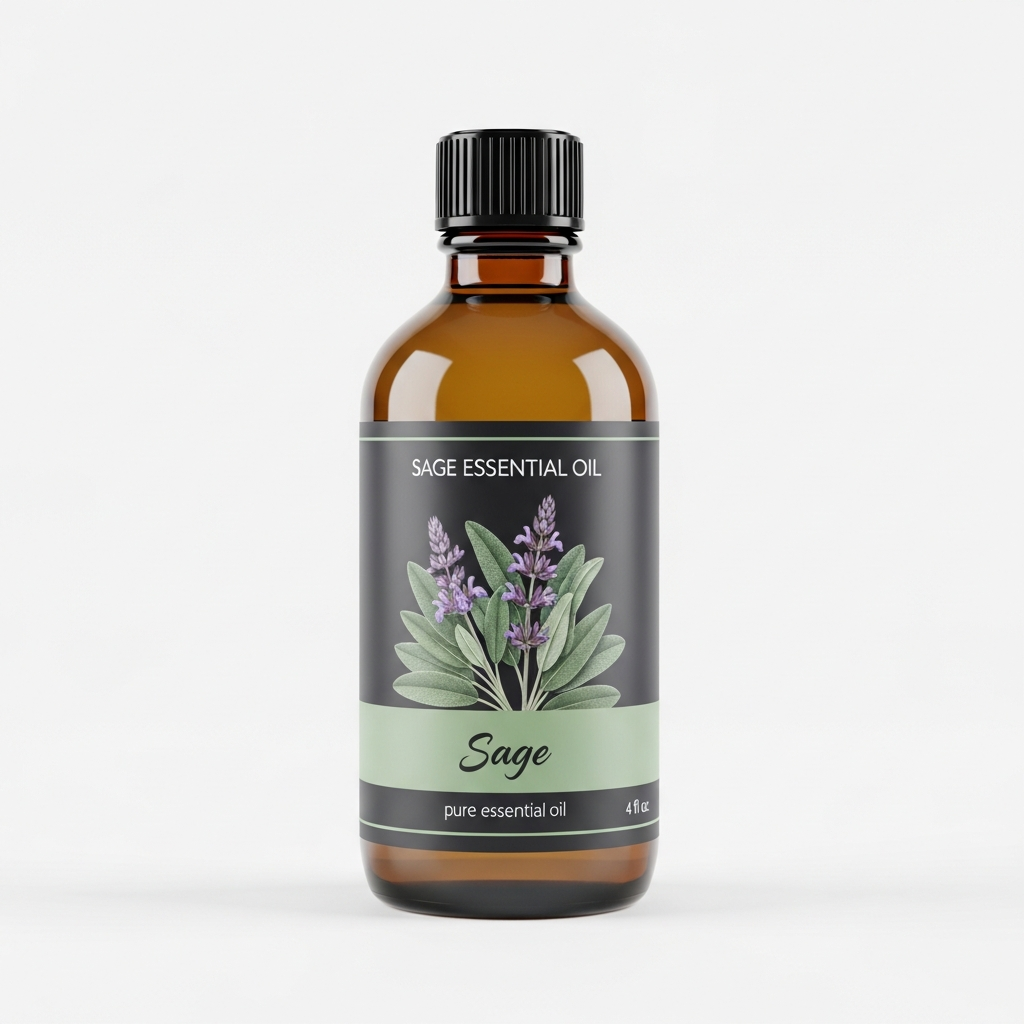
Sage Essential Oil from our own shop, in sizes from 0.5 oz to bulk.
From $13.99
Shop Now →Sources & Further Reading
- Tisserand Institute. Q&A: safety maximums for dermal application (undated). tisserandinstitute.org/safety-maximum-dermal
- Tisserand Institute. Bath safety (undated). tisserandinstitute.org/bath-safety
- IFRA, 2020. Standard: Thujone (Amendment 49). ifrafragrance.org/IFRA_STD_102
- ISO 9909:1997. Oil of Dalmatian sage (Salvia officinalis L.), via iTeh preview. standards.iteh.ai/ISO-9909-1997
- EMA/HMPC, 2016. Assessment report on Salvia officinalis L., folium and aetheroleum (EMA/HMPC/150801/2015). ema.europa.eu/EMA/HMPC/150801/2015
- EMA/HMPC, 2016. Public statement on Salvia officinalis L., aetheroleum (EMA/HMPC/41843/2009 Corr.1). ema.europa.eu/EMA/HMPC/41843/2009
- NAHA. Safety (undated). naha.org/explore-aromatherapy/safety
- Medsafe (NZ), 2011. Complementary Corner: essential oils associated with seizures. Prescriber Update 32(4). medsafe.govt.nz/ComplementaryCornerDecember2011
- FDA. Aromatherapy (undated). fda.gov/cosmetics/aromatherapy
- American Academy of Dermatology, 2021. How to test skin care products. aad.org/test-skin-care-products
- Fire and Emergency New Zealand, 2012. Heads Up 13: spontaneous combustion with organic oils. fireandemergency.nz/Heads-Up-013
- NCCIH, 2019. Massage therapy: what you need to know. nccih.nih.gov/massage-therapy