Patch Testing Sage Oil: What a Home Test Can and Cannot Show
A patch test you do at home on your forearm can catch one thing well: an oil that irritates skin within a day. It cannot clear you for daily use, because allergy takes days to show and builds with repeated exposure, and it says nothing at all about sage oil's larger problem, which is thujone. This article separates the two kinds of skin reaction, lays out what a clinic patch test does that a home test cannot, and gives the steps we would follow, labelled as ours.
Irritation and allergy are different problems with different tests
The NHS describes the split this way: irritant contact dermatitis comes from a substance that "directly damages the outer layer of skin"; allergic contact dermatitis comes from a substance that makes the immune system respond in a way that affects the skin. The reaction "usually occurs within a few hours or days of exposure" (NHS, contact dermatitis). Irritation depends on the dose on the day. Allergy depends on whether your immune system has learned the substance, which can take repeated contact, and once it has, a very small amount can set it off.
Sage oil has documented signals for both, none of them specific to our oils:
- The European Medicines Agency's 2016 assessment report says sage oil "is reported to be a moderate skin irritant and is not recommended for use in aromatherapy," citing Barnes 2007 and Newall 2002 (EMA/HMPC, 2016).
- In a 2024 opinion on a sage oil feed additive, the European Food Safety Authority's panel concluded sage oil "should be considered as irritant to skin and eyes, and as a dermal and respiratory sensitiser." The panel took this from the applicant's safety data sheet (skin sensitisation category 1, skin irritation category 2), not from its own testing of people (EFSA FEEDAP, 2024).
- The Cosmetic Ingredient Review's 2020 draft scoping document, citing older industry data, reports that undiluted sage oil was moderately irritating to rabbit skin under occlusion for 24 hours, and that one irritation reaction occurred in a 24-hour patch test of undiluted oil in 20 people. In a maximisation test in 25 people, 8% sage oil in petrolatum did not cause sensitisation. It gives no further detail on either study (CIR, 2020).
- The same document describes a 65-year-old woman who worked as an aromatherapist and developed hand eczema. Patch tested with her own oils diluted to 1% and 5% in petrolatum, she reacted to 17 of 20 oils, sage among them (++ at both strengths). The authors surmised that lemongrass oil had caused the first sensitisation. One person, one setting, one route: it shows that sage oil can provoke an allergic patch reaction in someone already sensitised, not how often.
What none of this gives is a rate for the general population. No source we fetched reports how many people react to sage oil.
What a clinic patch test does that a home test does not
The American Academy of Dermatology describes the clinic version: patches stay on for 48 hours, and "after 4 to 7 days, you will see your dermatologist again." If you "remove the patches, loosen them, or get them wet, you're likely to get inaccurate results," and the return visit matters because "skin allergies tend to develop in hours or days" (AAD, patch testing). The NHS diagnosis page gives a similar timetable: patches come off after 2 days and the skin is checked again 2 days later (NHS, diagnosis).
The clinic test differs from a home test in four ways:
- It uses standardised preparations at set concentrations; a home test uses whatever you mixed.
- Patches are on the back under controlled conditions; a home patch gets damp and rubbed.
- A dermatologist reads the result, including the difference between a true allergic reaction and an irritant one.
- It checks for a late reaction at day 4 to 7. Most people do a home test, see nothing at 24 hours, and stop looking.
The home test we would follow, and its limits
These steps are our adaptation of the clinic timetable. They are not a published protocol, we have not validated them, and a doctor may tell you something different for your skin.
- Test the blend you will actually use, never the neat oil. Our shop copy says to dilute 0.5% to 2% and patch test first; for reasons in the next section we would test at or below about 0.2%, which is roughly 1 drop of oil per ounce of carrier (1 oz is 29.57 ml; at about 20 drops per ml, 0.2% is about 1.2 drops; weigh rather than count).
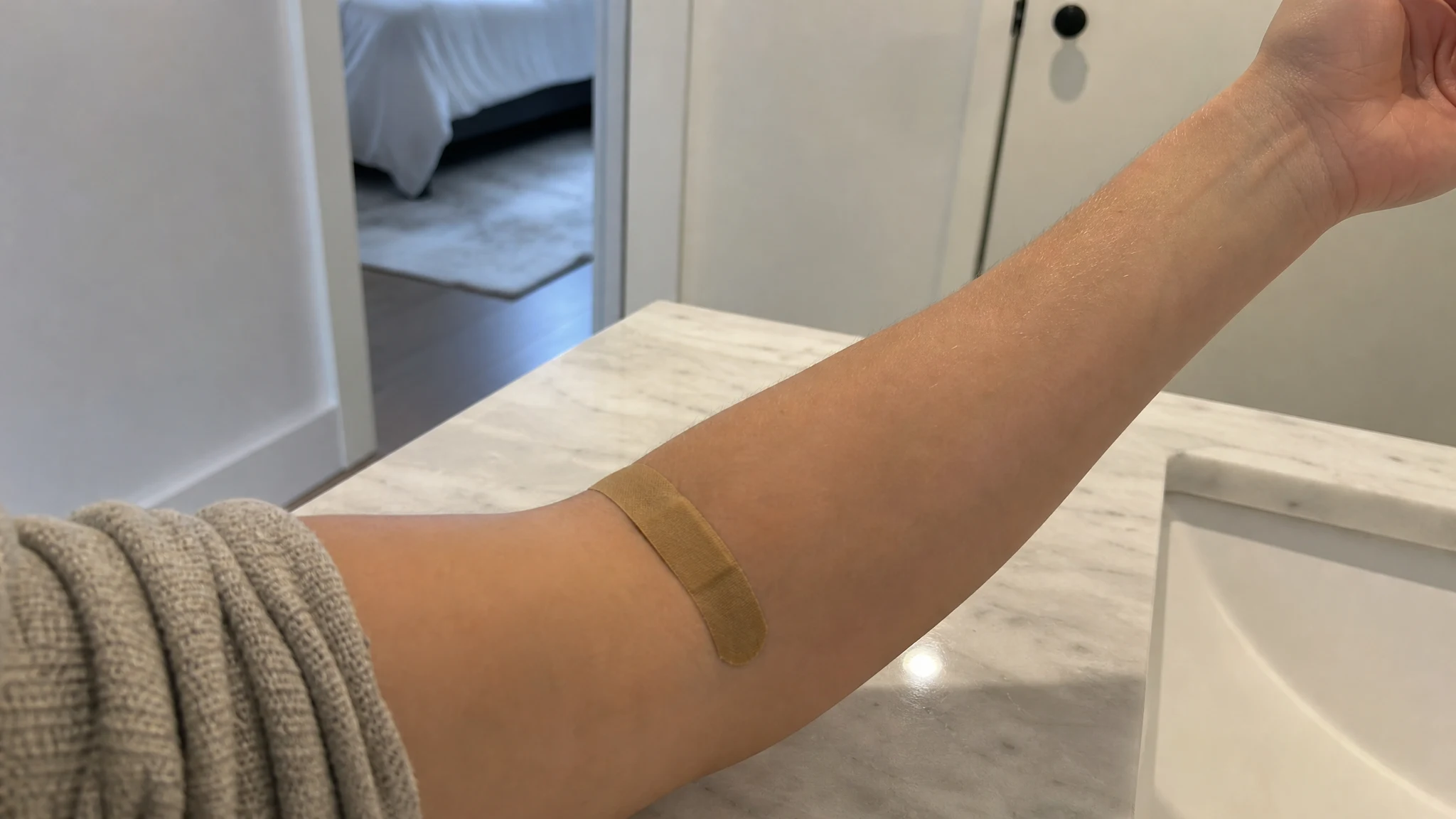
- Put a small amount of the blend on the pad of an adhesive bandage and stick it to the inner forearm. Keep it dry.
- Remove it at once if it itches, burns or stings. Do not wait out the 48 hours to be polite to the test.
- If nothing happens, leave it 48 hours, as the AAD and NHS patch times do, then look again at day 4 and day 7. Redness, bumps or itching that appears late counts.
- Repeat with a fresh dab on a different spot before you commit to daily use, because a single clean patch does not show you what repeated exposure does.
The Poison Control page on essential oils adds that if a rash does occur, you wash the oil off with soap and water, and that oils should not go on damaged skin (poison.org).
Why a clean result does not clear daily leave-on use
Three reasons, and they stack.
First, sensitisation can arrive later than the test. The aromatherapist case above is the pattern: repeated contact with oils over time, not one dab.
Second, oxidation changes the oil you are testing. In a study of 1,511 dermatitis patients at six European centres, 1.3% reacted to oxidised linalool and about 0.5% to oxidised caryophyllene; the authors concluded that autoxidation of fragrance terpenes contributes greatly to fragrance allergy (Matura et al., 2005). That study did not test sage oil. The EMA assessment report lists limonene and beta-caryophyllene among sage oil constituents (EMA/HMPC, 2016, above), so two of the terpenes in that study are present in the oil. Applying the finding to sage is our inference, and the report gives no percentages for them. The practical consequence is the shop's own storage advice: tightly capped, cool, dark, away from heat and sunlight (see how to store sage oil), and a fresh patch test if a bottle has been open for a long time.
Third, a skin test measures skin. It does not measure the neurotoxic risk that drives the sage-specific limits below.
Thujone sets the dose before skin does
Our shop copy gives 0.5% to 2% for a body oil. Authority-derived caps for thujone-bearing oils in leave-on products are lower. The IFRA thujone standard (Amendment 49, 2020) restricts thujone because of neurotoxicity, with maximums in the finished product of 0.095% in category 5A (body lotion), 0.032% in 5B (face moisturiser) and 0.0053% in 5D (baby products) (IFRA, 2020). ISO 9909:1997 (read from the publisher's scanned preview) allows 18 to 43% alpha-thujone and 3 to 8.5% beta-thujone in Dalmatian sage oil, which sums to 21 to 51.5%; the five sage oil batches in the EFSA opinion averaged about 25% alpha-thujone and 5.6% beta-thujone by gas chromatography. Dividing, the IFRA figures correspond to about 0.18 to 0.45% oil for a body product, 0.06 to 0.15% for the face and 0.010 to 0.025% for baby products. That is our arithmetic from IFRA's thujone limits and ISO 9909's composition range. It is not a statement about our oil, whose thujone content is unpublished, and IFRA limits fragrance mixtures, not aromatherapy sold as such; which category a massage oil falls into we could not verify.
So our stated position: do not use sage oil on the face or on children, and for adult body use stay at or below about 0.2%. Our process page also says to avoid it in pregnancy and breastfeeding and to leave it alone with a seizure disorder. We could not verify a Tisserand and Young skin maximum for sage, so we do not quote one. Anyone with a safety reason should ask in writing for a thujone figure before ordering; the certificate we publish for one batch (relative density, refractive index, optical rotation) contains none. See the thujone article for the numbers behind this and our dilution post for arithmetic by bottle size. Carrier oils are not something we sell; a supply shop or pharmacy is the place.
When to stop and who to ask
- Stop using the oil at the first itch, burn, blister or spreading redness, and do not use it on broken skin.
- The NHS says to speak to a pharmacist if dermatitis is troubling you, and to see a GP for symptoms that are persistent, recurrent or severe; a GP may refer you to a dermatologist if the cause is not found (NHS, contact dermatitis, above). Dermatologists perform patch testing (AAD, above).
- Call 999 for swelling of the lips, mouth, throat or tongue, fast or difficult breathing, a tight throat, or sudden confusion or fainting. The NHS lists these as possible signs of anaphylaxis, which needs immediate hospital treatment (NHS, allergies).
The FDA treats a product's intended use as the test of whether it is a cosmetic or a drug, judged by labelling and claims, and notes that "many plants contain materials that are toxic, irritating, or likely to cause allergic reactions" (FDA, aromatherapy). Our oils are sold as aroma and cosmetic materials, and we make no medical claim for them.
If you are on the fence, skip leave-on sage oil and use it in a diffuser at a light hand, in a room without children, pregnant people or pets. For the skin question, see our skin post, and ask a dermatologist rather than a seller.
Sage Essential Oil
Sage Essential Oil from our own shop, in sizes from 0.5 oz to bulk.
From $13.99
Shop Now →Sources & Further Reading
- NHS, undated. Contact dermatitis. nhs.uk/conditions/contact-dermatitis
- NHS, undated. Contact dermatitis: diagnosis. nhs.uk/conditions/contact-dermatitis/diagnosis
- NHS, undated. Allergies. nhs.uk/conditions/allergies
- American Academy of Dermatology, undated. Patch testing can find what's causing your rash. aad.org/patch-testing-rash
- EMA/HMPC, 2016. Assessment report on Salvia officinalis L., folium and aetheroleum (Rev. 1). ema.europa.eu
- EFSA FEEDAP Panel, 2024. Safety and efficacy of a feed additive consisting of sage oil. PMC11656093
- Cosmetic Ingredient Review, 2020. Scoping document, Salvia officinalis-derived ingredients. cir-safety.org
- Matura M et al., 2005. Selected oxidized fragrance terpenes are common contact allergens. Contact Dermatitis 52:320-328. PubMed 15932583
- ISO 9909:1997. Oil of Dalmatian sage (Salvia officinalis L.), preview. iteh.ai/ISO-9909-1997
- IFRA, 2020. IFRA Standard: Thujone (Amendment 49). ifrafragrance.org
- FDA, undated. Aromatherapy. fda.gov/cosmetics/aromatherapy
- Poison Control (poison.org), undated. Essential oils. poison.org/articles/essential-oils