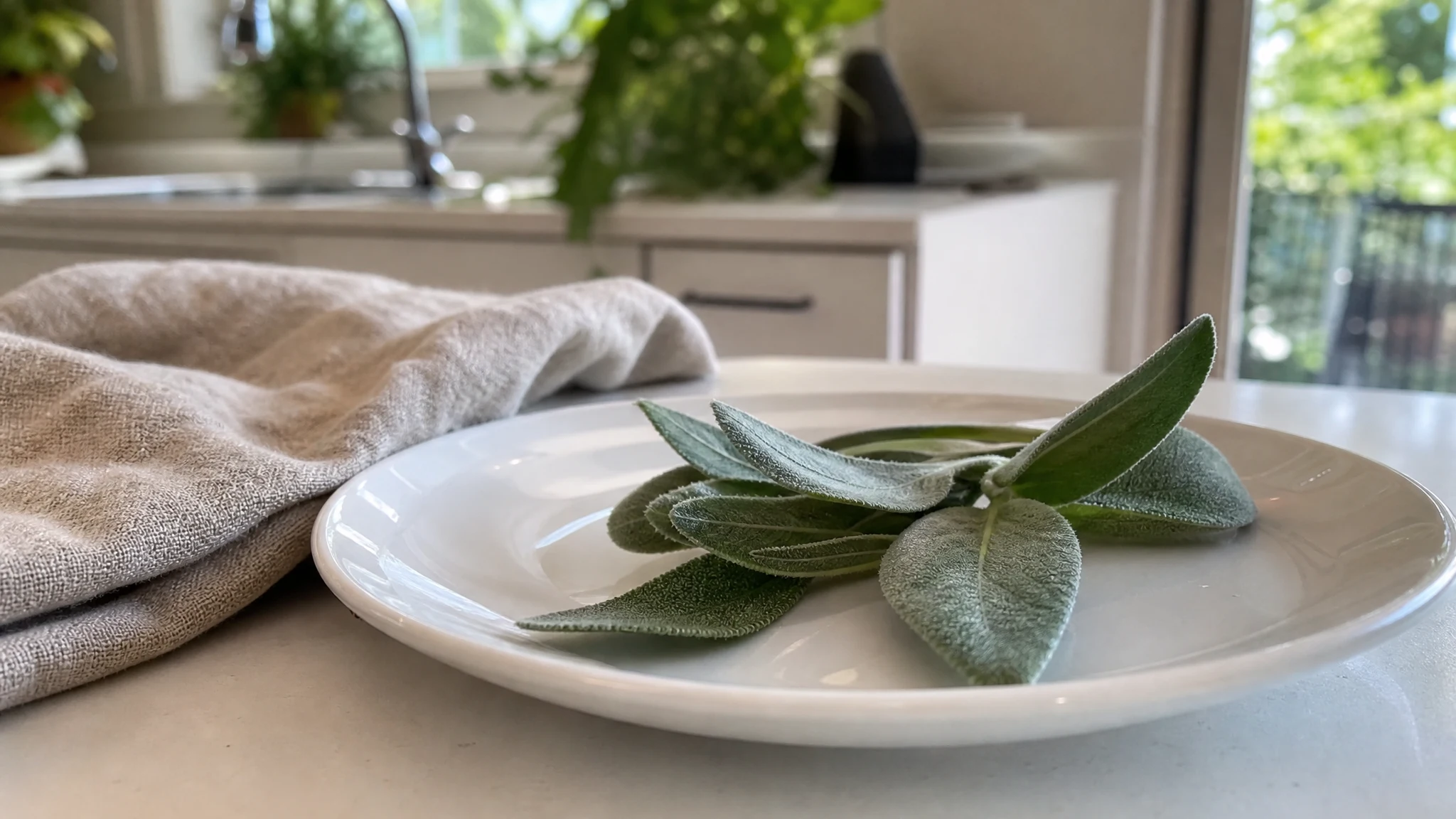
Sage Oil and Thujone: What the Number Means, Who Avoids It
The number that decides how sage oil should be used is its thujone content, and the Certificate of Analysis we publish does not contain one. It reports density, refractive index and optical rotation for one batch, nothing about constituents. This article sets out what thujone does, what regulators have said about it and when, what a drop of a typical sage oil would carry, and why we say to keep the dilution low and to ask any seller, us included, for a thujone figure in writing before you order.
What thujone is, and the mechanism
Thujone is a monoterpene ketone found in sage, wormwood, cedar leaf and tansy oils, in two forms, alpha and beta. In a 2000 paper in PNAS, Höld and colleagues showed that alpha-thujone suppresses GABA-induced currents in rat neurons, competes at a binding site on the GABA-A receptor, and produces poisoning signs in mice that resemble those of picrotoxinin, a classic GABA-A blocker. The signs in the mice were eased by diazepam and phenobarbital (Höld et al., 2000). Interfering with an inhibitory receptor fits with seizures, rather than skin reactions, being the headline hazard. The EMA's herbal committee puts it in one sentence: thujone "is toxic and may cause seizures at high doses as shown in animal studies and indicated from case reports" (EMA/HMPC, 2016).
What authorities have actually said, with dates
No single body has set a skin or inhalation limit for sage oil as sold for aromatherapy. What exists are food, medicine and fragrance-industry positions, each answering a different question.
| Body and year | What it says | What it does not cover |
|---|---|---|
| Council of Europe, 1999 (as reported by EMA, 2012) | Tolerable daily intake of thujone 10 micrograms per kg body weight per day, from a rat no-effect level of 5 mg/kg for convulsions with a safety factor of 500 | Oral intake from food and drink, not skin |
| Scientific Committee on Food, 2002 (as reported by EMA, 2012) | Found the data "inadequate to establish a TDI/ADI" | A primary text we did not read; we rely on EMA's quotation |
| JECFA, 1981 | "No ADI allocated"; thujone from flavourings such as sage to be reduced to the lowest practicable level | Oral intake |
| EU Regulation 1334/2008, Annex III | Thujone may not be added to food as such; caps in drinks of 10 mg/kg (alcoholic, non-Artemisia), 35 mg/kg (Artemisia spirits), 0.5 mg/kg (non-alcoholic Artemisia drinks) | Food and drink only |
| EMA herbal committee, 2012 and 2016 | Sage oil benefit-risk "negative"; for sage leaf preparations, thujone limited to 6.0 mg per person per day for at most 2 weeks; use by pregnant women and children "should be minimised" | Oral herbal medicines; the statement does not set a skin limit |
| IFRA Standard on thujone, Amendment 49, 2020 | Maximum thujone in the finished product from 0.0053% to 9.5% depending on product category, driven by neurotoxicity | Fragrance mixtures, not aromatherapy sold as such; the PDF does not define the category numbers |
Sources for the table: EMA/HMPC, 2012 for the Council of Europe and SCF lines and the pregnancy and children wording; JECFA, 1981; Regulation 1334/2008 Annex III (read on the UK retained copy); the 2016 EMA statement; IFRA, 2020. The EMA's 2012 text also records that its first sage leaf limit was 5 mg per person and that the figure was later raised to 6.0 mg, so a source quoting 5 mg is older, not wrong.
Two things follow. The EMA concluded that the benefits of sage oil do not outweigh its risks as a traditional herbal medicine, and said the clinical and toxicological data on the oil "can not be considered adequate". And its assessment report adds that sage oil "is reported to be a moderate skin irritant and is not recommended for use in aromatherapy", citing two reference books from 2002 and 2007 (EMA/HMPC, 2016 assessment report). We sell sage oil. We think you should know that sentence exists.
Why the number moves
Thujone content is not fixed by the plant name. The EMA assessment report, citing Bradley (2006), lists alpha-thujone at 10 to 60% and beta-thujone at 4 to 36% of the oil, with camphor 5 to 20% and 1,8-cineole 1 to 15%, and notes camphor from 7 to 50% across 25 commercial leaf sources. EFSA, assessing sage oil as an animal feed additive, characterised five batches by gas chromatography: alpha-thujone averaged 24.96% (23.54 to 26.00), beta-thujone 5.60%, camphor 18.74% and 1,8-cineole 10.70%, with specific gravity 915 to 916 kg/m3 (EFSA FEEDAP, 2024). Those five batches are one applicant's product, not a statement about ours.
Camphor matters here too. In rat work from 1981, commercial sage oil caused convulsions in rats above 0.50 g/kg and was lethal above 3.2 g/kg, and the authors tied commercial sage oil's toxicity to camphor and Dalmatian sage oil's to camphor plus thujone (Millet et al., 1981). In the same paper, commercial essences of sage, hyssop, thuja and cedar were linked to eight human poisonings, with tonic-clonic convulsions the main sign. That is oral and animal evidence, not a measure of skin or air exposure.
What is on our certificate, and what is not
The Certificate of Analysis names the product as Sage Essential Oil, botanical name Salvia officinalis, steam distilled, and reports for one batch a relative density of 0.915, a refractive index of 1.469 and an optical rotation of minus 10 degrees. It has no gas chromatography result: no thujone, camphor or cineole percentage. We will not give you a thujone figure for our oils because none is published on that certificate. If thujone matters to your decision (pregnancy, a seizure disorder, a workplace limit, anything for a household with children), ask whoever you buy from for a thujone figure in writing, with the batch it applies to, before you order. Our process page describes the safety stance in these words: sage oil "is high in thujone and is not an oil for casual, generous use."
The arithmetic of a drop
These are our calculations, using EFSA's five-batch thujone figures (alpha plus beta, about 28.5 to 32.2% of the oil) as an illustration, and the density on our certificate. They are orientation, not a safety limit, and skin or air exposure is not oral dosing.
- One drop is about 0.05 ml; at 0.915 g/ml that is about 46 mg of oil.
- At 28.5 to 32.2% thujone, a drop carries roughly 13 to 15 mg of thujone, more than twice the EMA's 6.0 mg per day oral limit for sage leaf preparations. That is why one drop swallowed is a different event from one drop in a diffuser.
- One ounce of carrier is 29.57 ml. At 2% that is 0.59 ml of oil (about 12 drops, 541 mg); at 0.5%, 0.148 ml (about 3 drops, 135 mg); at 0.2%, 0.059 ml (about 1 drop, 54 mg).
Weigh rather than count drops; droppers vary.
Skin: where our copy and the fragrance rules disagree
Our shop copy suggests 0.5% to 2% in a carrier oil for skin. The IFRA thujone limits, applied to the EFSA batch figures, give lower numbers for some leave-on categories. Dividing each IFRA limit by the thujone fraction: category 5A (commonly described as body lotion; IFRA's PDF does not define its categories, so these labels are unverified) 0.095% thujone gives about 0.30 to 0.33% oil; category 5B (face moisturiser, same caveat) 0.032% gives about 0.10 to 0.11%; category 5D (baby products, same caveat) 0.0053% gives about 0.017 to 0.019%. Fine fragrance, category 4 at 1.4%, allows about 4.3 to 4.9%. IFRA limits fragrance mixtures, not massage oils sold as such, and the standard's categories are defined elsewhere, so this is a comparison, not a rule.
Our position: the top of our 0.5% to 2% range is above what that comparison supports for body products. We recommend that adults who use sage oil on the body stay at or below about 0.2%, roughly one drop per ounce of carrier, that nobody use it on the face, and that it not be used on children at all. The Tisserand Institute says its maximums for internal toxicities are "flexible as they depend on the amount of essential oil that gets into the body" and are based on maximum possible whole-body application (Tisserand Institute). That page does not mention sage, and we could not verify a Tisserand maximum for sage oil, so none is quoted here.
Who should not use it
Our process page says to avoid sage oil during pregnancy and breastfeeding, not to use it on or around children, to leave it alone with a seizure disorder, and to diffuse lightly. The sources agree in direction. The EMA calls use in pregnancy and lactation "not recommended" and, on thujones, uses the words abortifacient and emmenagogic; see the pregnancy article. A 2011 case report described seizures in a newborn and a toddler after accidental exposure to sage oil, both with good outcomes (Halicioglu et al., 2011); the children's side is in its own article.
If someone has swallowed it or has a seizure
Call emergency services for a seizure. For a swallowed oil, call Poison Help at 1-800-222-1222 or use the webPOISONCONTROL tool; the National Capital Poison Center lists sage oil by name and says swallowing more than a very small amount has caused seizures in children (poison.org). Ask a pharmacist or your physician about any decision that depends on a dose. For general use questions, our safety basics article and the ingestion article cover the rest.
If you only want sage's smell, a light touch costs you little: low dilution, short sessions, no face, no children, and a thujone figure in writing if you cannot do without one.
Sage Essential Oil
Sage Essential Oil from our own shop, in sizes from 0.5 oz to bulk.
From $13.99
Shop Now →Sources & Further Reading
- EMA/HMPC, 2016. Public statement on Salvia officinalis L., aetheroleum (EMA/HMPC/41843/2009 Corr.1). ema.europa.eu
- EMA/HMPC, 2012. Public statement on the use of herbal medicinal products containing thujone, Rev. 1 (EMA/HMPC/732886/2010). ema.europa.eu
- EMA/HMPC, 2016. Assessment report on Salvia officinalis L., folium and aetheroleum (EMA/HMPC/150801/2015). ema.europa.eu
- IFRA, 2020. IFRA Standard: Thujone, Amendment 49. ifrafragrance.org/IFRA_STD_102
- Höld KM et al., 2000. Alpha-thujone (the active component of absinthe): GABA-A receptor modulation and metabolic detoxification. PNAS 97:3826-31. pubmed/10725394
- Millet Y et al., 1981. Toxicity of some essential plant oils. Clin Toxicol 18:1485-98. pubmed/7333081
- Halicioglu O et al., 2011. Toxicity of Salvia officinalis in a newborn and a child. Pediatr Neurol 45:259-60. pubmed/21907890
- EFSA FEEDAP Panel, 2024. Safety and efficacy of a feed additive consisting of an essential oil from Salvia officinalis L. EFSA Journal 22(12):e9135. pmc/PMC11656093
- JECFA, 1981. Thujone, evaluation. inchem.org/jec_2273
- European Union, 2008. Regulation (EC) 1334/2008, Annex III (UK retained copy). legislation.gov.uk
- Tisserand Institute. Maximum dermal use levels. tisserandinstitute.org
- National Capital Poison Center. Essential oils. poison.org/essential-oils