Sage Essential Oil Around Children: The Reasons for a No
Our answer for sage oil is a plain no: not on children, and not in the air they breathe. Our process page says so, and the published record is the reason it has no exceptions. This article lays out what the European Medicines Agency, poison centres and case reports say about sage, camphor and children, why a child-resistant cap is not a safeguard we can promise, and what to do after an exposure. It gives no age-based dilution table, because we have no basis for one.
Is there a dilution that works for a child?
We cannot give one. The EMA's assessment report on sage says oral sage is not recommended in children for lack of adequate data, that dosing is supported only for adults and those over 12, and that nothing has been established for under 18s (EMA/HMPC, 2016). That is about leaf preparations taken by mouth; it is not a skin rule. But the EMA's thujone statement, which covers the oil's main neurotoxic constituent, says there are no studies allowing a reliable assessment for sensitive groups such as pregnant women and children and that use of thujone-containing products in these groups "should be minimised" (EMA/HMPC, 2012). When a regulator says the data to set a limit do not exist, the honest dilution is none.
What has actually happened to children
The case literature is small and mostly oral, which is exactly why it should be read carefully.
- Newborn and toddler, 2011. A case report in Pediatric Neurology described generalised tonic-clonic seizures in a newborn and a toddler after accidental exposure to sage oil. The seizure was a single event in the toddler and repeated in the newborn; both had good outcomes (Halicioglu et al., 2011). The EMA's report adds the detail: a 33-day-old boy had been given sage oil instead of an antispasmodic for colic, and a 5-year-old girl had taken about 5 ml of sage oil for intestinal colic and seized about 20 minutes later.
- Three patients, 1999. A Swiss case series described seizures in two adults and one child after plant essential oils taken for therapy, and listed oils from 11 plants, sage among them, as strong convulsants through monoterpene ketones such as camphor, thujone and pulegone. The child's course was less favourable than the adults' (Burkhard et al., 1999).
- Sage tea, not the oil. The EMA report also reproduces an 18-month-old who developed tonic-clonic movements two hours after a tea made from home-grown sage and later had more seizures; the authors of the original case suggested it may have unmasked a seizure focus. That is a herbal tea and a single case, so it shows the thujone question reaches beyond oil, not that tea carries the same dose.
The poison centres name the oil directly. The National Capital Poison Center's essential oils page lists sage oil and states that swallowing more than a very small amount has caused seizures in children, adds that children "have thin skin and immature livers, which might make them more susceptible to toxic effects than adults", and describes a 22-month-old with a prolonged seizure after eating camphor (poison.org).
Why camphor belongs in this discussion
Sage oil carries camphor as well as thujone. The EMA, citing Bradley (2006), gives camphor at 5 to 20% of the oil, and EFSA's five characterised batches averaged 18.74% (EFSA FEEDAP, 2024). A case series described three children aged 15 to 36 months with camphor seizures: two had swallowed it, and one was exposed by repeated rubbing of camphor on the skin. The paper notes that in 1982 the FDA restricted camphor content to below 11% in some medicinal products (Khine et al., 2009). That is camphor products, not sage oil, so the application to our oil is an inference: an oil with camphor at EFSA's 18.74% average would be above that 11% figure. We do not have a camphor figure for our oils; our certificate does not contain one.
How often, and who
A review by the NSW Poisons Information Centre covered 4,412 essential oil exposures between July 2014 and June 2018. Sixty-three percent (2,790) involved people under 15, about 80% were accidental, and 31% were symptomatic at the time of the call. The oils were mostly eucalyptus (46.4%), tea tree (17%), lavender (6.1%), clove (4.1%) and peppermint (3.5%); sage was not among the listed leaders (University of Sydney, 2019, summarising the Medical Journal of Australia paper, which we could not open). That tells you where the volume is. It says nothing about how sage compares.
The bottle is the second rule
The CPSC list of products requiring child-resistant packaging has no entry for essential oils as a class; it names things like liquids with more than 5% methyl salicylate and certain hydrocarbon products by percentage and viscosity (16 CFR 1700.14). Whether a given oil falls under one of the narrower entries depends on its contents, and we cannot tell you that for ours. We do not claim our bottles have child-resistant caps. The Tisserand Institute advises keeping oils where young children cannot reach them and buying child-resistant packaging, and notes that such caps do not always prevent accidents (Tisserand Institute). Our recommendation is stricter than a cap: a high shelf or a locked box, the lid on, and sage never left on a bathroom counter or in a diffuser bag within reach.
Diffusing in a house with children
Our process page says not to use sage oil around children. The sources we read include no study of sage oil vapour in rooms where children are present, and none of how much thujone reaches a child by inhalation. Absence of data is not a finding of no risk, and the EMA's reasoning for minimising exposure applies to a group where the data do not exist. In practice: if children live in the home, choose a different scent for the diffuser, or run nothing sage-based. We do not sell diffusers; manufacturer manuals govern how much oil a unit takes.
If a child is exposed
- Seizure, unresponsiveness, trouble breathing: call emergency services.
- Swallowed or possibly swallowed: call Poison Help at 1-800-222-1222 or use the webPOISONCONTROL tool. The poison.org page notes that aspirating an essential oil can cause pneumonia, which is one reason to take the call before deciding what to do.
- On the skin: the same page says to wash off remaining oil with soap and water, and to treat any allergic reaction with trouble breathing as an emergency.
- Questions about a child's scent products: ask a paediatrician or pharmacist, not a seller. We sell neat sage oil and no kid-safe line.
For the fuller thujone background see the thujone article; pets are covered in their own piece, and the rest of the household rules are in our safety basics. A broader look at room diffusing is in the diffusing safety article.
If you came here to find a sage dilution for a child, the answer from the sources and from us is that there is not one, and that the better question for a family is which other way of scenting the room does not involve this bottle.
Sage Essential Oil
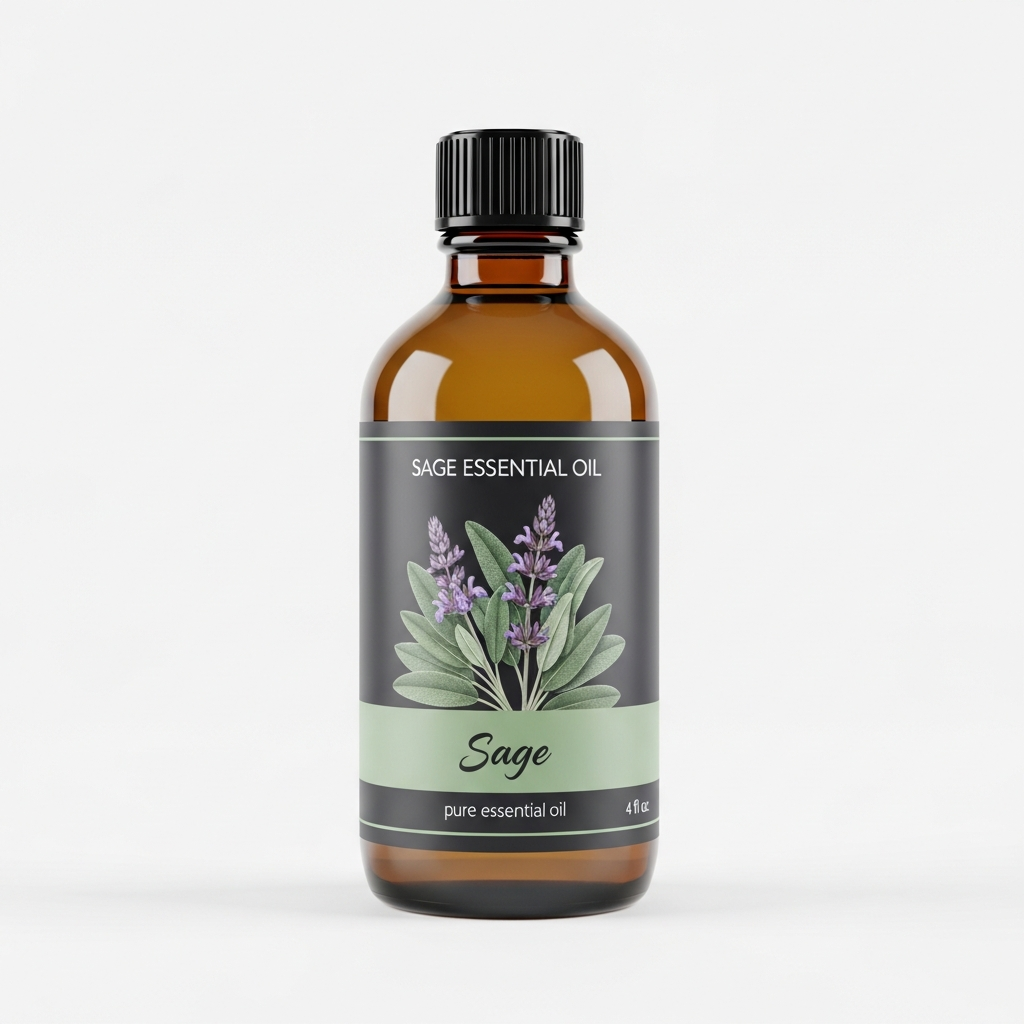
Sage Essential Oil from our own shop, in sizes from 0.5 oz to bulk.
From $13.99
Shop Now →Sources & Further Reading
- EMA/HMPC, 2016. Assessment report on Salvia officinalis L., folium and aetheroleum (EMA/HMPC/150801/2015). ema.europa.eu
- EMA/HMPC, 2012. Public statement on the use of herbal medicinal products containing thujone, Rev. 1. ema.europa.eu
- Halicioglu O et al., 2011. Toxicity of Salvia officinalis in a newborn and a child. Pediatr Neurol 45:259-60. pubmed/21907890
- Burkhard PR et al., 1999. Plant-induced seizures: reappearance of an old problem. J Neurol 246:667-70. pubmed/10460442
- Khine H et al., 2009. A cluster of children with seizures caused by camphor poisoning. Pediatrics 123:1269-72. pubmed/19403490
- National Capital Poison Center. Essential oils. poison.org/essential-oils
- University of Sydney, 2019. Essential oil poisoning calls on the rise, children most affected (on Lee, Harnett and Cairns, Med J Aust 2019). sydney.edu.au
- EFSA FEEDAP Panel, 2024. Sage oil from Salvia officinalis L. as a feed additive. EFSA Journal 22(12):e9135. pmc/PMC11656093
- US CPSC, 16 CFR 1700.14, substances requiring special packaging. law.cornell.edu/16/1700.14
- Tisserand Institute. Safety guidelines. tisserandinstitute.org