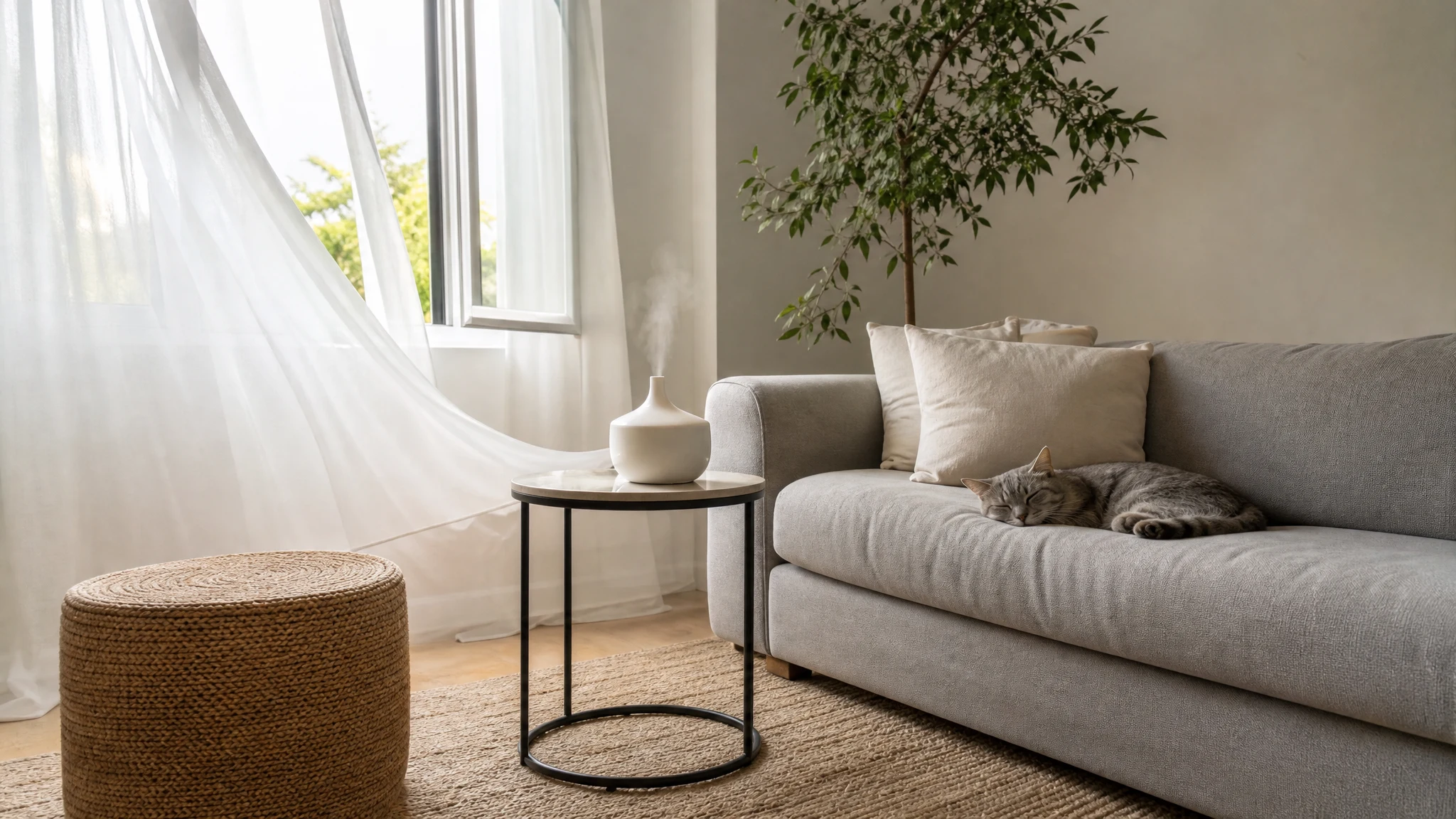
Is Diffusing Essential Oils Safe? What Air Studies Measured
Nobody can honestly answer yes or no to whether diffusing essential oils is safe, because the studies that exist measured air, not people, and only for a few oils. What they do show is that a diffuser puts terpenes into room air in a burst at the start, that the type of diffuser changes the amount by roughly a factor of ten, and that the people and animals in the room matter more than the minute count. Our position: run it intermittently in a ventilated room, keep it out of rooms with infants, cats, birds, and anyone who is pregnant, and regard asthma as a reason to ask a physician first.
What did the air studies actually measure?
Three papers cover most of what is public, and none of them tested sage.
- Zisook and colleagues, 2025 (Journal of Occupational and Environmental Hygiene) ran tea tree oil in a simulated U.S. household with an ultrasonic diffuser, then a heat diffuser. Total volatile organic compounds rose one to two orders of magnitude above a background of about 200 to 300 ppb. With the ultrasonic unit, terpene levels stayed below the exposure limits the authors applied. With the heat unit, terpene levels ran about ten times higher, and alpha-pinene and several other terpenes exceeded long-term derived no-effect levels. One oil, one setup; the abstract does not give room size or run time.
- Kim and Kwon, 2026 (Journal of Environmental Science and Health A) ran one commercial diffuser in an office for two weeks. Emissions were highest right after deployment and declined. In the first two hours limonene, alpha-pinene and beta-pinene rose about 3.2-, 13- and 14-fold above background, to 5.8, 2.2 and 1.7 micrograms per cubic metre. An unidentified compound spiked up to 698-fold; the authors could not rule out atmospheric formation or a sampling artifact.
- Angulo Milhem and colleagues, 2020 reviewed essential-oil-based products and indoor air. They conclude such products are significant terpene sources, that results vary between experiments, and that terpenes can react with indoor oxidants to form formaldehyde and secondary organic aerosols. Their stated conclusion is that these products "can negatively impact indoor air quality."
A search of the Europe PMC index for sage or Salvia together with diffuser or indoor air terms returned no study of diffused sage oil. So any number we gave for sage in a room would be invented. What we can say is arithmetic and composition: EMA's assessment report, citing Bradley (2006), lists sage oil at 10 to 60% alpha-thujone and 5 to 20% camphor, and the ISO 9909 standard for Dalmatian sage oil allows 4.5 to 24.5% camphor and 5.5 to 13% 1,8-cineole. Our COA contains no constituent figures, so we cannot say where our batch sits.
How long should a diffuser run?
The two sources most often quoted do not quite agree, and both trace to the same people. The Tisserand Institute says "ideally, diffuse essential oils for 30-60 minutes on, then 30-60 minutes off." The North American Association for Holistic Aromatherapy (NAHA) says inhalation "presents a very low level of risk to most people," then quotes Tisserand and Balacs that the only likely risk is prolonged exposure, "perhaps 1 hour or more," to high vapor levels, which "could lead to headaches, vertigo, nausea and lethargy." Neither gives measurements behind the interval; it is a precaution, not a threshold. The Kim and Kwon data point the same direction for another reason: emissions are highest at the start, so the first hour is the heavy one, and leaving a window open or the door ajar costs nothing.
Heat matters more than clock time. If the Zisook result generalises beyond tea tree, a heat or candle-style diffuser is the worse choice for a room you sit in.
What about asthma?
The American Academy of Allergy, Asthma and Immunology answers a reader's question on diffusers directly: no published studies have specifically examined diffused essential oils and asthma, diffused oils such as lavender, eucalyptus and tea tree release volatile organic compounds including terpenes, terpenes have been linked to breathlessness at night and airway hyperresponsiveness, and the answering physicians recommend that patients "exercise caution." Your asthma action plan or physician decides whether a diffuser belongs in the room. We make no claim about any breathing condition.
Children, pets and pregnancy
Children. The poison data point at the bottle, not the vapor. A review of New South Wales poisons centre calls from July 2014 to June 2018 counted 4,412 essential-oil exposures; 2,790 (63%) involved children under 15, about 80% were accidental, and 31% of callers were already symptomatic. The National Capital Poison Center notes that children "have thin skin and immature livers" and that aspirating an oil "can cause pneumonia." Our process page says not to use sage on or around children. Keep the bottle and the diffuser tank out of reach; the US Poison Help line is 1-800-222-1222.
Pets. The ASPCA (4 June 2020) says "cats are especially sensitive to essential oils" and "we wouldn't recommend using any essential oils in areas where your pets have access" unless supervised or approved by your veterinarian. Pet Poison Helpline says cats and birds are at greatest risk and lists 800-213-6680. Neither page discusses diffusers specifically, so the diffuser advice is inference from the general statements. Our pets article goes through it.
Pregnancy and breastfeeding. No fetched source measures a diffuser's effect in pregnancy. What exists is a ban on the oil: EMA's assessment report calls sage contraindicated in pregnancy and lactation and describes its thujones as abortifacient and emmenagogic, and NAHA lists Salvia officinalis among oils to avoid throughout pregnancy, labor and breastfeeding. Our process page says the same. A midwife or obstetrician decides anything beyond that. See our pregnancy article.
Where sage differs from a citrus or mint
EMA's public statement on sage oil (2016) calls it "characterised by high levels of thujone," says thujone "is toxic and may cause seizures at high doses as shown in animal studies and indicated from case reports," and rates the benefit-risk balance of sage oil negative. That statement concerns taking the oil by mouth; the 6.0 mg per person per day ceiling it gives is for oral sage leaf preparations. Medsafe, New Zealand's regulator, lists sage, rosemary, eucalyptus and others among essential oils associated with seizures, names camphor, thujone and cineole as the substances involved, and calls the risk "very low" but probably under-reported; it says seizures followed both oral and topical use and mentions nothing about inhalation. So no authority we read quantifies a diffuser risk for sage, and none clears it. Our process page says sage "needs a lighter hand" than a mint or a citrus and to leave it alone with a seizure disorder.
How many drops?
We sell no diffusers; the maker's manual is the authority for your unit. One example, a 120 mL ultrasonic unit's manual (NOW, 2022), lists recipes from 3 to 16 drops in total, tells you to fill with tap water and clean the unit at each oil change. Reasoning from that range and from our process page, our recommendation for sage is to start at the lowest drop count your manual allows, one or two drops in a small tank, run it on a timer in a room you can ventilate, and stop at the first headache, cough or eye irritation. Clean the tank as the manual says; the diffuser setup article and the drops and water volume article cover the arithmetic.
When to stop and who to ask
- A seizure, difficulty breathing, or a child or animal that has swallowed or licked oil: emergency services or a poison centre (people 1-800-222-1222; pets Pet Poison Helpline 800-213-6680).
- Asthma, epilepsy or a seizure disorder, pregnancy: ask your physician, midwife or obstetrician before using sage in a diffuser.
- A pet or bird showing distress near a diffuser: turn it off, open windows and call your veterinarian.
Our two sage oils are sold neat, for aroma use only; the process page carries our own cautions, and a buyer with a safety reason should ask in writing for a thujone figure before ordering, since the published COA has none.
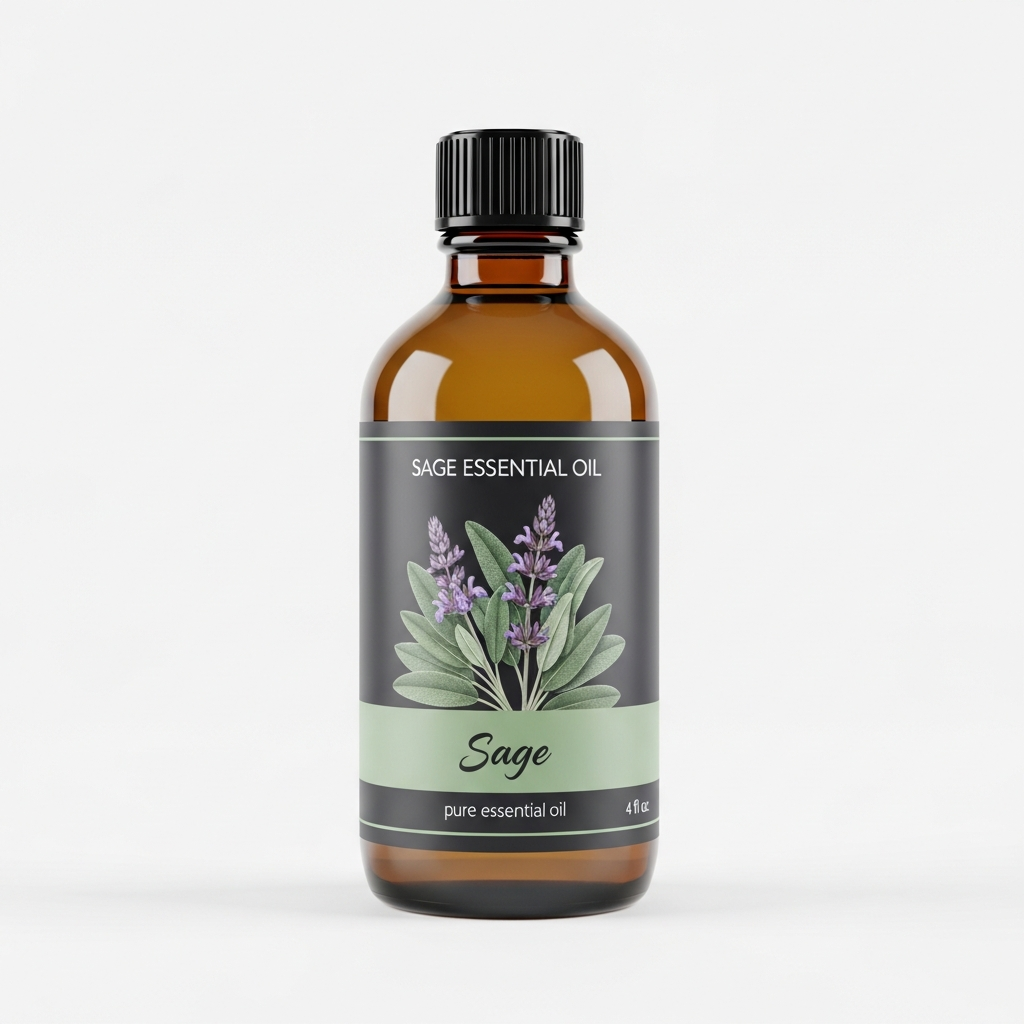
Sage Essential Oil
Sage Essential Oil from our own shop, in sizes from 0.5 oz to bulk.
From $13.99
Shop Now →Sources & Further Reading
- Zisook R. et al., 2025. Volatile organic compound and particle emissions from the use of tea tree oil in essential oil diffusers. J Occup Environ Hyg. pubmed.ncbi.nlm.nih.gov/41004428
- Kim P-G, Kwon J-H, 2026. Time-dependent emission characteristics of terpenes from an essential oil diffuser. J Environ Sci Health A 61(4):263-271. pubmed.ncbi.nlm.nih.gov/41805452
- Angulo Milhem S. et al., 2020. Does the ubiquitous use of essential oil-based products promote indoor air quality? Environ Sci Pollut Res 27:14365-14411. pubmed.ncbi.nlm.nih.gov/32162221
- Tisserand Institute. Safety Guidelines (undated). tisserandinstitute.org/safety-guidelines
- NAHA. Safety (undated). naha.org/explore-aromatherapy/safety
- AAAAI. Are essential oil diffusers harmful to asthma patients? (reviewed 2020). aaaai.org/ask-the-expert/oil-diffusers-asthma
- University of Sydney, 2019. Essential oil poisoning calls on the rise (Med J Aust 2019;212). sydney.edu.au/news-opinion
- National Capital Poison Center. Essential oils: poisonous when misused (undated). poison.org/articles/essential-oils
- ASPCA, 2020. Pet poisons: be mindful of these household products and cleaning agents. aspca.org/news
- Pet Poison Helpline. Essential oils (undated). petpoisonhelpline.com/blog/essential-oils
- EMA/HMPC, 2016. Public statement on Salvia officinalis L., aetheroleum (EMA/HMPC/41843/2009 Corr.1). ema.europa.eu/EMA/HMPC/41843/2009
- EMA/HMPC, 2016. Assessment report on Salvia officinalis L., folium and aetheroleum (EMA/HMPC/150801/2015). ema.europa.eu/EMA/HMPC/150801/2015
- ISO 9909:1997. Oil of Dalmatian sage (Salvia officinalis L.), via iTeh preview. standards.iteh.ai/ISO-9909-1997
- Medsafe (NZ), 2011. Complementary Corner: essential oils associated with seizures. Prescriber Update 32(4). medsafe.govt.nz/ComplementaryCornerDecember2011
- NOW Foods, 2022. Ultrasonic diffuser model 7512 manual. nowfoods.com/7512 manual