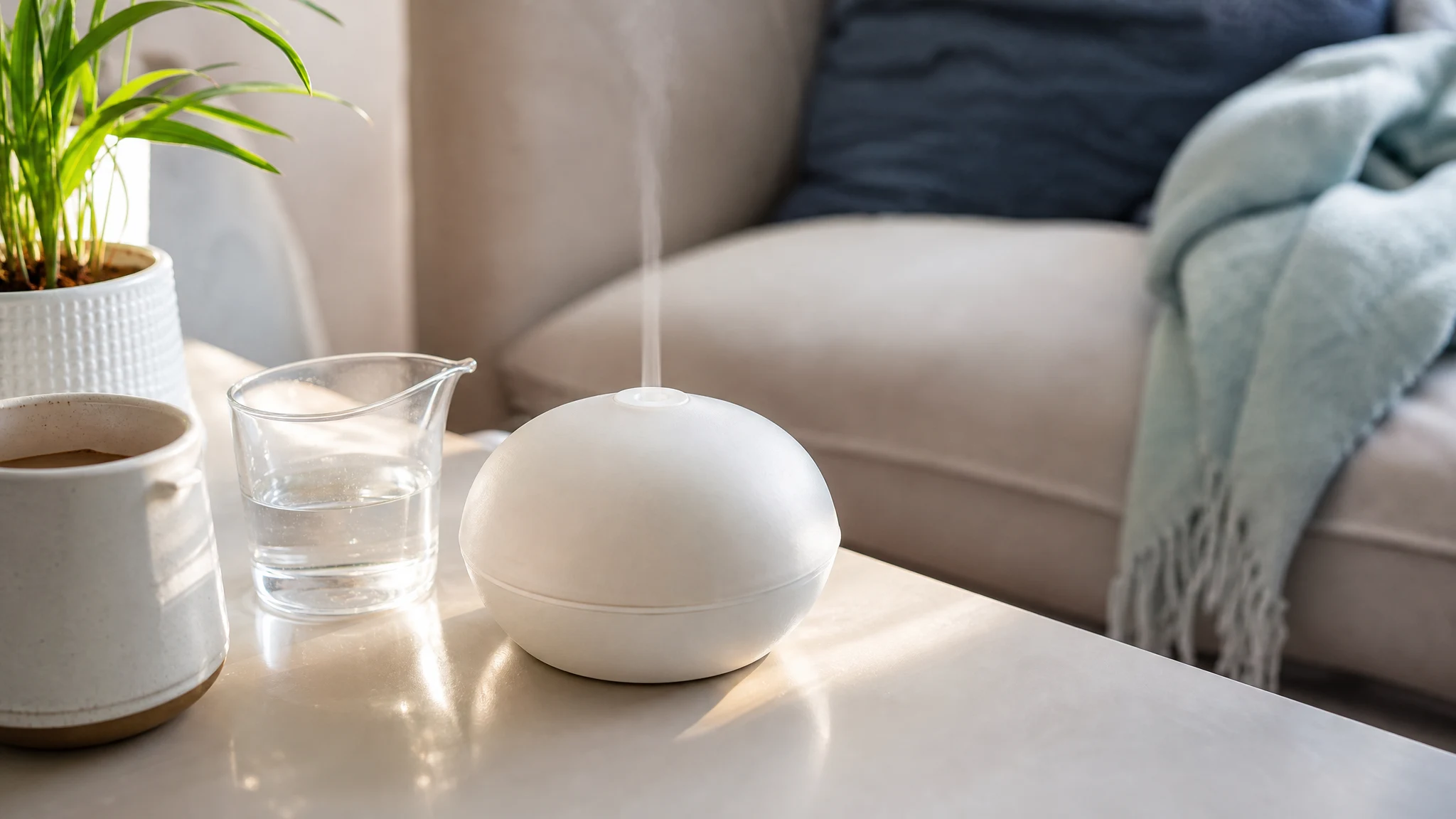
How Many Drops of Essential Oil in a Diffuser? The Maths
There is no universal number of drops for a diffuser, because the three manuals we read give three different answers: a recipe card with 1 to 15 drops of a single oil in a 120 mL tank, a care sheet with 5 to 10 drops, and a nebulizer manual with 20 to 25 drops of neat oil and no water. Room size does not set the number. The machine does, and the sensible habit is the low end of your manual's range, run on a timer. For sage oil, which our process page says needs "a lighter hand than you would use with a mint or a citrus," we recommend starting below the manuals' figures.
What the manuals print, converted to a common scale
We work at about 20 drops per ml, which is 0.05 ml a drop. Droppers differ, so treat every conversion as approximate. The percentage is oil volume as a share of the tank water (oil ml divided by water ml); it ignores that oil floats on top rather than dissolving.
| Source | Water | Drops | Oil, ml | Share of water | Drops per 100 mL water |
|---|---|---|---|---|---|
| NOW Foods 7512, lowest single oil on recipe card | 120 mL | 1 | 0.05 | 0.04% | 0.8 |
| NOW Foods 7512, a 4-drop blend on the card | 120 mL | 4 | 0.2 | 0.17% | 3.3 |
| NOW Foods 7512, the largest blend on the card (16 drops) | 120 mL | 16 | 0.8 | 0.67% | 13.3 |
| Stevie Buoy care sheet | "Fill Line" (volume not stated) | 5 to 10 | 0.25 to 0.5 | cannot compute | cannot compute |
| Organic Aromas nebulizer manual | none | 20 to 25 neat | 1.0 to 1.25 | not applicable | not applicable |
The NOW figures come from its 2022 manual, which states a 120 mL capacity, runs up to 5 hours, and gives recipes using "1 drop" to "15 drops" of individual oils with no per-volume rule (NOW Foods manual, 2022). By our count the blends on its card total between about 4 and 16 drops; the card's quantities are printed beside oil names, so check the original before relying on our sum. The Stevie Buoy care sheet says to add "5-10 drops of Essential oil or Fragrance oil depending on your preference and size of your Ultrasonic Diffuser" (Stevie Buoy, 2022). The nebulizer manual says to add 20 to 25 drops of essential oil to the reservoir and adds that adding too much at once lets air oxidise the oil, which "become[s] stiff and clog[s] the nozzle" (Organic Aromas manual).
The spread inside one tank is already 16-fold (1 to 16 drops in 120 mL). Between machine types the nebulizer's 1 ml or more of neat oil has no water counterpart at all. That is why a number copied from a blog is a coin flip.
Room size is not a quantity of oil
The NOW manual rates the 120 mL unit for coverage "up to 1,000 square feet." Nothing in the document links that area to a drop count. The Tisserand Institute's page on diffusing says only that the amount "may need adjusting 'depending upon room size, diffuser size, air flow and other factors'" (Tisserand Institute, diffusion guidelines). It also notes that people become "nose blind" to a running aroma, which is one plausible route to adding more drops than a room needs. Both points favour the same habit: pick the low end, leave the room, come back, and judge the smell fresh.
A worked example: how much oil leaves per hour
This is arithmetic, not a measurement, and it assumes the oil leaves at the same rate as the water, which it will not (oil floats on the surface and the mist draws unevenly). It gives a picture of the order of magnitude. The NOW unit runs up to 5 hours on 120 mL, so it uses about 24 mL of water an hour. Spread across that run:
- 16 drops over 5 hours is about 3.2 drops an hour, or about 0.16 ml.
- 4 drops over 5 hours is about 0.8 drops an hour.
- 2 drops over 5 hours is about 0.4 drops an hour.
Run it 30 minutes on and 30 off, the schedule Robert Tisserand gives as "30-60 minutes on, then 30-60 minutes off," and the hourly rate while it is on stays the same but the room gets half the total (Tisserand Institute, above). The reason to use the low end is simple proportion: halve the drops and, on this crude picture, you halve the oil available to leave the tank.
What measurement studies add
Two papers measured what real diffusers release. A US household simulation with tea tree oil found terpene levels below applicable exposure limits from an ultrasonic diffuser, and about ten times higher from a heat diffuser, with alpha-pinene and several other terpenes over long-term derived no-effect levels (Zisook et al., 2025). In a two-week office test, emission of limonene, beta-pinene and alpha-pinene peaked just after switch-on and declined, with indoor levels several times background within two hours (Kim and Kwon, 2026). Neither tested sage. Neither tells you a drop count. They justify two habits: ventilate, and do not run the unit continuously.
How to handle sage
We sell sage oil in two listings, and nothing else: no diffusers, droppers or blends, so a drop count for your machine has to come from your manual. For sage, our recommendation is 1 to 2 drops in a unit of about 100 to 120 mL, which is 0.04% to 0.08% of the water by our arithmetic, below the lowest blend total on the NOW card. This is our stated position, derived from reasoning, not from a test: we have not run sage in any diffuser. The reasons are these.
- Our process page says sage oil is high in thujone, "not an oil for casual, generous use," and needs a lighter hand when diffusing.
- The European Medicines Agency describes thujone as toxic and capable of causing seizures at high doses, based on animal studies and case reports (EMA/HMPC, 2016). That concerns consuming the oil. We found no study or authority that gives an inhalation limit for thujone.
- The scale, for orientation only: on the certificate we publish for one batch the relative density is 0.915, so one drop weighs about 0.046 g. If that batch's thujone were anywhere in ISO 9909's allowed total of 21% to 51.5%, one drop would contain roughly 10 to 24 mg of thujone. The certificate gives no thujone figure and the ISO range is for Dalmatian sage oil generally, not for our batch. Only a fraction of what is loaded becomes airborne, and no source converts this to an inhaled dose.
Weigh before you trust a dropper: twenty drops should weigh about 0.9 g if the dropper delivers 20 per ml and the oil has the certificate's density. If yours weigh much more or less, scale your drops accordingly. Do not diffuse sage in a room with children, pregnant people or pets. Our process page says to avoid sage in pregnancy and breastfeeding, not to use it on or around children, and to leave it alone with a seizure disorder; the ASPCA says cats are "especially sensitive to essential oils" (ASPCA, 2020). Anyone who needs a thujone figure before diffusing should ask for one in writing before ordering.
Setup and scheduling are in how to use a diffuser, machine types in types of diffusers, sage blends in our sage diffuser post and the wider question in our diffusing article. For skin dilution arithmetic, see how to dilute sage oil.
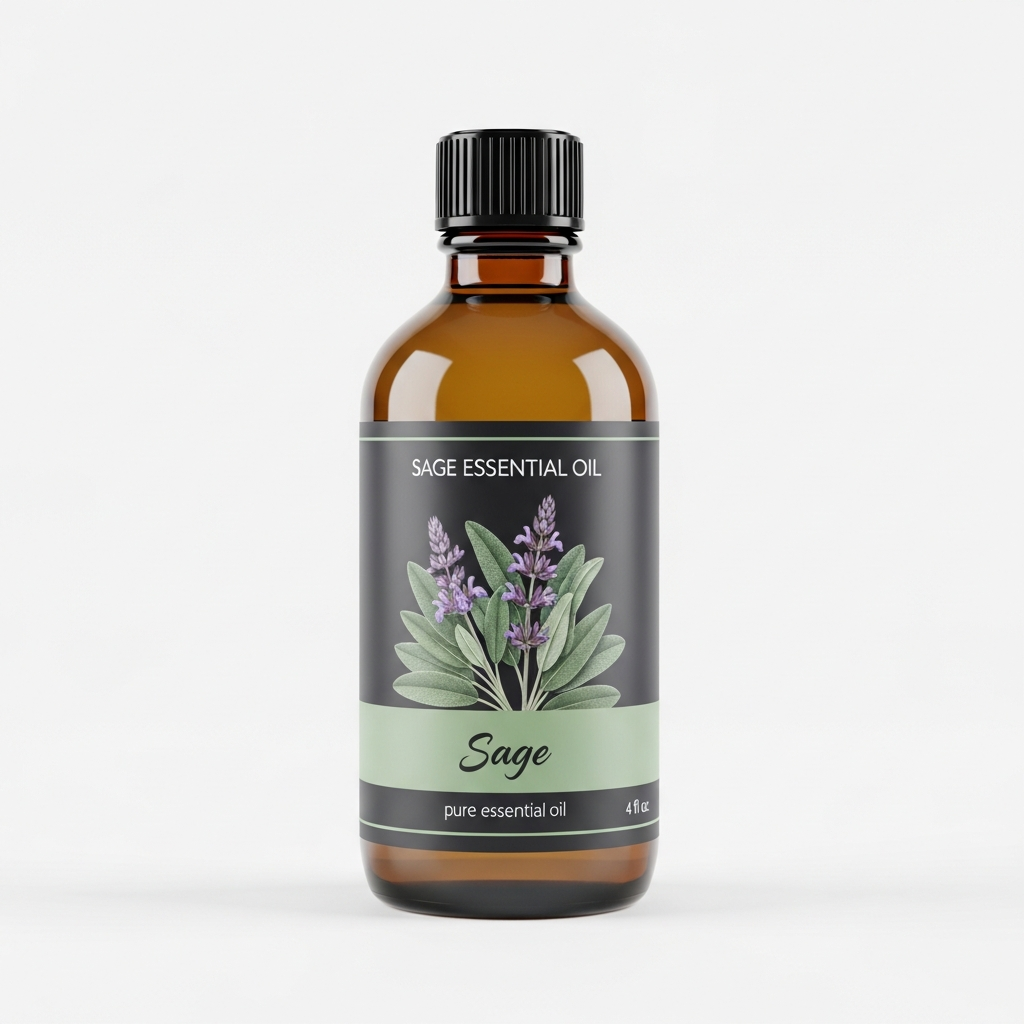
Sage Essential Oil
Sage Essential Oil from our own shop, in sizes from 0.5 oz to bulk.
From $13.99
Shop Now →Sources & Further Reading
- NOW Foods, 2022. Ultrasonic Oil Diffuser manual, model 7512. nowfoods.com/7512 manual
- Stevie Buoy, 2022. Ultrasonic Diffuser Care. Ultrasonic_Diffuser_Care_2022.pdf
- Organic Aromas, undated. Mobile-Mini Nebulizing Diffuser instruction manual. organicaromas.com
- Tisserand Institute, undated. Safety guidelines for diffusing essential oils at home. tisserandinstitute.org
- Zisook RE et al., 2025. Volatile organic compound and particle emissions from the use of tea tree oil in essential oil diffusers. J Occup Environ Hyg. PubMed 41004428
- Kim P-G, Kwon J-H, 2026. Time-dependent emission characteristics of terpenes from an essential oil diffuser. J Environ Sci Health A 61:263-271. PubMed 41805452
- EMA/HMPC, 2016. Public statement on Salvia officinalis L., aetheroleum. ema.europa.eu
- ISO 9909:1997. Oil of Dalmatian sage (Salvia officinalis L.), preview. iteh.ai/ISO-9909-1997
- ASPCA, 2020. Pet poisons: household products and cleaning agents. aspca.org