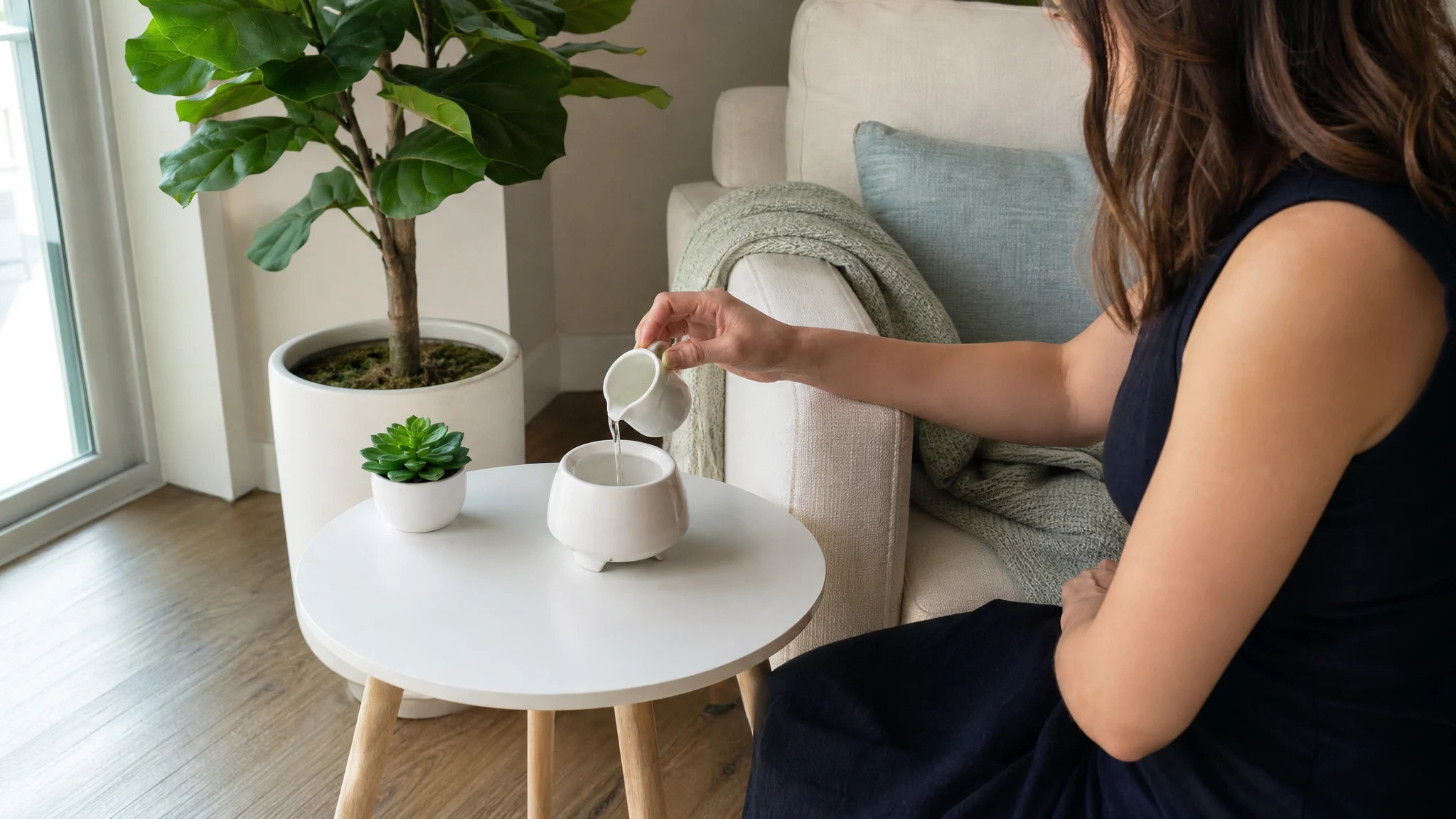
How to Use an Essential Oil Diffuser: Setup, Run Time, Room
The best diffuser instructions are the ones printed in the manual that came with your diffuser, and the second best is a timer. Water volume, drop count and run time all differ by model, and the figures in most blog posts are averages of nothing. This is the order we would work in: read the manual, fill, dose low, run on a schedule, and decide who is in the room before you start. We sell sage oil (two listings) and no diffusers, so nothing here is a product recommendation.
Step 1: take the number from the manual, not from a blog
Two manufacturer documents show how far the numbers drift. The NOW Foods ultrasonic diffuser (model 7512) holds 120 mL, runs up to 5 hours and is rated by its maker for coverage "up to 1,000 square feet." Its recipe card uses between 1 and 15 drops of a single oil, and it states no drops-per-volume rule (NOW Foods manual, 2022). A Stevie Buoy care sheet says to add 5 to 10 drops "depending on your preference and size of your Ultrasonic Diffuser" (Stevie Buoy, 2022). A nebulizing diffuser manual from another maker has you put 20 to 25 drops of undiluted oil in a glass reservoir with no water at all (Organic Aromas manual). Same activity, three different instructions, because the machines are different. Our separate article on drops in a diffuser converts these to millilitres and percentages; the machine types are compared in types of diffusers.
Step 2: place it and fill it
- Stand it on a hard, level surface you do not mind wetting. The NOW manual warns that "oil mist can damage wooden and painted surfaces" and tells you to wipe up residue "quickly and often." It also says not to aim the unit at walls, ceilings or furniture, and not to put it on loose fabric that can block air flow.
- Keep it where cords, hot surfaces and small hands cannot reach. Both ultrasonic documents say to keep the unit away from children and pets.
- Fill with water to the marked line and do not overfill. Water type is where manuals and health agencies disagree. The NOW manual says to use room-temperature tap water and "do not use distilled or purified/filtered water," and its troubleshooting table lists distilled water as the cause of "no mist." The US Environmental Protection Agency, writing about humidifiers generally, says distilled water releases less mineral dust than tap water, and the CDC recommends distilled water or water that has been boiled and cooled (EPA, humidifier care; CDC, waterborne germs at home). We cannot resolve that for your model. Follow your own manual, and read the EPA's mineral-dust point as the reason surfaces near the diffuser get a white film.
- Add the oil to the water. The NOW manual says to add it "directly into the water."
Step 3: dose low
Dose is where most diffuser overuse starts, and the reasoning is simple: you stop noticing a smell you are sitting in. The Tisserand Institute's page on diffusing quotes Shane Carper noting that people become "nose blind" to a running aroma, and says the right amount depends on "room size, diffuser size, air flow and other factors" (Tisserand Institute, diffusion guidelines). The result is a habit of adding drops because the room smells of nothing, when the nose has simply stopped counting.
The room-size claim on the box is not a dose. The NOW figure of 1,000 square feet describes how far a 120 mL unit can push mist, and nothing in the document links square footage to a drop count. Start with the manual's low end and judge by what you smell when you walk back in from another room, not by what you smell sitting next to the unit.
Step 4: run it on a schedule, not overnight
Robert Tisserand's guideline is "30-60 minutes on, then 30-60 minutes off," and he says that with continuous diffusion "benefits do not increase." Very low levels, where the oil is barely noticeable, he considers "fine anywhere, for any length of time" (Tisserand Institute, above). That is the position of one practitioner, not a regulatory limit, and we found no air-quality study that measures an exposure threshold for diffuser schedules.
What measurement studies do show is that the first minutes matter most. In a two-week office test of a commercial diffuser, emission rates of limonene, beta-pinene and alpha-pinene peaked right after switch-on and then declined, and within two hours indoor levels of the three were several times background (Kim and Kwon, 2026). A US household simulation using tea tree oil found terpene levels from an ultrasonic diffuser below applicable exposure limits and levels from a heat diffuser about ten times higher, with several terpenes above long-term derived no-effect levels (Zisook et al., 2025). Neither used sage oil, neither measured thujone, and both are single studies of specific machines. Taken together they support one practical rule: ventilate, and prefer a timer to a switch you remember to turn off. A model with an automatic shut-off is the simplest way to get that.
The nebulizer manual cited above builds the schedule in: the unit runs 2 minutes on and 1 minute off, for two hours, then shuts down. The NOW unit shuts itself off when the water gets low, which gives you a hard stop of at most 5 hours; that is a limit on the machine, not a recommendation to run it that long.
Step 5: decide who is in the room
- Pets. The ASPCA says cats are "especially sensitive to essential oils" and warns that inhaling oils could lead to aspiration pneumonia (ASPCA, 2020). Ask your veterinarian before diffusing any oil where animals live; see our pets article for what poison lines publish.
- Children. Poison Control notes that children "have thin skin and immature livers," and that reed diffuser liquid, an essential oil in isopropyl alcohol, "must be kept out of the reach of children" (poison.org). A paediatrician is the person to ask about infants.
- Pregnancy. Ask your midwife or obstetrician about any oil. For sage specifically, see our pregnancy article.
- Seizure disorders. Our process page says to leave sage oil alone with a seizure disorder. A neurologist is the person to ask.
Where sage fits, and where it does not
Our process page says diffusing sage "needs a lighter hand than you would use with a mint or a citrus," and that sage oil is high in thujone and "not an oil for casual, generous use." The European Medicines Agency describes thujone as toxic and capable of causing seizures at high doses, based on animal studies and case reports, and concludes that the benefit-risk balance of sage oil is negative, adding that consuming it in single-ingredient products carries a high risk of exceeding the recommended daily thujone intake (EMA/HMPC, 2016). That statement concerns swallowing the oil, not inhaling it, and we found no inhalation study that gives a thujone limit. Our stated recommendation, which is ours and not a standard: 1 to 2 drops in a unit of around 100 mL, a 30-to-60-minute cycle, an open door or window, and no sage in rooms with children, pregnant people or pets. We have not tested this on a machine. Our sage diffuser post covers blends, and the question of whether diffusing is wise at all is taken up in our diffusing article.
Anyone with a safety reason to want the thujone content should ask for a figure in writing before ordering. The certificate we publish for one batch covers density, refractive index and optical rotation and lists no constituents. When you are done, empty the tank; cleaning the diffuser is the next article in this sequence.
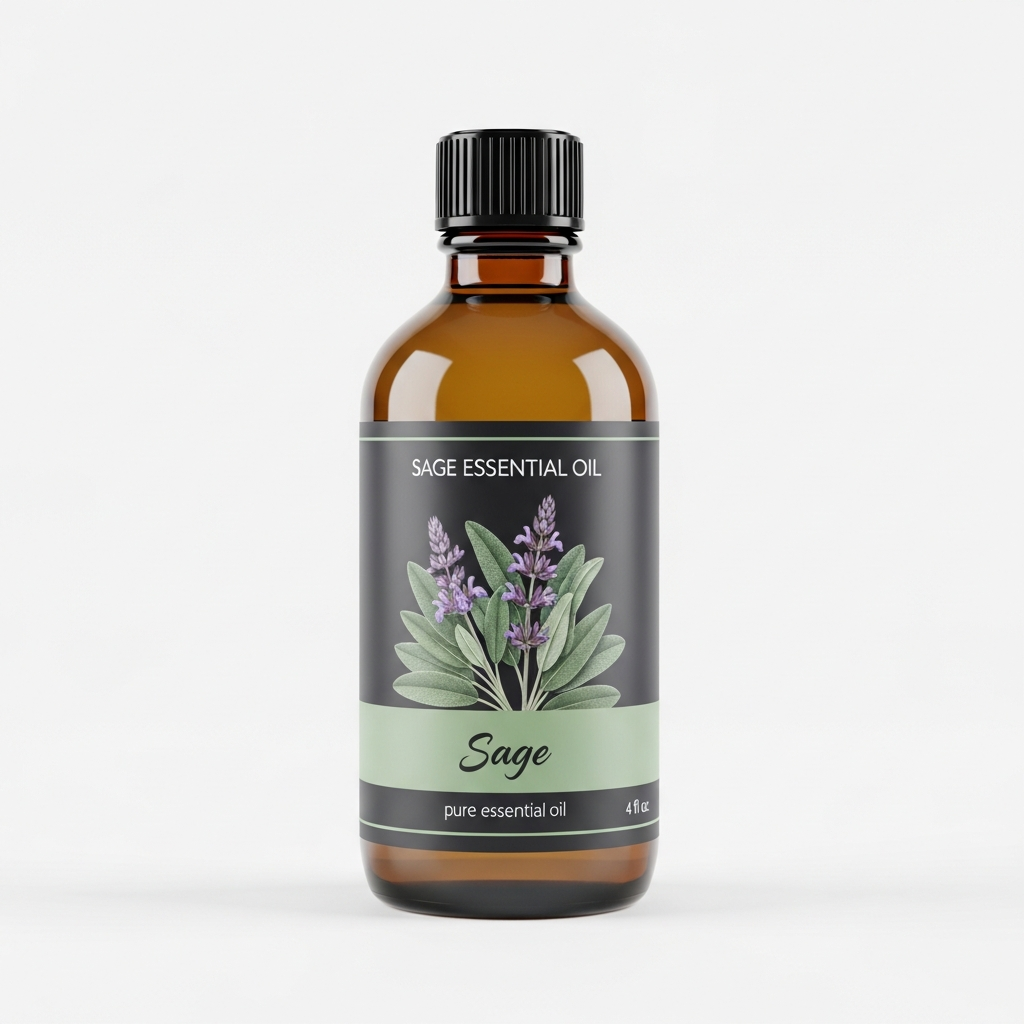
Sage Essential Oil
Sage Essential Oil from our own shop, in sizes from 0.5 oz to bulk.
From $13.99
Shop Now →Sources & Further Reading
- NOW Foods, 2022. Ultrasonic Oil Diffuser manual, model 7512. nowfoods.com/7512 manual
- Stevie Buoy, 2022. Ultrasonic Diffuser Care. Ultrasonic_Diffuser_Care_2022.pdf
- Organic Aromas, undated. Mobile-Mini Nebulizing Diffuser instruction manual. organicaromas.com
- US EPA, 2026. Use and care of home humidifiers. epa.gov
- CDC, 2024. Preventing waterborne germs at home. cdc.gov
- Tisserand Institute, undated. Safety guidelines for diffusing essential oils at home. tisserandinstitute.org
- Kim P-G, Kwon J-H, 2026. Time-dependent emission characteristics of terpenes from an essential oil diffuser. J Environ Sci Health A 61:263-271. PubMed 41805452
- Zisook RE et al., 2025. Volatile organic compound and particle emissions from the use of tea tree oil in essential oil diffusers. J Occup Environ Hyg. PubMed 41004428
- ASPCA, 2020. Pet poisons: household products and cleaning agents. aspca.org
- Poison Control (poison.org), undated. Essential oils. poison.org/articles/essential-oils
- EMA/HMPC, 2016. Public statement on Salvia officinalis L., aetheroleum. ema.europa.eu