Sage Essential Oil and Pets: What Poison Lines Report
Sage is one of the oils a veterinary poison service names when it lists essential oils that can poison animals, and the camphor and thujone in sage oil are the reasons we think it is a poor choice anywhere an animal lives. Our shop copy says to keep it away from pets. This article reports what the poison lines and one regulator's feed-additive review actually say, separates what is documented from what is inference, and puts the veterinarian, not a seller, in charge of any decision about an animal.
If your animal has been exposed
Call before you search. The ASPCA Animal Poison Control Center's number is (888) 426-4435; Pet Poison Helpline lists (855) 764-7661 in its page header and 800-213-6680 in its text, and its article does not explain the difference (ASPCA, 2020; Pet Poison Helpline). Call your own veterinarian or an emergency clinic as well. What Pet Poison Helpline's veterinary article says to do, by route:
- Do not induce vomiting: the page says "Do not induce emesis in these patients due to risk of aspiration."
- Skin: bathe with liquid dishwashing detergent.
- Ingestion: dilute early with water or food.
- Inhalation: move the animal to fresh air.
The same page says signs usually appear within about 6 to 8 hours and that the most common are drooling, vomiting, lethargy and anorexia, along with irritation of the airway, skin and mucous membranes. It also says animals with minor exposure and no signs can be watched at home but should see a veterinarian if signs develop. Treat that as the poison line's wording, not as a permission: a veterinarian or poison-line toxicologist decides, with the product, the amount and the animal's weight in hand. Keep the bottle and the label.
What the poison services actually say about sage
The Pet Poison Helpline article says essential oil toxicosis "can affect all species, but cats and birds are at the greatest risk", and lists among oils that can cause poisoning "cedar, sage, cypress, some juniper oils, and tarragon". It does not give a dose, and it does not discuss diffusers. The ASPCA's 4 June 2020 article does not name sage: it says cats are "especially sensitive to essential oils", that inhaling the oils could lead to aspiration pneumonia, that "toxicity varies among specific oils", and that the Center would not recommend "using any essential oils in areas where your pets have access" (ASPCA, 2020). Together: one service names sage, the other advises against all essential oils where pets roam, and neither publishes a threshold. Anyone who gives you a drop count for a cat is not citing either.
Why cats are the worry
A 2011 paper in PLoS One found that the UGT1A6 gene, which codes for a major detoxifying enzyme, is a non-functional pseudogene in all cat family species, fixed an estimated 35 to 11 million years ago; the authors link it to cats' sensitivity to phenolic drugs such as acetaminophen and aspirin (Shrestha et al., 2011). That paper is about drugs, not sage oil, so the application to sage is an inference. A second source applies the same idea to sage oil directly: when EFSA's feed-additive panel assessed sage oil in 2024, it noted that "cats have an unusually low capacity for glucuronidation particularly for aromatic compounds" and raised its required margin of exposure for thujone to 500 for cats (EFSA FEEDAP, 2024). The panel's reference point was a benchmark dose of 8 mg per kg body weight per day for alpha-thujone, derived from seizures in rats. Dogs are not exempt: at the feed level the applicant proposed (40 mg of oil per kg of feed), the panel's thujone margin of exposure was 30 for dogs and 26 for cats, against a figure of 100 it wanted for most species. That is a feed additive eaten daily, a different exposure from a diffuser, but it shows a regulator treating thujone as the limiting issue for both animals. Birds, which Pet Poison Helpline puts beside cats at greatest risk, are not addressed in either the ASPCA article or the EFSA opinion we read.
Arithmetic for one drop and a small cat
These are our calculations, as orientation only. No source we read gives a toxic dose of sage oil for a cat or a dog.
- One drop is about 0.05 ml; at the 0.915 density on our published certificate that is about 46 mg of oil.
- For a 4 kg cat that is about 11 mg of oil per kg.
- If the oil resembled the five batches EFSA analysed (alpha plus beta thujone about 28.5 to 32.2%), that drop holds roughly 13 to 15 mg of thujone, or about 3.3 to 3.7 mg per kg of cat. We do not know the thujone content of our oils.
- EFSA's reference of 8 mg/kg/day divided by its margin of 500 for cats is 0.016 mg/kg/day. The drop above is over 200 times that figure.
That comparison is about swallowed oil; we have no equivalent figure for air. What the numbers show is why "a little" is not a small amount for a small animal.
Diffusers, sprays and skin
For a diffuser, the documented position is the ASPCA's advice not to use essential oils in areas pets can reach. The sources we read include no study of sage oil vapour and pets. Inhalation can carry the risk the ASPCA names, aspiration pneumonia, and the National Capital Poison Center says aspirating an essential oil can cause pneumonia (poison.org). A diffuser also deposits oil on surfaces, coats and bedding, and a cat that grooms swallows what lands on its fur; that is our reasoning, not a quoted finding. Rooms an animal can leave are better than rooms it cannot, but a cat in the next room still shares the air. Our process page says to diffuse sage lightly and our shop copy says to keep it away from pets. We sell no diffusers; a maker's manual is the source for how much oil a unit takes, and a veterinarian is the source for whether it belongs in a house with your animal.
Skin: our shop copy gives 0.5% to 2% for body oils for people. Nothing we read gives a pet dilution, and we do not offer one. Do not put sage oil on an animal. See the thujone article for why we lean lower than that range even for adults.
Storage and the rest of the household
Treat the bottle the way you would treat a medication on a counter. Keep sage oil closed, in a cupboard an animal cannot open, and wipe spills with a paper towel you then bin. Rooms where pets sleep, birds' cages and water bowls are not places to use it. The same advice applies to children (the children article); for the general household basics see our safety basics and the broader diffusing safety article.
If you live with an animal and like the herbal scent, make the choice with your veterinarian. We do not recommend sage oil near cats or birds.
Sage Essential Oil
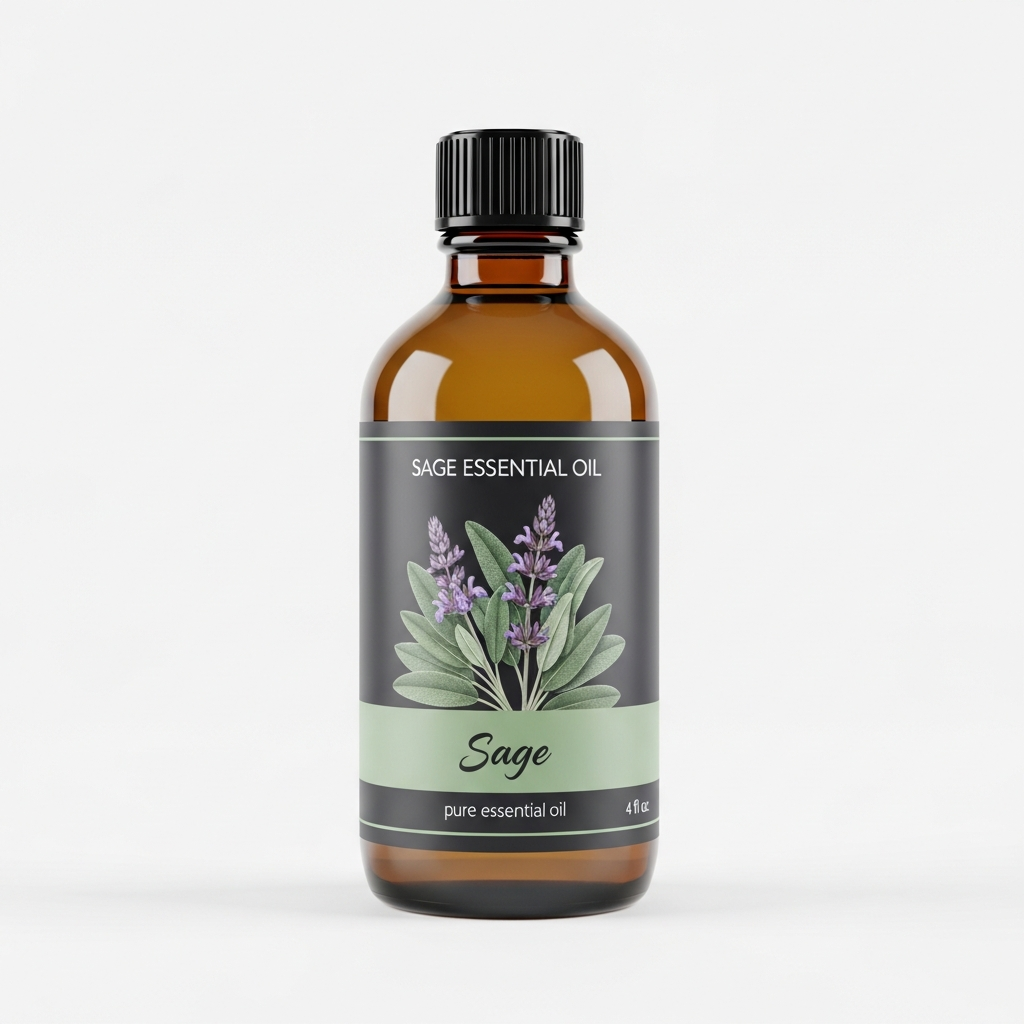
Sage Essential Oil from our own shop, in sizes from 0.5 oz to bulk.
From $13.99
Shop Now →Sources & Further Reading
- ASPCA, 2020. Pet poisons: be mindful of these household products and cleaning agents (4 June 2020). aspca.org
- Pet Poison Helpline. Essential oils. petpoisonhelpline.com
- Shrestha B et al., 2011. Evolution of a major drug metabolizing enzyme defect in the domestic cat and other felidae. PLoS One 6(3):e18046. pubmed/21464924
- EFSA FEEDAP Panel, 2024. Safety and efficacy of a feed additive consisting of an essential oil from Salvia officinalis L. EFSA Journal 22(12):e9135. pmc/PMC11656093
- National Capital Poison Center. Essential oils. poison.org/essential-oils