How to Clean an Essential Oil Diffuser: Residue and Water
Clean a water-based diffuser more often than the manufacturer's minimum, because the schedules that matter come from two different problems: oil film on the mist disc, and standing water. A manual covers the first, and the US Environmental Protection Agency and the CDC cover the second, and their advice is stricter. We sell sage oil (two listings) and no diffusers, so this is a summary of what the documents say, with the places they disagree marked.
Two problems, two timetables
Oil residue. The NOW Foods manual for its ultrasonic model says to clean it "every time you change oils" and explains why: "Oils are corrosive, and over time, they build up on the ceramic parts." Its troubleshooting table gives "oils are clinging to ceramic disc or sensor" as the cause of little or no mist (NOW Foods manual, 2022). A Stevie Buoy care sheet says a diffuser "will develop an oil build-up that can prevent it from working properly" and asks for a quick clean after every use plus a deeper clean every 1 to 2 months (Stevie Buoy, 2022).
Standing water. The EPA's page on home humidifiers says standing water lets microorganisms grow and that breathing mist containing these pollutants "has been implicated as causing a certain type of inflammation of the lungs." It singles out ultrasonic and impeller models as the most likely to spread such particles. The agency says to empty, dry and refill portable units each day, scrub them every third day to remove scale and film, and rinse well after any cleaner so chemical residue does not get into the air (EPA, humidifier care). The CDC says "germs can live in humidifiers and spread through the mist" and to "empty all water from humidifiers every day," then let them air dry (CDC, waterborne germs at home).
Both pages are about humidifiers. A diffuser that mists water is a small version of one, so applying them is our inference. That inference is why we recommend the stricter schedule below rather than the manuals' lighter one.
The schedule we would follow
| When | What | Source |
|---|---|---|
| Every time you stop | Empty the tank, wipe it dry, leave it open to air | EPA and CDC, daily; Stevie Buoy, after every use |
| Every oil change | Rinse the tank and wipe it dry; clean the mist disc and sensor with a cotton swab | NOW Foods manual |
| Every third day of use | Scrub the tank to remove film and scale; rinse thoroughly | EPA |
| Every 1 to 2 months | Deep clean with vinegar, as below | Stevie Buoy |
If you diffuse a few times a week, that adds up to more cleaning than the manual's minimum. Our reasoning is that you cannot see inside the base while it runs, and the EPA's stated reason for the every-third-day scrub, scale and film, applies to a diffuser tank as it does to a humidifier.
The steps, from the two manuals
The two ultrasonic documents give steps that overlap, and then disagree.
- Unplug the unit. Both manuals start there.
- Pour out any remaining water and oil. Stevie Buoy adds: pour it away from the operating buttons.
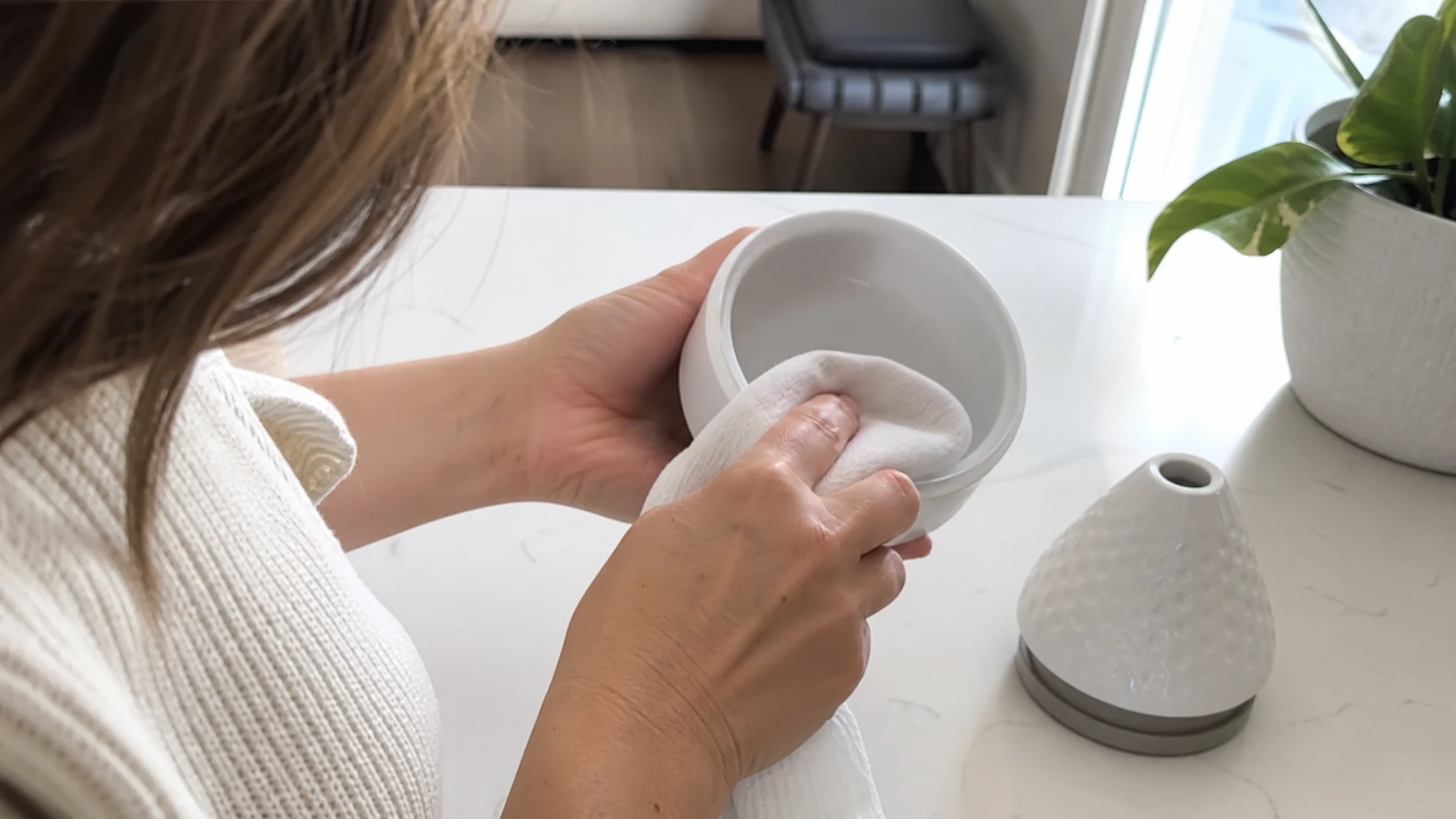
- Rinse the tank with clean water and wipe it dry with a clean cloth (NOW).
- Clean the mist disc, or "ultrasonic mist chip," with a cotton swab. NOW says to use a swab "gently." Stevie Buoy specifies a cotton bud dipped in rubbing alcohol.
- Deep clean, per Stevie Buoy: fill the tank halfway with water, add one teaspoon (about 5 mL) of white vinegar, run the diffuser for 10 to 15 minutes, empty it, dab a cotton tip in white vinegar on the tight spots, wipe the mist chip again with alcohol, rinse with clean water and dry with a cloth.
- Let it dry before you store it. If you will not use it for a while, NOW says to unplug it and pour the water out.
Where they disagree. The NOW manual says "do not use detergents, solvents or abrasive agents" and never to use "corrosive solvent." The Stevie Buoy sheet says to wipe the inside with "a tiny amount of isopropyl alcohol or detergent." Both could be right for their own machines. Your manual wins over this article. The EPA adds one more instruction that applies to every method: rinse the tank well after any cleaner so residue does not get into the air.
The nebulizing type is cleaned differently because it has no water. The Organic Aromas manual for its Mobile-Mini unit says that after every 5 to 6 uses, or when you change scent, you pour out the oil and swirl 1 to 3 mL of high-percentage isopropyl alcohol in the glass reservoir for 1 to 2 minutes. Monthly, it asks for a one-hour soak in boiling water with a little dish soap (Organic Aromas manual). A reed diffuser has no tank to clean; its care sheets are about replacing reeds. The differences are set out in types of diffusers.
A tipped-over unit, and a few other manual rules
- NOW says that if the unit tips over during operation, water could flow into the inner chamber: unplug it, empty all the water, and set it aside "in a ventilated place for 3 days" before reuse.
- Do not put your hand above the ceramic disc while it runs, and do not touch the water-level sensor (NOW).
- Wipe up spills and mist residue promptly, as the NOW manual warns oil mist "can damage wooden and painted surfaces."
Does the oil keep the tank clean?
No source we fetched says so. The EPA's guidance on standing water and microorganisms makes no exception for what you add to it, and the NOW manual treats oil as the thing that must be cleaned off. We will not claim our sage oil, or any oil, keeps a diffuser free of growth, and we do not sell it as a cleaning product. We found no study comparing film build-up from different oils, so whether a sage tank gets filmier than a lemon tank is unknown. The NOW manual's wording, that oils are corrosive and build up, is general, and the Organic Aromas manual's list of thick oils that clog micro-tubes names resins and roots, not sage.
What residue means for skin and for sage
What sits in a used tank is oil without the dilution of a skin blend. The European Medicines Agency reports sage oil to be "a moderate skin irritant" (EMA/HMPC, 2016), and our shop copy calls it a concentrated botanical material and says to keep it away from eyes. Reasoning from that, wipe up with a cloth or paper towel rather than bare hands. Rinse the cloth, and keep the tank and any oil-soaked cloth out of reach of children and pets. If a rash follows, our patch test article covers what a reaction means and who to ask, and Poison Control's number for swallowed oil is 1-800-222-1222 (poison.org).
Because sage oil is high in thujone, our process page asks for a lighter hand when diffusing it, and says to avoid it around pregnancy, children and seizure disorders; see how to use a diffuser and drops in a diffuser for how we would dose it. Cleaning belongs to the same discipline as storage: how to store sage oil covers the bottle. When your diffuser's manual and an article like this one differ, follow the manual, and if the unit smells musty or the water looks cloudy, empty and clean it before the next run.

Sage Essential Oil
Sage Essential Oil from our own shop, in sizes from 0.5 oz to bulk.
From $13.99
Shop Now →Sources & Further Reading
- NOW Foods, 2022. Ultrasonic Oil Diffuser manual, model 7512. nowfoods.com/7512 manual
- Stevie Buoy, 2022. Ultrasonic Diffuser Care. Ultrasonic_Diffuser_Care_2022.pdf
- Organic Aromas, undated. Mobile-Mini Nebulizing Diffuser instruction manual. organicaromas.com
- US EPA, 2026. Use and care of home humidifiers. epa.gov
- CDC, 2024. Preventing waterborne germs at home. cdc.gov
- EMA/HMPC, 2016. Assessment report on Salvia officinalis L., folium and aetheroleum (Rev. 1). ema.europa.eu
- Poison Control (poison.org), undated. Essential oils. poison.org/articles/essential-oils