Does Aromatherapy Work? What the Trial Reviews Conclude
The honest answer depends on three things the question leaves out: which oil, which route (inhaled, rubbed in, or swallowed) and which outcome. Reviews of aromatherapy trials find small effects on self-reported feelings in studies of low quality, and no review we could read shows that any oil changes the course of a disease. We sell one botanical, sage, and none of what follows is a claim for it.
Start with the reviews, not the headlines
Lee, Choi, Posadzki and Ernst searched 12 databases and found 10 systematic reviews of aromatherapy covering hypertension, depression, anxiety, pain and dementia. Their 2012 verdict: "the evidence is not sufficiently convincing that aromatherapy is an effective therapy for any condition," and most of the reviews were of poor methodological quality (Lee et al., Maturitas, 2012). That is an overview of reviews, so it is a verdict on the quality of the whole pile.
The US National Center for Complementary and Integrative Health is similarly sparing. On insomnia its aromatherapy page says "we don't know whether it's helpful because little rigorous research has been done," and it describes one study in which lemon improved mood while "neither scent affected stress indicators" (NCCIH, last updated January 2020). The page is dated, so newer trials exist that it does not cover.
What individual reviews found
| Source | What was studied | Reported result | What it does not show |
|---|---|---|---|
| Hwang and Shin, 2015 | 12 trials pooled, studies from 2000 to August 2013, aromatherapy for sleep quality | Pooled effect favoured aromatherapy (95% CI 0.540 to 1.745); inhalation did better than massage | Abstract names no particular oil; the two subgroup intervals overlap |
| Donelli et al., 2019 | Lavender only, any route; 37 trials (3,964 people) in the pooled analysis | Inhaled lavender reduced anxiety scores; oral Silexan 80 mg/day for 6 weeks or more also did; massage looked promising | Authors rate most included studies low quality with high risk of bias |
| Hines et al., Cochrane, 2018 | Aromatherapy for postoperative nausea and vomiting; 16 studies, 1,036 people | No clear effect on nausea severity against placebo; lower use of rescue anti-sickness drugs | Certainty ranged from moderate to very low; peppermint alone showed no clear effect on severity |
These are the best-behaved cases and they still carry caveats. The Cochrane authors judged aromatherapy may be about as effective as placebo for nausea at the end of follow-up, while the lavender review concluded the inhaled effect is of reasonable size but of limited certainty (Hwang and Shin, J Altern Complement Med, 2015; Donelli et al., Phytomedicine, 2019; Hines et al., Cochrane, 2018).
Why the results are hard to trust: our reasoning
This section is reasoning from how the trials are built, not a finding from one source. A scent is hard to hide. If one group smells lavender and the other smells liquid paraffin (the design of a migraine trial we describe in our headache post), participants know which group they are in, and outcomes people report themselves, such as an anxiety score, can follow expectation. Short follow-up and small groups compound this. The sage-oil hospital trial below lists exactly those limits: small groups and no medium- or long-term follow-up.
Three routes that get lumped together
Inhaling a scent, massaging a diluted oil into skin and swallowing an extract are different exposures. Many of the studies that get quoted for "sage" or "rosemary" are the third kind, and they say nothing about inhaled oil.
- Tildesley and colleagues gave 25 to 150 microlitres of a standardised Salvia lavandulaefolia (Spanish sage) oil extract to 20 and then 24 volunteers in crossover trials; the 50 microlitre dose improved immediate word recall. The record does not state the route, and this is Spanish sage, a different plant from the Salvia officinalis on our COA (Tildesley et al., Pharmacol Biochem Behav, 2003).
- Kennedy and colleagues gave 30 healthy adults placebo, 300 mg or 600 mg of dried Salvia officinalis leaf on separate days. Mood improved before a stress task and the lower dose's anxiety effect disappeared during the task itself, while the lower dose reduced performance later (Kennedy et al., Neuropsychopharmacology, 2006). Dried leaf is not an essential oil.
- The one sage-oil inhalation trial we found is a Romanian hospital study of 174 inpatients, 124 aroma and 50 control, with two drops on the pillow for at least 30 minutes a day. Allocation was by ward, not by person. Ratings of hospital services did not differ significantly between the groups (p = 0.8969). The oil was made in-house and measured 17.98% 1,8-cineole, 15.86% borneol and 8.74% alpha-thujone (Mot et al., Antioxidants, 2022). The paper's abstract says inhaling the oil "could improve" patient satisfaction; its own results table does not show a significant difference.
Sage specifically: what we searched and found
On 29 October 2026 we ran a Europe PMC title-and-abstract query combining sage or Salvia, aromatherapy or inhalation or essential oil terms, and sleep, insomnia, anxiety, stress or headache. It returned 89 records. We read the titles and abstracts of the first 25: none was a trial of inhaled Salvia officinalis oil for sleep, stress or headache. The closest were a rat study of a different species (Salvia heldreichiana) and clary sage work, which is another plant altogether. We did not read the other 64.
The NCCIH sage page (last updated April 2025) reports "only small amounts of research" on common sage, which it says suggests it might reduce hot flash frequency and might improve memory in healthy people, and states the uncertainty about those findings. The same page says it "may be unsafe to use sage during pregnancy because its component thujone may have harmful effects" (NCCIH, April 2025). That page concerns the herb as a supplement, not the oil.
The EMA's herbal committee takes a harder line on the oil. It says sage oil is "characterised by high levels of thujone" and that thujone "is toxic and may cause seizures at high doses" (EMA/HMPC, statement adopted 2010, corrected 2016). Case reports describe a newborn and a toddler with generalised tonic-clonic seizures after accidental exposure to sage oil, both recovering well (Halicioglu et al., Pediatr Neurol, 2011). Together that is why we do not suggest sage oil for any wellness goal.
What counts as a claim for a product
US law judges a product by its intended use, shown through labelling and promotion. The FDA's aromatherapy page lists claims to relieve colic, ease pain, relax muscles, address depression or anxiety, or help you sleep as drug claims, and notes that cosmetics do not need FDA approval before they go on the market (FDA, page current as of 8 September 2023). We claim nothing medicinal for our sage oils. For the use cases people do ask us about, see our uses overview and the sleep and stress posts.
A decision order for a reader
- Is there a symptom? Persistent trouble sleeping, anxiety that does not lift or a headache with red-flag signs belongs with a clinician, not a bottle. The NHS says to see a GP if sleep trouble has lasted months, and to call 999 or go to A&E for a headache that started suddenly and is extremely painful or comes with a seizure, weakness or confusion.
- Is it a scent you enjoy? That is a legitimate reason to use a scent. It is not a medical plan.
- Is anyone vulnerable in the room? Pregnant people, young children, pets and anyone with a seizure disorder change the answer for sage. Our process page says to avoid it in pregnancy and breastfeeding, not to use it on or around children, and to leave it alone with a seizure disorder.
- Which route? If a study used capsules or an extract, it is not evidence about the bottle on your shelf.
We sell two sage oils and nothing else: no diffusers, carriers, bottles or kits, and no other essential oil. For the trials above, the oils tested were mostly lavender, so a lavender supplier is the place to ask about lavender; for sage, our safety basics post comes first.
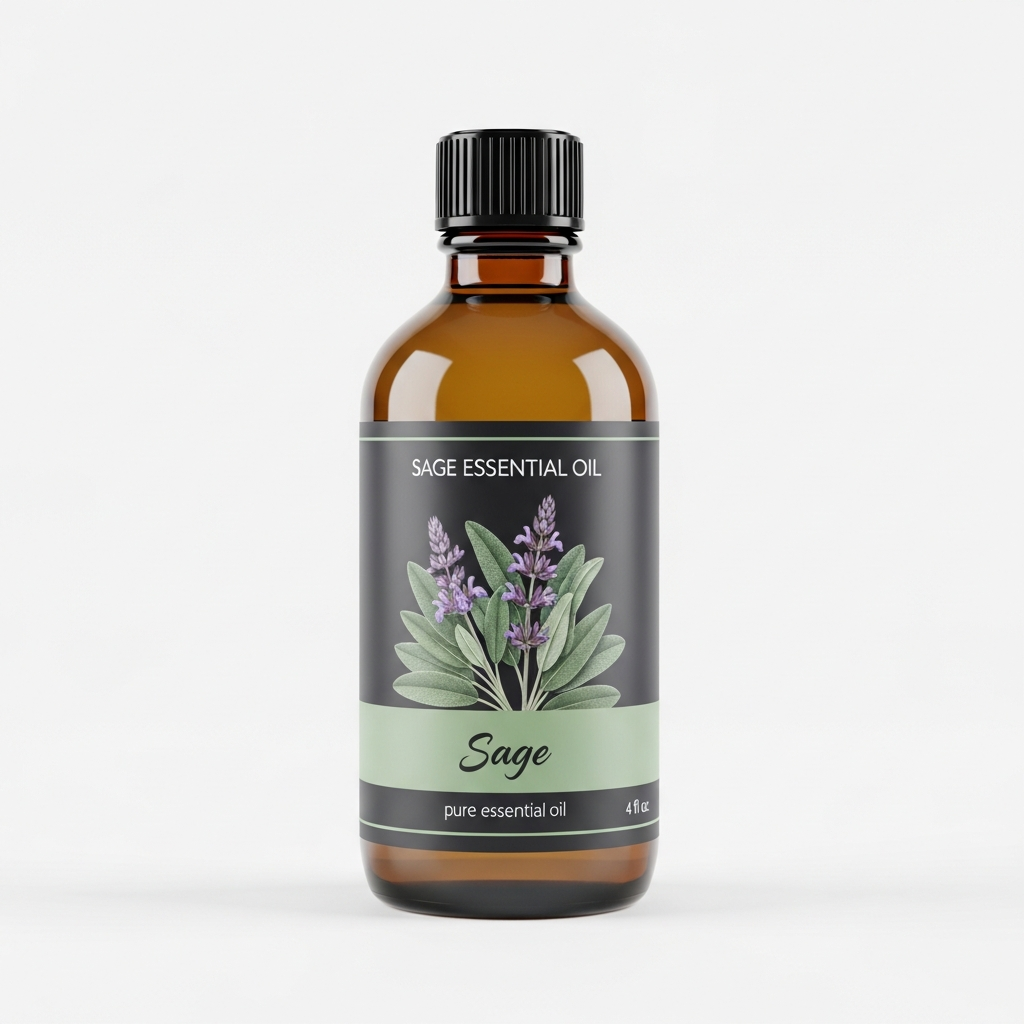
Sage Essential Oil
Sage Essential Oil from our own shop, in sizes from 0.5 oz to bulk.
From $13.99
Shop Now →Sources & Further Reading
- Lee MS, Choi J, Posadzki P, Ernst E, 2012. Aromatherapy for health care: an overview of systematic reviews. Maturitas 71(3):257-260. Europe PMC MED/22285469
- NCCIH, January 2020. Aromatherapy. nccih.nih.gov/health/aromatherapy
- Hwang E, Shin S, 2015. The effects of aromatherapy on sleep improvement: a systematic literature review and meta-analysis. J Altern Complement Med 21(2):61-68. Europe PMC MED/25584799
- Donelli D et al., 2019. Effects of lavender on anxiety: a systematic review and meta-analysis. Phytomedicine 65:153099. Europe PMC MED/31655395
- Hines S et al., 2018. Aromatherapy for treatment of postoperative nausea and vomiting. Cochrane Database Syst Rev. Europe PMC MED/29523018
- Tildesley NT et al., 2003. Salvia lavandulaefolia (Spanish sage) enhances memory in healthy young volunteers. Pharmacol Biochem Behav 75(3):669-674. Europe PMC MED/12895685
- Kennedy DO et al., 2006. Effects of cholinesterase inhibiting sage (Salvia officinalis) on mood, anxiety and performance on a psychological stressor battery. Neuropsychopharmacology 31(4):845-852. Europe PMC MED/16205785
- Mot MD et al., 2022. Salvia officinalis L. essential oil: characterization, antioxidant properties, and the effects of aromatherapy in adult patients. Antioxidants 11(5):808. PMC9137537
- NCCIH, April 2025. Sage. nccih.nih.gov/health/sage
- EMA/HMPC, 2016 (adopted 2010). Public statement on Salvia officinalis L., aetheroleum, EMA/HMPC/41843/2009. ema.europa.eu/EMA/HMPC/41843/2009
- Halicioglu O et al., 2011. Toxicity of Salvia officinalis in a newborn and a child: an alarming report. Pediatr Neurol 45(4):259-260. Europe PMC MED/21907890
- FDA, 2023. Aromatherapy. fda.gov/cosmetics/cosmetic-products/aromatherapy
- NHS. Headaches; Insomnia. nhs.uk/conditions/headaches; nhs.uk/conditions/insomnia