Essential Oils for Sleep: What the Research Shows About Sage
Sage oil has no sleep research behind it, and we do not suggest it for the bedroom. The pooled sleep studies that exist are about aromatherapy in general, mostly with other oils, and the main guideline for long-lasting insomnia puts a talking therapy first. Below is what each source actually covers, so you can see where the gap is.
What the pooled review found, and what it left out
Hwang and Shin searched for randomised and quasi-experimental trials of aromatherapy and sleep quality published between 2000 and August 2013. They identified 245 publications, 13 met their criteria and 12 went into the meta-analysis. Overall the pooled result favoured aromatherapy (95% confidence interval 0.540 to 1.745), and inhalation did better than massage: the intervals were 0.792 to 1.541 for inhalation and 0.128 to 2.166 for massage (Hwang and Shin, J Altern Complement Med, 2015).
Three limits matter. The abstract reports no overall effect size, only intervals. It does not name the oils, so you cannot read "lavender" or "sage" into it. And the two subgroup intervals overlap heavily, so "inhalation beat massage" is a tendency, not a settled ranking. The authors' own conclusion is that specific guidelines for use need to be developed.
The US National Center for Complementary and Integrative Health states the position more cautiously still: aromatherapy is sometimes used for insomnia, "but we don't know whether it's helpful" because little rigorous research has been done (NCCIH, last updated January 2020). Read that as a statement about 2020; newer trials exist that it does not cover.
What guidelines say comes first
The American College of Physicians guideline on chronic insomnia disorder in adults recommends cognitive behavioural therapy for insomnia (CBT-I) as the initial treatment for all adults, a strong recommendation backed by moderate-quality evidence. When CBT-I alone does not work, it advises a shared decision with a clinician about adding short-term medication, a weak recommendation backed by low-quality evidence (Qaseem et al., Ann Intern Med, 2016). No aroma appears in that recommendation.
The NHS gives the practical threshold: see a GP if changing your sleeping habits has not helped, if you have had trouble sleeping for months, or if it makes daily life hard to cope with. It defines short-term insomnia as under three months and long-term as three months or more. It also notes that pharmacy sleep aids containing valerian or lavender may help for one to two weeks and "should not be taken for any longer," and that they do not resolve insomnia (NHS, undated). A pharmacist can tell you what is in a given product, and a physician or sleep clinic is the right place if apnoea or another sleep disorder is possible.
What we looked for on sage
On 29 October 2026 we ran a Europe PMC title-and-abstract search combining sage or Salvia, aromatherapy, inhalation or essential-oil terms, and sleep, insomnia, anxiety, stress or headache. It returned 89 records. We read the titles of the first 25. None was a trial of inhaled Salvia officinalis oil for sleep. Two 2026 records tested inhaled aromatherapy and sleep in older adults, but their titles do not name sage. We did not read the remaining 64, and we cannot rule out a study we did not find.
The nearest sage-oil inhalation study is a Romanian hospital trial in which two drops of an in-house sage oil were placed on the pillow daily for at least 30 minutes. It measured patients' ratings of hospital services, not sleep; the difference between groups was not significant (p = 0.8969). The oil's profile was 17.98% 1,8-cineole, 15.86% borneol and 8.74% alpha-thujone, which differs from the commercial sage oils the European Food Safety Authority assessed, where alpha-thujone averaged about 25% (Mot et al., Antioxidants, 2022; EFSA FEEDAP, 2024). The sage studies on mood and memory that you may find elsewhere used oral extracts or dried leaf. We cover those in our evidence overview; they say nothing about breathing a scent overnight.
Why thujone is a reason to leave sage out of a bedroom
This is the part specific to sage. The EMA's herbal committee describes sage oil as "characterised by high levels of thujone" and thujone as something that "is toxic and may cause seizures at high doses" (EMA/HMPC, adopted 2010, corrected 2016). A seizure disorder is the reason our own process page tells people to leave the oil alone, and that page also says to avoid it in pregnancy and breastfeeding, not to use it on or around children, and to diffuse with a lighter hand than you would use with a mint or citrus oil. Children are the worry in a bedroom. Case reports describe a newborn and a toddler with generalised tonic-clonic seizures after accidental exposure to sage oil; both recovered well (Halicioglu et al., Pediatr Neurol, 2011). Those were accidents, not diffusing, so they do not show what a diffuser does.
A night-long diffuser also runs against the usual guidance on duration. The Tisserand Institute advises diffusing for 30 to 60 minutes on and then 30 to 60 minutes off, not constantly all day (Tisserand Institute, undated). Whatever oil goes in, a device left running until morning is outside that range.
What would change our answer
Three things would: a controlled trial of inhaled Salvia officinalis oil with sleep as the measured outcome, a stated thujone figure for the specific oil used, and a safety review that addresses sleeping children and pets in the same house. None of the three exists in what we found. Until then, "no evidence" is not the same as "shown not to work," and the thujone caution is a reason of its own that does not depend on the evidence gap. Anyone who still wants sage in the house at night should ask for a thujone figure in writing before ordering; the COA we publish (one batch, density, refractive index and optical rotation) does not contain one.
If you are shopping for something to help you sleep
We sell sage oil in two listings and nothing marketed for sleep. We do not claim our oil helps anyone sleep, and under US law a claim that a product helps you sleep is a drug claim (FDA, page current as of September 2023). If you want a scent you enjoy in a room you are awake in, our diffuser post covers sage, with the caution above. For sleep that is not working, ask a physician, and expect them to start with sleep habits and CBT-I.
If anyone in the household has a safety reason to question sage (pregnancy, a child, a pet, a seizure disorder), our safety basics post is the first stop, and a physician or veterinarian is the last word.
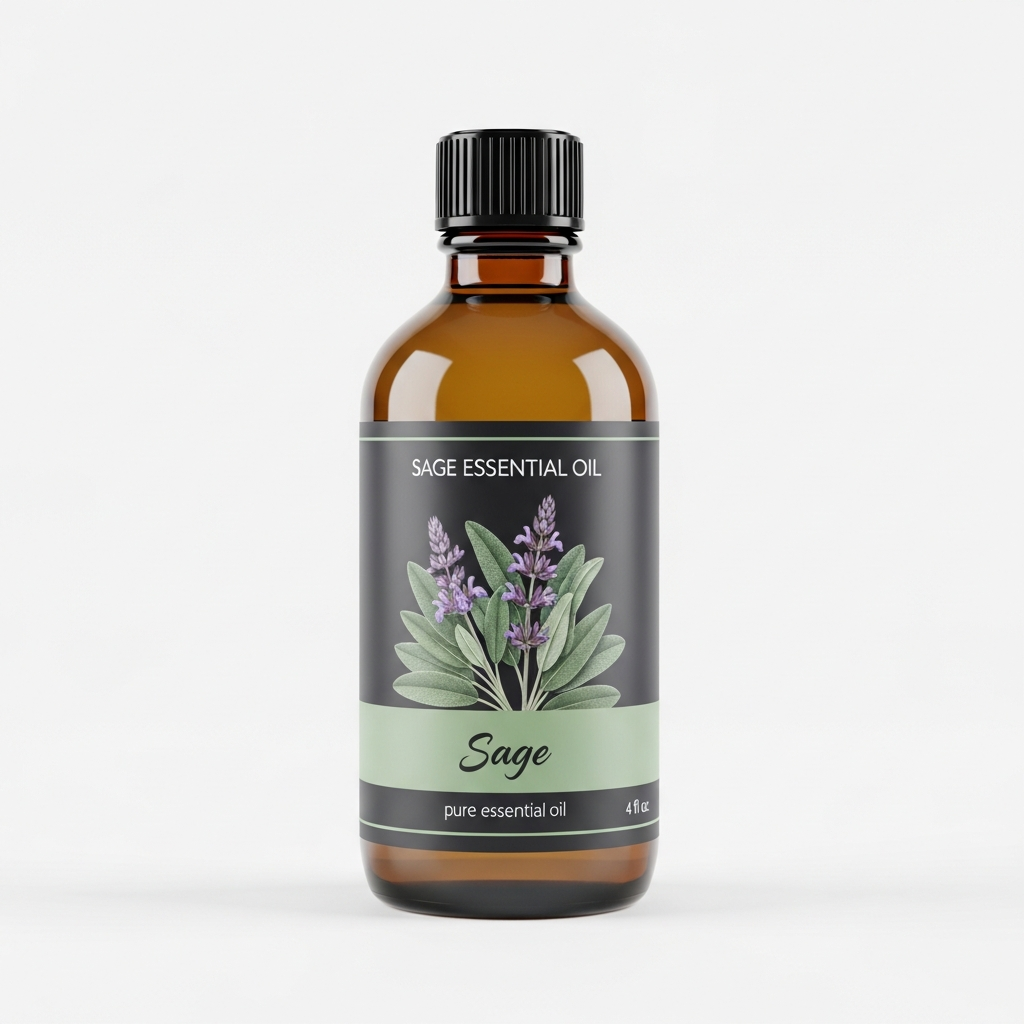
Sage Essential Oil
Sage Essential Oil from our own shop, in sizes from 0.5 oz to bulk.
From $13.99
Shop Now →Sources & Further Reading
- Hwang E, Shin S, 2015. The effects of aromatherapy on sleep improvement: a systematic literature review and meta-analysis. J Altern Complement Med 21(2):61-68. Europe PMC MED/25584799
- NCCIH, January 2020. Aromatherapy. nccih.nih.gov/health/aromatherapy
- Qaseem A et al., 2016. Management of chronic insomnia disorder in adults: a clinical practice guideline from the American College of Physicians. Ann Intern Med 165(2):125-133. Europe PMC MED/27136449
- NHS. Insomnia. nhs.uk/conditions/insomnia
- Mot MD et al., 2022. Salvia officinalis L. essential oil: characterization, antioxidant properties, and the effects of aromatherapy in adult patients. Antioxidants 11(5):808. PMC9137537
- EFSA FEEDAP Panel, 2024. Safety and efficacy of a feed additive consisting of an essential oil derived from the leaves of Salvia officinalis L. (sage oil). EFSA Journal 22(12):e9135. PMC11656093
- EMA/HMPC, 2016 (adopted 2010). Public statement on Salvia officinalis L., aetheroleum, EMA/HMPC/41843/2009. ema.europa.eu/EMA/HMPC/41843/2009
- Halicioglu O et al., 2011. Toxicity of Salvia officinalis in a newborn and a child: an alarming report. Pediatr Neurol 45(4):259-260. Europe PMC MED/21907890
- Tisserand Institute, undated. Safety guidelines. tisserandinstitute.org/safety-guidelines
- FDA, 2023. Aromatherapy. fda.gov/cosmetics/cosmetic-products/aromatherapy