Essential Oils for Headaches: What Two Trials Tested
Before any oil, check the red flags. The NHS says to call 999 or go to A&E if a headache comes with a seizure, numbness or weakness, difficulty speaking, drowsiness or confusion, loss of vision, a rash that does not fade under a rolled glass, a very high temperature with a stiff neck, or if it started suddenly and is extremely painful. Sage oil is not a headache product, and the two trials most often quoted for oils and headaches did not use it.
The red-flag list, in full
The NHS page on headaches lists these as reasons for 999 or A&E: a seizure; numbness or weakness in the body or face; a sudden, extremely painful onset; a head injury within the last three months; difficulty speaking, balancing, walking or remembering; drowsiness or confusion; loss of vision; a rash that does not fade when a glass is rolled over it; and a very high temperature, stiff neck or bright lights bothering you. It lists an urgent GP appointment or NHS 111 for a headache with vision or eye problems, one triggered or worsened by coughing, sneezing, bending or exercise, one with vomiting, jaw pain when eating or a tender scalp, and, in a child, one that is getting worse or wakes them at night. See a GP if self-care is not working, if headaches are getting worse, or if you get them regularly. It also names taking too many painkillers as a common cause (NHS, undated). A scent does not belong in that decision.
What each trial gave, side by side
| Gobel et al., 1994 | Sasannejad et al., 2012 | |
|---|---|---|
| Oil | Peppermint oil and eucalyptus oil preparations, with ethanol | Lavender essential oil |
| Route | Applied to forehead and temples (skin) | Inhaled for 15 minutes |
| People | 32 healthy adults, double-blind crossover, placebo-controlled | 47 patients with confirmed migraine |
| Comparison | Placebo preparation | Liquid paraffin inhaled for 15 minutes |
| What was measured | Experimental pain sensitivity, cognitive and muscle-relaxation measures in a headache model | Self-recorded headache severity every 30 minutes for two hours |
| Reported result | Peppermint oil with ethanol significantly reduced sensitivity to headache-related pain; the mix with eucalyptus had little effect on pain sensitivity | Severity fell 3.6 (SD 2.8) points on a visual analogue scale versus 1.6 (SD 1.6) with paraffin; 92 of 129 lavender-treated attacks responded fully or partly versus 32 of 68 with paraffin |
| What it does not show | Anything in people with headaches; the abstract does not give the oil strength | Which part of the effect is expectation, since lavender is easy to tell from paraffin |
Sources: Gobel et al., Cephalalgia, 1994; Sasannejad et al., Eur Neurol, 2012.
Reading these two trials carefully
The Gobel experiment used healthy volunteers and an experimental pain model, so it tells us what the preparation did to a laboratory measure, not what it does for a person with a headache. The full text is paywalled and we read only the abstract, which does not state the percentage of oil in the ethanol. We therefore make no comparison between that strength and our 0.5% to 2% copy. Anyone repeating "10% peppermint in ethanol" should find that figure in the paper itself, because we could not confirm it.
The Sasannejad trial is closer to real life, but it counts attacks, not people (129 attacks treated with lavender and 68 with paraffin among 47 patients), and the outcome was self-reported. The comparison group inhaled liquid paraffin, which smells different, so participants could probably guess their group. That last point is our reasoning rather than a statement from the paper. The authors themselves concluded that inhaled lavender may be an effective and safe option for acute migraine and described it as the first placebo-controlled trial of its kind. A single trial of that size is a reason for a larger trial, not for a conclusion.
Neither trial used sage, and nothing we found in a Europe PMC search on 29 October 2026 (sage or Salvia with aromatherapy-type terms and headache, sleep, anxiety or stress terms: 89 records; we read the titles of the first 25) was a trial of sage oil for headache. We did not read the other 64.
Why sage is the wrong oil to put near a headache
A headache sends people toward the forehead and temples, and this is where our advice is plainest: do not put sage oil on the face, and do not use it on or around children. Our shop copy gives 0.5% to 2% in a carrier for skin. For adult body use we stay at or below about 0.2%, roughly one drop per ounce of carrier (0.2% of 29.57 ml is about 0.06 ml, or one to two drops at 20 drops per ml; weigh it). The reason is thujone. The EMA's herbal committee says sage oil is "characterised by high levels of thujone" and that thujone "is toxic and may cause seizures at high doses" (EMA/HMPC, adopted 2010, corrected 2016). EFSA's 2024 opinion on commercial sage oils measured about 25% alpha-thujone and 5.6% beta-thujone, and classed sage oil as an irritant to skin and eyes and a dermal and respiratory sensitiser (EFSA FEEDAP, 2024). Skin on the temples sits close to the eyes.
The arithmetic shows how fast the percentage moves. If an oil is about 30.6% thujone (the EFSA figure, applied as an assumption since our own oil has no published thujone figure), a blend at 0.2% oil holds about 0.06% thujone and one at 2% about 0.6%. IFRA's thujone standard (Amendment 49, 2020) restricts thujone in finished products by category because of neurotoxicity; it governs fragrance mixtures rather than aromatherapy sold as such (IFRA Standard, Thujone, 2020). Our process page also says the oil is for light, low-dilution use, to be avoided in pregnancy and breastfeeding, and left alone by anyone with a seizure disorder.
Camphor is the second issue. Sage oils carry camphor, and a Pediatrics case series described three children aged 15 to 36 months who had seizures after camphor, two who swallowed it and one with repeated skin exposure (Khine et al., Pediatrics, 2009). A separate report describes a newborn and a toddler with generalised tonic-clonic seizures after accidental exposure to sage oil, both recovering well (Halicioglu et al., Pediatr Neurol, 2011). Those are accidents involving small children. They are why headache-hour advice about "a dab on the temples" is not something we would give for sage.
If you still use an oil
US law judges a product by its intended use, and the FDA lists claims to ease pain among those it treats as drug claims (FDA, page current as of September 2023). We make no headache claim for our sage oils. If you use any essential oil on skin, the Tisserand Institute says "Do not apply undiluted essential oils to your skin," and that people who are pregnant, have epilepsy or asthma or a skin condition should seek a doctor's advice first (Tisserand Institute, undated). We sell no peppermint or lavender; for those, ask a supplier for a document naming the species and a physician or pharmacist about your own headaches.
For our oil's own dilution maths see diluting sage oil, and for what the research on aromatherapy as a whole looks like, the evidence overview. The stress and anxiety post covers the other common reason people ask.
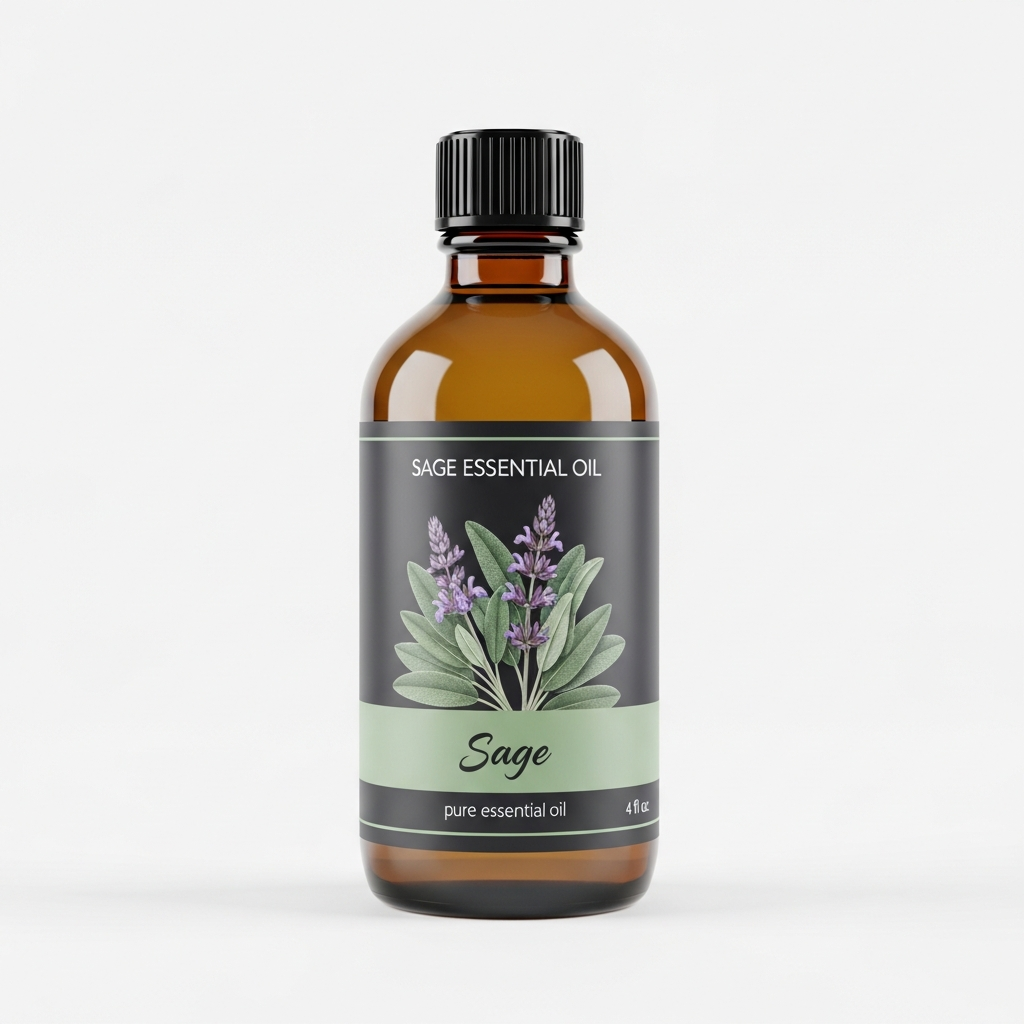
Sage Essential Oil
Sage Essential Oil from our own shop, in sizes from 0.5 oz to bulk.
From $13.99
Shop Now →Sources & Further Reading
- NHS. Headaches. nhs.uk/conditions/headaches
- Gobel H, Schmidt G, Soyka D, 1994. Effect of peppermint and eucalyptus oil preparations on neurophysiological and experimental algesimetric headache parameters. Cephalalgia 14(3):228-234. Europe PMC MED/7954745
- Sasannejad P et al., 2012. Lavender essential oil in the treatment of migraine headache: a placebo-controlled clinical trial. Eur Neurol 67(5):288-291. Europe PMC MED/22517298
- EMA/HMPC, 2016 (adopted 2010). Public statement on Salvia officinalis L., aetheroleum, EMA/HMPC/41843/2009. ema.europa.eu/EMA/HMPC/41843/2009
- EFSA FEEDAP Panel, 2024. Safety and efficacy of a feed additive consisting of an essential oil derived from the leaves of Salvia officinalis L. (sage oil). EFSA Journal 22(12):e9135. PMC11656093
- IFRA, 2020. IFRA Standard, Thujone, Amendment 49. ifrafragrance.org/standards/IFRA_STD_102
- Khine H et al., 2009. A cluster of children with seizures caused by camphor poisoning. Pediatrics 123(5):1269-1272. Europe PMC MED/19403490
- Halicioglu O et al., 2011. Toxicity of Salvia officinalis in a newborn and a child: an alarming report. Pediatr Neurol 45(4):259-260. Europe PMC MED/21907890
- FDA, 2023. Aromatherapy. fda.gov/cosmetics/cosmetic-products/aromatherapy
- Tisserand Institute, undated. Safety guidelines. tisserandinstitute.org/safety-guidelines