Essential Oils for Stress and Anxiety: What Trials Can Say
If you are in distress now, skip this article and call or text 988 in the United States, or call 911 in an emergency. Everything below is about a narrower question: what trials of scent and anxiety did, and what they did not show. Sage oil is not a product for stress or anxiety, and we make no such claim for it.
Help first, evidence second
The National Institute of Mental Health says that anyone suicidal or in emotional distress can use the 988 Suicide & Crisis Lifeline, which connects you with a trained crisis counsellor by call, text or chat, and that life-threatening situations call for 911 or the nearest emergency room. It adds that veterans can use the Veterans Crisis Line and that a primary care provider can do an initial mental health screening (NIMH, find help page). NIMH describes anxiety disorders as involving "more than occasional worry or fear," anxiety that "does not go away, is felt in many situations, and can get worse over time" (NIMH, last reviewed December 2024).
In England, the NHS says a GP can be seen if you think you might have generalised anxiety disorder, which may be diagnosed when you have felt anxious a lot of the time for at least six months. It says a GP will usually advise talking therapies, usually cognitive behavioural therapy, before medicine, and that adults can self-refer to NHS talking therapies without a GP (NHS, undated). Its page makes no statement about complementary treatments either way.
The evidence ladder, from strongest design down
1. A pooled review of lavender, the best-studied case
Donelli and colleagues searched through November 2018 and pooled 37 randomised trials with 3,964 participants. Inhaled lavender reduced anxiety on validated scales such as the STAI, and oral lavender oil capsules (Silexan 80 mg/day for at least six weeks) reduced scores on the Hamilton and Zung scales. Lavender massage also looked promising. The authors rate most included studies as low quality with a high risk of bias, and they judge that the inhaled effect has reasonable size but limited certainty (Donelli et al., Phytomedicine, 2019). Two cautions follow. The result is for lavender only, and the oral capsule is a manufactured pharmaceutical-style product, not a bottle of oil to sniff.
2. The overview of reviews
Lee and colleagues found 10 systematic reviews covering anxiety, depression, hypertension, pain and dementia and concluded that "the evidence is not sufficiently convincing that aromatherapy is an effective therapy for any condition," noting that most of the reviews were poor in method (Lee et al., Maturitas, 2012). That is older than the lavender review, which is a reasonable place to see a disagreement: the broader, earlier verdict is harsher than the later, narrower one.
3. The government summary
NCCIH's aromatherapy page describes a study comparing lemon and lavender scent in people under stress. Lemon had "a positive effect on mood" but "neither scent affected stress indicators" (NCCIH, last updated January 2020). So even a favourable report on mood separates the feeling from the measured stress markers.
How to read the next headline
This is our checklist, reasoned from the studies above rather than taken from any one of them. Ask which material was used (lavender, lemon, dried sage leaf, a capsule), which route (inhaled, massaged, swallowed), who was studied (healthy volunteers, hospital patients, rats) and what was measured (a feeling reported on a questionnaire, or a physiological marker). Then ask what the comparison group smelled. Each answer narrows what the result can say about your own situation, and the studies here narrow it a lot: the lemon-lavender report, for example, found a mood change and no change in stress indicators in the same people.
What studies of sage tested, and why they are not about a scent
Kennedy and colleagues gave 30 healthy adults placebo, 300 mg or 600 mg of dried Salvia officinalis leaf on separate days. Mood improved before a stressor task, and the lower dose lowered anxiety, but that effect disappeared during the stressor itself, and the lower dose reduced alertness and, later, performance (Kennedy et al., Neuropsychopharmacology, 2006). The material was dried leaf, the exposure was a measured dose, the participants were healthy adults, and the paper studied mood around a laboratory task, not anxiety as a condition. It is not evidence about inhaling sage oil.
On 29 October 2026 we ran a Europe PMC title-and-abstract search combining sage or Salvia, aromatherapy-type terms, and sleep, insomnia, anxiety, stress or headache terms: 89 records. We read the titles of the first 25 and found no trial of inhaled Salvia officinalis oil for stress or anxiety. The nearest were an anxiolytic study of Salvia heldreichiana in rats (a different species and animal) and clary sage work (another plant). We did not read the other 64.
Why we do not point anyone to sage for this
The reasons are specific to sage and have nothing to do with the evidence gap. The EMA's herbal committee says sage oil is "characterised by high levels of thujone," which it describes as toxic and capable of causing seizures at high doses (EMA/HMPC, adopted 2010, corrected 2016). EFSA classes sage oil as an irritant to skin and eyes and a dermal and respiratory sensitiser (EFSA FEEDAP, 2024). Our own process page says the oil is not for casual, generous use, to avoid it in pregnancy and breastfeeding, not to use it on or around children, to leave it alone with a seizure disorder, and to diffuse lightly.
Anxiety can also push people toward more of whatever feels like it helps: more drops, a longer session, a stronger blend. That is a reasoned observation, not a sourced finding, and it is the reason we would not offer sage as a coping tool. A person who is already anxious and doses by feel with an oil that has a thujone caution is a poor combination.
If you want a scent in a stressful week
A scent you like, in a ventilated room, with nobody pregnant, young or seizure-prone in it, is a preference. It is not a plan. For a herbal-fresh room scent, our diffuser post covers sage with its caution, and the sleep post and the evidence overview sit alongside this one. The FDA lists claims to address depression or anxiety among drug claims for aromatherapy products, a line we stay on the right side of (FDA, page current as of September 2023).
For symptoms that interfere with work, sleep or relationships, or that have lasted months, talk to a physician, a psychologist or another licensed mental health professional. We sell sage oil only, and it is not the answer here.
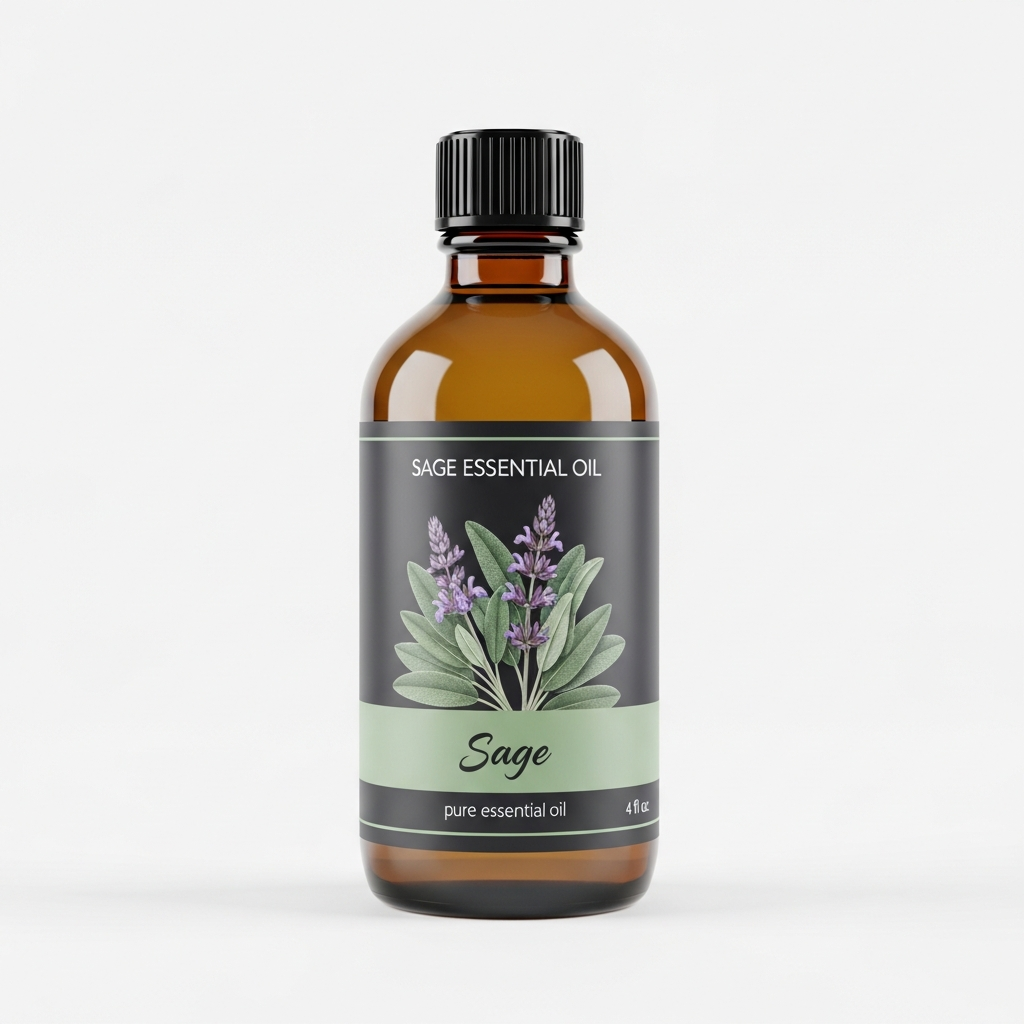
Sage Essential Oil
Sage Essential Oil from our own shop, in sizes from 0.5 oz to bulk.
From $13.99
Shop Now →Sources & Further Reading
- NIMH. Find help. nimh.nih.gov/health/find-help
- NIMH, reviewed December 2024. Anxiety disorders. nimh.nih.gov/health/topics/anxiety-disorders
- NHS. Generalised anxiety disorder in adults. nhs.uk/mental-health/conditions/generalised-anxiety-disorder
- Donelli D et al., 2019. Effects of lavender on anxiety: a systematic review and meta-analysis. Phytomedicine 65:153099. Europe PMC MED/31655395
- Lee MS, Choi J, Posadzki P, Ernst E, 2012. Aromatherapy for health care: an overview of systematic reviews. Maturitas 71(3):257-260. Europe PMC MED/22285469
- NCCIH, January 2020. Aromatherapy. nccih.nih.gov/health/aromatherapy
- Kennedy DO et al., 2006. Effects of cholinesterase inhibiting sage (Salvia officinalis) on mood, anxiety and performance on a psychological stressor battery. Neuropsychopharmacology 31(4):845-852. Europe PMC MED/16205785
- EMA/HMPC, 2016 (adopted 2010). Public statement on Salvia officinalis L., aetheroleum, EMA/HMPC/41843/2009. ema.europa.eu/EMA/HMPC/41843/2009
- EFSA FEEDAP Panel, 2024. Safety and efficacy of a feed additive consisting of an essential oil derived from the leaves of Salvia officinalis L. (sage oil). EFSA Journal 22(12):e9135. PMC11656093
- FDA, 2023. Aromatherapy. fda.gov/cosmetics/cosmetic-products/aromatherapy