
Sage Oil Uses: The Complete Guide for Home, Skin, and Aromatherapy
Key Takeaways
- Sage essential oil is steam-distilled from Salvia officinalis leaves and carries a sharp, herbal, slightly camphorous scent that grounds a room instantly.
- Quality sourcing matters enormously: look for GC/MS-tested oil with a clear country of origin and a disclosed thujone content.
- Always dilute to 1% or lower for most skin applications (roughly 5-6 drops per 30 ml of carrier oil).
- Sage oil blends beautifully with citrus, cedarwood, lavender, and rosemary for both aromatic and cosmetic applications.
- Pregnant individuals, nursing mothers, young children, and people with certain neurological conditions should avoid sage oil or consult a qualified healthcare provider before use.
- Home and cleaning applications are where sage oil truly shines with minimal safety complexity.
What Is Sage Essential Oil?
Sage essential oil comes from Salvia officinalis, the same broad-leafed garden sage that sits in every well-stocked kitchen herb rack. The oil is produced by steam distillation, which passes pressurized steam through harvested leaves and flowering tops, rupturing the tiny oil glands embedded in the leaf surface. That aromatic vapour condenses, separates from the water, and becomes the concentrated essential oil most of us know simply as sage oil.
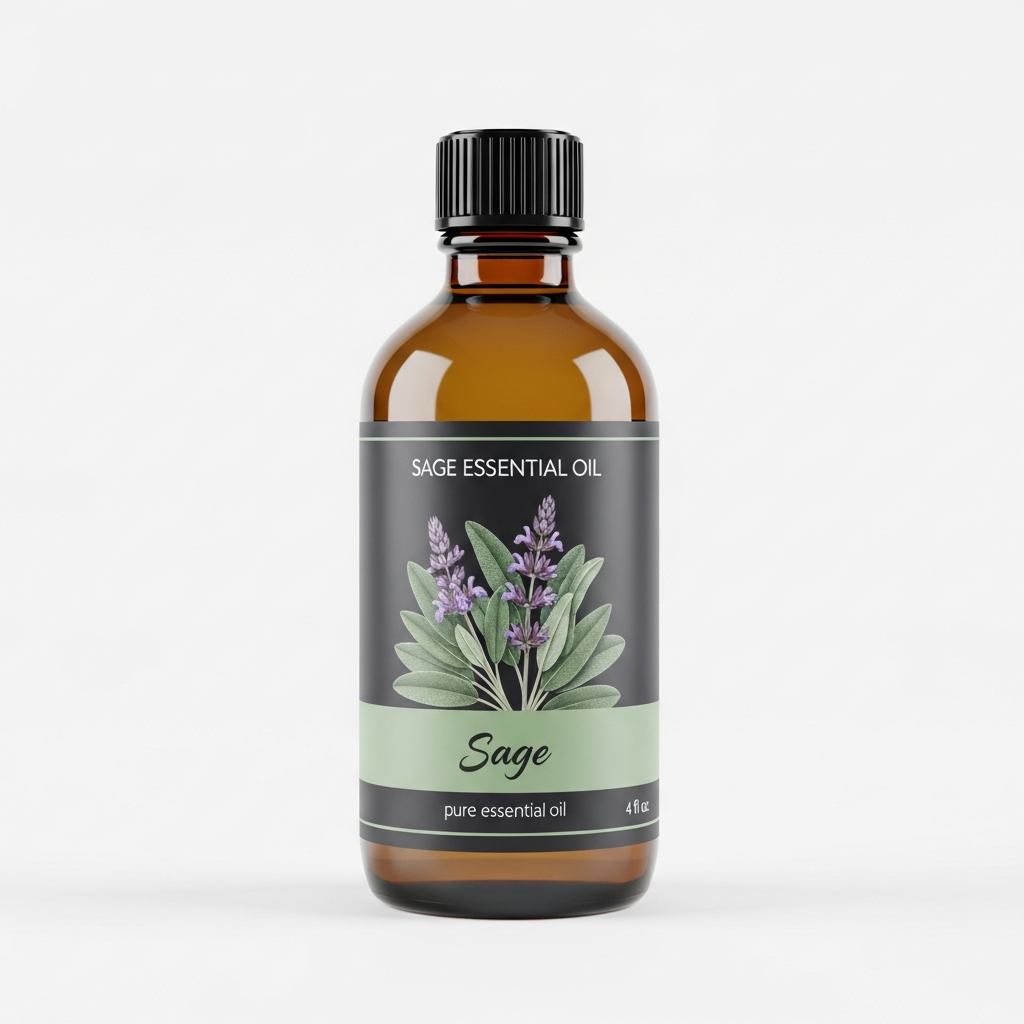
It is worth being precise about which sage you are working with. Salvia officinalis, sometimes called common sage or garden sage, is a very different plant from Salvia sclarea (clary sage) and from the white sage (Salvia apiana) used in Indigenous North American ceremony. Their chemical profiles, aromas, and safety considerations differ substantially. This guide focuses entirely on distilled garden sage (S. officinalis) oil.
The Chemistry Behind Sage Essential Oil Benefits
Garden sage oil is dominated by several key compounds: alpha-thujone and beta-thujone, camphor, 1,8-cineole, and borneol. The thujone content is the reason sage oil carries more safety caveats than many popular essential oils. Thujone is a ketone that can affect the nervous system at high concentrations, which is why dose awareness is non-negotiable with this oil.
The proportion of these compounds shifts depending on where and when the plant was harvested, the altitude, the climate of that particular growing season, and the distillation method used. A good supplier will share a GC/MS (gas chromatography/mass spectrometry) report so you can see exactly what is in the bottle you are buying. More on that in the sourcing section below.
A Note on Aroma
If you have only ever smelled dried sage in a spice jar, the essential oil will surprise you. It opens with a sharp, almost medicinal herbal note, followed by a warm camphor character, and then a dry, slightly earthy base. It is assertive. A little goes a long way in a diffuser blend or a cosmetic formula. That intensity is exactly what makes it so effective as a room-defining aromatic anchor.
| Property | Detail |
|---|---|
| Botanical name | Salvia officinalis |
| Plant part used | Leaves and flowering tops |
| Extraction method | Steam distillation |
| Colour | Pale yellow to colourless |
| Scent profile | Sharp, herbal, camphorous, warm, dry |
| Key chemical components | Alpha-thujone, beta-thujone, camphor, 1,8-cineole, borneol |
| Blends well with | Lavender, bergamot, cedarwood, lemon, rosemary, clary sage |
| Maximum skin dilution (IFRA guidance) | 0.4% for leave-on products; up to 1% for rinse-off |
Sage Oil in Aromatherapy: Scent, Atmosphere, and Ritual
Aromatic use is where most people first encounter sage oil, and for good reason. The scent has a way of immediately shifting the atmosphere of a room. People often describe it as grounding, clarifying, and herbal in the best possible sense: like stepping into a kitchen garden on a dry summer morning.
One of the core sage oil benefits in an aromatic context is its versatility across different daily rituals. It works as well in a focused morning diffuser blend as it does in an evening wind-down mist.
Diffusing Sage Oil
An ultrasonic or nebulizing diffuser is the most common way to work with sage oil aromatically. Because the scent is strong, start with just 2 drops of sage oil in a blend of 8 to 10 drops total. Sage pairs particularly well with citrus oils like bergamot or lemon, which soften its camphor edge, and with grounding base notes like cedarwood or frankincense.
For a practical starting point, try 2 drops sage, 4 drops bergamot, and 3 drops cedarwood in a 100 ml water-based diffuser. The bergamot lifts the blend, the sage anchors it with that characteristic herbal sharpness, and the cedarwood rounds off the base into something genuinely pleasant for extended diffusion.
You can explore a much wider range of diffuser combinations in our guide to sage oil in the diffuser: fresh herbal blends for a grounded atmosphere.
Room Mists and Linen Sprays
A sage oil room mist is one of the simplest and most satisfying ways to refresh a space. The classic approach is to dissolve your essential oils in a small amount of high-proof alcohol (such as 190-proof grain alcohol or perfumer's alcohol) before adding distilled water to the spray bottle. This step is important: oil and water do not mix, so without a solubiliser or alcohol, the oil will just float on top and potentially leave stains.
A basic room mist formula:
- 30 ml perfumer's alcohol
- 70 ml distilled water
- 15 drops sage essential oil
- 10 drops lemon essential oil
- 8 drops lavender essential oil
Shake before each use. Mist into the air, not directly onto fabrics, as sage oil can leave faint marks on delicate textiles.
For a dedicated room-reset ritual using sage oil mist, see our guide: a fresh start room ritual with sage oil mist, diffuse, and reset.
Sage Oil and Atmosphere: What People Report
Aromatic traditions around sage span multiple cultures and centuries. Anecdotal evidence and some preliminary research suggest that aromas from the sage family may support a sense of mental clarity during focused work or study. People report that diffusing sage oil during a morning work session helps them feel more present and less scattered. These are subjective, experiential observations rather than clinical outcomes, but they reflect consistent patterns in how users interact with the oil.
Some research suggests that compounds like 1,8-cineole, present in garden sage oil, may play a role in supporting cognitive function during aromatherapy exposure. The research is preliminary, and findings should be understood as interesting observations rather than established conclusions.
Sage Oil for Skin: Cosmetic Uses and Formulation Tips
Sage oil has a long history in herbal cosmetics, and its high thujone content is the reason formulation precision matters here more than with many other botanicals. The sage oil benefits for skin are real and observable in well-designed formulas, but the oil must be used at appropriate concentrations.
Appropriate Dilutions for Skin Use
The International Fragrance Association (IFRA) publishes usage guidelines based on safety assessments, and for garden sage oil, the recommended maximum for leave-on skin products (such as face serums, body oils, and lotions) is 0.4%. In practical terms, that means roughly 2 drops of sage oil per 30 ml of finished product. For rinse-off products like cleansers and body washes, the limit extends to around 1%.
These numbers may feel conservative. They are based on thujone exposure over repeated daily use, which accumulates. If you are making your own products and using them every day, staying within these limits protects you over the long term.
Skin Types That Tend to Work Well With Sage Oil
Sage oil is most commonly incorporated into formulas for oily, combination, and acne-prone skin profiles. The camphor and borneol content gives it a cooling, astringent character that many people with oily skin find appealing in a toner or lightweight serum. It is not typically the first choice for very dry or sensitised skin, where the sharp camphorous nature can feel harsh.
That said, formulation context matters. When sage oil is blended into a richer carrier like rosehip seed oil or squalane, the overall product may work for a wider range of skin types. The carrier softens the delivery of the more aggressive volatile components.
Cosmetic Applications Worth Exploring
- Facial toner: A few drops of sage oil dissolved in witch hazel (use a solubiliser like polysorbate 20 for a clearer formula) makes a refreshing, astringent toner. Keep the sage concentration at or below 0.4%.
- Body scrub: Sage oil at 0.5-1% in a salt or sugar scrub gives a vivid herbal scent and a light cooling sensation on the skin. Because scrubs are rinsed off, slightly higher concentrations are acceptable.
- Cleansing oil: A drop or two in a jojoba or sunflower cleansing oil blend adds aromatic complexity and suits the double-cleansing routine well. See our deeper look at sage oil for skin: fresh herbal notes in your cleansing routine.
- Deodorant formulas: Sage oil is a traditional inclusion in natural deodorant sticks and creams. Its characteristic scent profile is well-suited to this application, and many DIY formulators value it here.
Patch Testing: Always, Without Exception
Before using any sage oil product on your face or body for the first time, apply a small amount of the diluted formula to the inside of your elbow. Wait 24 hours. If you notice redness, itching, or irritation, discontinue use. This is especially important with sage oil given its relatively assertive chemical profile.
Sage Oil for Hair and Scalp
The scalp is skin, which means the same dilution principles apply. Sage oil has been used in herbal hair care traditions for a very long time, particularly in formulas aimed at oily scalp conditions and as a fragrant addition to herbal rinses.
Scalp Massage Blends
A pre-shampoo scalp massage with a sage-infused oil is a ritual that many people find grounding and pleasurable. Because the scalp is a relatively robust surface and the product is rinsed off, you can work with sage oil at around 1% dilution in this context.
A simple scalp massage blend:
- 30 ml jojoba oil (or a mix of jojoba and castor oil)
- 6 drops sage essential oil
- 4 drops rosemary essential oil
- 3 drops cedarwood essential oil
Apply to sections of dry or damp hair, massage into the scalp for 5 minutes, leave on for 20 to 30 minutes, then shampoo out thoroughly.
Herbal Hair Rinses
A sage herb rinse (using brewed sage tea rather than the essential oil) is a classic approach for adding shine and herbal freshness to darker hair tones. For those who prefer essential oils, a few drops of sage oil can be added to a final rinse of cool water, though a solubiliser such as polysorbate 20 is needed to disperse the oil evenly rather than leaving droplets sitting on the hair shaft.
For a full range of sage oil hair care ideas, including scalp massage techniques and rinse formulas, visit our guide to sage oil for hair: herbal scalp massage and rinse ideas.
Adding Sage Oil to Existing Hair Products
One of the lowest-effort ways to work sage oil into a hair care routine is simply adding a drop or two to your existing shampoo or conditioner, right in the palm of your hand before application. This keeps the concentration low (well under 1% at normal product amounts) and gives you the aromatic experience without the need to formulate from scratch.
Sage Oil Around the Home: Cleaning Sprays, Linen Mists, and More
This is arguably where sage essential oil benefits are easiest to access with the fewest safety considerations. Using sage oil in cleaning products, air fresheners, and home-fragrance applications does not involve skin contact or inhalation at concentrated levels. It is a genuinely accessible entry point for anyone new to essential oils.
Kitchen and Surface Sprays
Sage oil has been a favourite in herbal household cleaning formulas for generations. Its sharp, herbal scent is particularly well-suited to kitchen environments, where it complements rather than clashes with food aromas. A basic all-purpose kitchen spray using castile soap, water, and essential oils benefits from sage oil as a key aromatic component.
Basic kitchen surface spray:
- 250 ml distilled water
- 2 tablespoons liquid castile soap
- 15 drops sage essential oil
- 10 drops lemon essential oil
- 5 drops tea tree essential oil
Combine in a spray bottle. Shake before each use. Suitable for countertops, stovetop surrounds, and general kitchen surfaces. Avoid use on natural stone without testing a small area first, as the soap content can dull some sealants over time.
We have a full rundown of herbal spray formulas in our guide to sage oil in natural cleaning: herbal sprays for the kitchen.
Laundry and Linen Applications
A few drops of sage oil added to wool dryer balls is one of the simplest home fragrance applications there is. The heat of the dryer diffuses the oil gently through the load, leaving a subtle herbal freshness on fabrics. Use 3 to 5 drops per ball, applied about 10 minutes before the cycle ends to preserve the top notes.
For a linen spray (to mist over bedding, sofas, and curtains), the room mist formula described in the aromatherapy section above works well. Keep concentrations modest on delicate or light-coloured fabrics.
Candles and Wax Melts
For those who make their own candles or wax melts, sage oil is a rewarding fragrance component. It holds reasonably well in soy wax at standard fragrance loads (6-10% by weight). It is often more effective as part of a blend than as a solo note, since the camphor character can become monotonous at high concentrations. Pairing with lavender or cedarwood at a ratio of roughly 1 part sage to 3 parts other oils tends to produce a well-rounded, herbal candle fragrance.
Yoga Mats and Exercise Spaces
Sage oil is a popular inclusion in DIY yoga mat cleaning sprays. A simple formula of water, a small amount of witch hazel, and a few drops each of sage and tea tree oils in a spray bottle makes an effective mat refresh between sessions. The aromatic experience of unrolling a mat that carries a light herbal sage scent is something many practitioners genuinely look forward to.
Blending Sage Essential Oil: Pairings, Ratios, and Inspiration
Learning to blend with sage oil well is largely a process of learning what softens its intensity without erasing its character. Sage is a top-to-middle note oil: it registers immediately on the nose, but it does not linger as long as a true base note would. This means you need other oils in the blend to carry the scent forward over time.
Classic Pairings for Sage Essential Oil
| Companion Oil | Aromatic Effect | Suggested Ratio (Sage : Companion) |
|---|---|---|
| Bergamot | Softens camphor edge, adds a bright citrus lift | 1:3 |
| Lavender | Rounds out the herbal sharpness, adds a floral softness | 1:2 |
| Cedarwood (Atlas) | Adds a warm, woody base that anchors the blend | 1:2 |
| Lemon | Brings freshness and brightness, very kitchen-friendly | 1:3 |
| Rosemary | Deepens the herbal quality, adds a slightly resinous note | 1:1 |
| Frankincense | Adds depth and a smoky, sacred quality to the base | 1:2 |
| Clary Sage | Related but sweeter; bridges sage's sharp edge with something rounder | 1:2 |
| Peppermint | Intensifies the cool, fresh quality; very invigorating in a diffuser | 1:4 |
Three Ready-to-Use Blend Recipes
The Morning Focus Diffuser Blend
Designed for diffuser use in a workspace or study. Combine in the diffuser reservoir:
- 2 drops sage essential oil
- 3 drops rosemary essential oil
- 3 drops lemon essential oil
- 1 drop peppermint essential oil
Run for 30 minutes on, 30 minutes off. This is a stimulating blend, not one for late evenings.
The Grounding Evening Room Mist
This is a softer, calmer aromatic profile suited to later in the day:
- 3 drops sage essential oil
- 5 drops lavender essential oil
- 4 drops cedarwood essential oil
- 2 drops frankincense essential oil
Dissolve in 10 ml of perfumer's alcohol, add to 90 ml of distilled water in a spray bottle. Mist into the air before a wind-down routine.
The Herbal Kitchen Candle Blend
For a 200g soy wax candle at an 8% fragrance load (16g total fragrance):
- 4g sage essential oil
- 6g lemon essential oil
- 4g cedarwood essential oil
- 2g rosemary essential oil
Add to fully melted wax at around 65°C, stir thoroughly, and pour into a suitable container with a correctly sized wick.
For a much wider range of blend ideas, including citrus-heavy and wood-forward combinations, visit our detailed resource on 10 sage oil blends: citrus, cedar, and lavender pairings.
Safety, Dilution, and What to Watch Out For
Sage essential oil is one of the most chemically complex and potent oils in common use. Its safety profile deserves careful attention. None of what follows is intended as medical advice: always consult a qualified healthcare provider about your specific situation.
The Thujone Question
Thujone is the component in garden sage oil that generates the most discussion among aromatherapists and formulators. It is a bicyclic ketone, and at high concentrations it can act as a neurotoxin. The important context is that normal, diluted use of sage essential oil in cosmetics and aromatherapy does not expose you to anywhere near problematic thujone levels.
The concern arises primarily with undiluted oral ingestion (which should not happen with essential oils generally) and with very heavy, prolonged undiluted topical application. Standard cosmetic and aromatic use within IFRA guidelines is a different matter entirely. The key is sticking to recommended dilutions rather than reasoning that "more is more."
Who Should Exercise Extra Caution or Avoid Sage Oil
- Pregnant individuals: Sage oil is generally considered best avoided during pregnancy due to its ketone content and its traditional association with uterine stimulation. Consult a qualified healthcare provider before any use.
- Nursing mothers: Some research suggests that sage-family plants may influence milk production. Caution and professional guidance are warranted.
- Young children: Essential oils high in camphor and 1,8-cineole are not appropriate for use near or on young children. Keep diffusion away from rooms where infants and toddlers sleep or spend significant time.
- People with a history of neurological conditions: The thujone content is a specific reason to seek guidance from a healthcare provider before using sage oil aromatically or topically in this context.
- People taking certain medications: If you are on any prescribed medication, consult your healthcare provider before adding any essential oil to your regular routine.
Dilution Reference Table
| Application Type | Recommended Maximum Dilution | Approx. Drops per 30 ml Carrier |
|---|---|---|
| Leave-on face product (serum, oil) | 0.4% | 2 drops |
| Leave-on body product (lotion, body oil) | 0.4% | 2 drops |
| Rinse-off product (shampoo, body wash, scrub) | 1% | 6 drops |
| Pre-wash scalp massage oil | 1% | 6 drops |
| Room spray / linen mist | 1-2% of water phase | Varies by bottle size |
| Diffuser blend (100ml reservoir) | 2 drops sage in a 10-drop total blend | N/A |
| Candle or wax melt | Per standard fragrance load; follow wax manufacturer guidelines | N/A |
General Safety Practices
- Never apply undiluted (neat) sage oil directly to skin.
- Keep all essential oils out of reach of children and pets.
- Store sage oil in a tightly sealed amber or dark glass bottle, away from heat and direct light. Properly stored, it retains quality for 2 to 3 years.
- If sage oil contacts eyes, rinse with a fatty carrier oil (such as sweet almond oil) first to help remove it, then flush with water. Seek medical attention if irritation persists.
- Diffuse in a well-ventilated room. Continuous, all-day diffusion of any essential oil is not recommended.
The information in this guide is for educational and cosmetic purposes only. Nothing here constitutes medical advice. Consult a qualified healthcare provider for any health-related questions before incorporating new essential oils into your routine.
How to Buy Sage Essential Oil: Sourcing and Quality Markers
The essential oil market has a transparency problem. Labels vary wildly in how much useful information they convey, and the phrase "100% pure" is essentially unregulated. Knowing what to look for protects your investment and, more importantly, your safety.
What a Quality Label Should Tell You
- Botanical name: It should say Salvia officinalis, not just "sage." This distinguishes it from clary sage (S. sclarea), white sage (S. apiana), and other relatives.
- Country of origin: High-quality garden sage oil is commonly produced in the Balkans (particularly Dalmatia in Croatia), France, and parts of the Mediterranean. The origin tells you something about the likely growing conditions and traditional cultivation methods.
- Extraction method: Steam distillation. If this is not listed, ask the supplier.
- Batch number and GC/MS testing: A reputable supplier will either publish GC/MS reports on their website or provide them on request. This report shows you the actual chemical composition of the oil in that specific batch.
- No additives or diluents: The ingredient list should contain only the oil itself. Any additional carriers or synthetic fragrance components should be explicitly disclosed.
Price as a Quality Indicator
Sage essential oil is not among the most expensive oils on the market. A small 10 ml bottle should cost somewhere between $8 and $20 USD from a reputable supplier, depending on origin and quality tier. Prices significantly below this range often indicate adulteration with cheaper solvents or rectified (chemically altered) oil. Prices significantly above this range are not necessarily indicators of superior quality: they may simply reflect premium branding.
Organic vs. Conventional
Certified organic sage oil is available and worth considering if you plan to use the oil extensively in leave-on skin formulas. The certification process ensures that the plant material was grown without synthetic pesticides. However, it does not automatically mean higher aromatic quality or a superior GC/MS profile. Organic certification and chemical purity testing are complementary pieces of information, not substitutes for each other.
Dalmatian Sage: A Note on Regional Prestige
Sage oil from Dalmatia (the coastal region of Croatia) has a long-standing reputation among perfumers and formulators for its aromatic quality. Dalmatian sage oil tends to have a well-balanced thujone-to-camphor ratio and a particularly clean, sharp herbal profile. If you can find a verified Dalmatian origin oil with a current GC/MS report, it is generally considered a benchmark against which other garden sage oils are measured.
That said, quality French sage and Spanish sage oils are also highly regarded, and origin alone should not be the only purchasing criterion. A GC/MS report from a Dalmatian oil will always tell you more than the geography on the label.
Storing Your Sage Oil Correctly
Once you have found a quality oil, storage matters. Sage oil oxidises over time, and oxidised oils are more likely to cause skin sensitisation. Keep your bottle in a cool, dark location (a drawer or cabinet away from windows and heat sources is ideal). Refrigeration is an option for long-term storage, though you should allow the oil to come to room temperature before use, as cold thick oil is harder to measure accurately.
Write the purchase date on the bottle. Most garden sage essential oil maintains its character for 2 to 3 years under good storage conditions. After this point, it may still be usable for cleaning or candle applications, but skin and aromatic use is best reserved for fresher oil.
Putting It All Together: Building a Sage Oil Practice
Sage essential oil rewards the curious and the patient. Its scent is not immediately easy in the way that lavender or sweet orange are easy. It takes a little time to learn how it sits in a blend, how much is enough in a room spray, and which carrier oils work best with it in a scalp formula. That learning process is genuinely enjoyable.
Start with your diffuser and a simple 3-oil blend. Get comfortable with the scent before moving to skin applications. When you are ready to explore cosmetic use, begin with a rinse-off product like a body scrub or shampoo add-in, where the dilution parameters are slightly more forgiving than leave-on formulas.
The sage oil benefits that people return to again and again are largely aromatic and atmospheric: the way it sharpens a space, the herbal freshness it brings to a kitchen spray, the grounding quality of a cedarwood-and-sage evening diffuser blend. These are accessible pleasures that require no special expertise, just good oil and a little curiosity.
Whether you are building your first essential oil shelf or adding sage to an already sophisticated collection, the most important things are sourcing well, diluting correctly, and paying attention to how the oil works with your formulas and your senses over time.