Thujone in Sage Oil: What It Is and Why It Matters
Ask a perfumer, a toxicologist and a regulator about sage oil and you tend to get the same one-word answer: thujone. It is the compound that gives garden sage oil much of its character and the one that sets the limits for how we use it, so it is worth understanding properly before the first bottle is opened.
What thujone is
Thujone is a ketone found in two forms, alpha and beta, in sage, wormwood, cedarleaf and tansy among other plants. Perfumers even use "thujonic" as a word for a family of impressions: herbaceous, minty, camphoraceous, green, warm and spicy all at once. In his 2002 piece for Perfumer & Flavorist, Michael Britten-Kelly notes that the smell of thujone on its own seems inseparable from the oils that carry it.
The reason it also draws attention from regulators is how it behaves in the body at high doses. A 2000 study in PNAS found that alpha-thujone modulates the GABA type A receptor, a signalling channel in the nervous system: it suppressed GABA-driven currents in rat neurons, and poisoned mice showed signs similar to those of a classic blocker of that receptor. That fits with seizures, rather than skin reactions, being the concern regulators name.
How much is in the oil
There is no single number, because sage oil varies with where the plant grew and when it was harvested. The European Medicines Agency's assessment report lists alpha-thujone at 10 to 60% and beta-thujone at 4 to 36%, and describes the composition as very variable. EFSA analysed five batches of one supplier's sage oil and found alpha-thujone averaging 24.96% and beta-thujone 5.60%, so about 30.6% thujone in total, alongside 18.74% camphor and 10.70% 1,8-cineole.
For scale, a drop of about 0.05 ml weighs roughly 0.046 g at a relative density of 0.915, which is the figure on the Certificate of Analysis we publish for one batch. At 30.56% thujone that drop carries about 14 mg of it. That is arithmetic from a sample oil, not a measurement of ours, but it shows why sage is used in drops rather than splashes.
What the authorities have actually said
No body has set a skin or room limit for sage oil sold for aromatherapy, so the useful guidance comes from neighbouring fields.
- EMA, 2016. The agency's herbal committee states that sage oil is characterised by high levels of thujone and that "Thujone is toxic and may cause seizures at high doses as shown in animal studies and indicated from case reports." For sage leaf preparations taken by mouth it allows 6.0 mg of thujone per person per day for at most two weeks. That is a limit for oral herbal medicines, not for skin or air, but it gives a sense of scale against the 14 mg in one drop. Its assessment report also repeats reference-book guidance that sage oil is a moderate skin irritant and not recommended for aromatherapy.
- IFRA, 2020. The fragrance industry's thujone standard sets a maximum for thujone in finished products, from 0.0053% to 9.5% depending on the product category, with neurotoxicity named as the property driving the limit.
The IFRA numbers translate easily into sage oil. Divide the thujone limit by the share of thujone in the oil and you have the most sage a product can hold. At 30.56% thujone, a body oil applied by hand (limit 0.095%) can hold about 0.31% sage oil, a facial moisturiser (0.032%) about 0.1%, and a candle (9.5%) about 31%. If an oil sits at the top of the EMA ranges, about 96% combined, the body oil figure falls to about 0.1%.
Why this is the right thing to know first
Many oils can be used by feel. You open the bottle, smell it, add a drop or two, and adjust. Sage asks you to slow down. We think that is part of its character: it is an oil for people who like to weigh, write things down and work from a plan. If that sounds like you, you will probably enjoy it, because the dry, green, camphor-edged aroma rewards a careful hand.
It also helps to know what thujone is not. It is not a flaw in the oil, and it is not something to be afraid of in a bottle that is handled sensibly. It is simply a strong ingredient, and strong ingredients earn small amounts.
What this means for how we use sage
Our skin guidance for sage is 0.5% to 2% in a carrier oil, with a patch test first. The thujone sums come out below the top of that range for body products, so we begin at the low end, we do not treat 2% as a target, and we encourage you to read the IFRA standard against your own formulation. Our process page puts the human side plainly: sage is high in thujone and not an oil for casual, generous use. Avoid it during pregnancy and breastfeeding, do not use it on or around children, and leave it alone if you have a seizure disorder. Diffusing needs a lighter hand than you would use with a mint or a citrus.
It also explains why we are careful about what we say about our own oil. The Certificate of Analysis we publish for one batch names Salvia officinalis, steam distilled leaf, and lists density, refractive index and optical rotation. It has no constituent figures, so it cannot tell you the thujone share of any bottle. If that number matters for what you plan to make, perhaps because of pregnancy, a seizure disorder, children in the home or a workplace limit, ask us in writing through the contact page before you order and we will tell you what we can document.
Our article on sage oil in pregnancy and breastfeeding and the one on reading a sage GC-MS report take up the two questions this one raises most.
Once you know the number behind the rules, sage gets easier to work with, not harder.
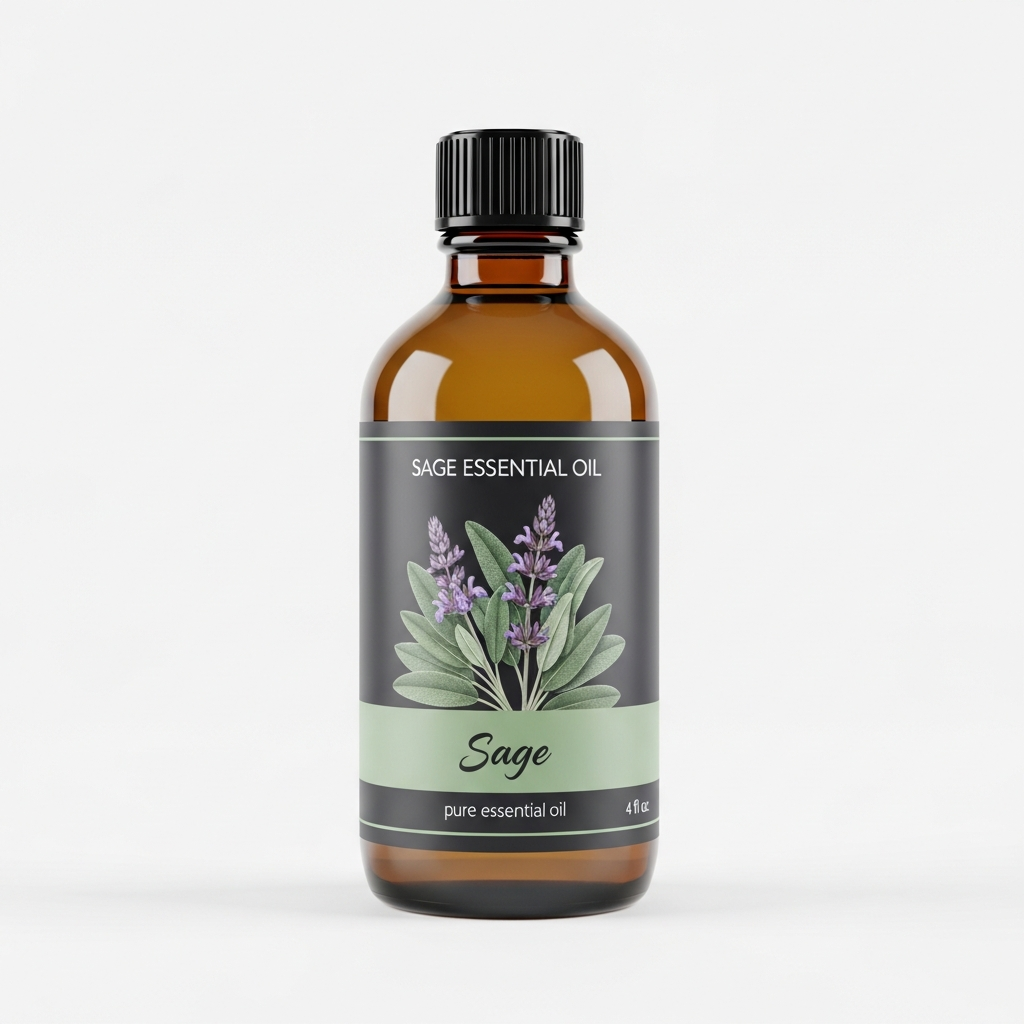
Sage Essential Oil
Sage Essential Oil from our own shop, in sizes from 0.5 oz to bulk.
From $13.99
Shop Now →Sources & Further Reading
- Höld KM et al., 2000. Alpha-thujone (the active component of absinthe): gamma-aminobutyric acid type A receptor modulation and metabolic detoxification. Proc Natl Acad Sci U S A. PubMed 10725394
- Britten-Kelly M, 2002. New Aroma Chemicals: Thujone Alternatives. Perfumer & Flavorist 27(3). perfumerflavorist.com
- EMA/HMPC, 2016. Public statement on Salvia officinalis L., aetheroleum (EMA/HMPC/41843/2009 Corr. 1). ema.europa.eu
- EMA/HMPC, 2016. Assessment report on Salvia officinalis L., folium and Salvia officinalis L., aetheroleum (EMA/HMPC/150801/2015). ema.europa.eu
- EFSA FEEDAP Panel, 2024. Safety and efficacy of a feed additive consisting of an essential oil derived from the leaves of Salvia officinalis L. (sage oil) for use in all animal species (FEFANA asbl). EFSA Journal. PMC11656093
- IFRA, Thujone, IFRA Standard, Amendment 49 (2020). ifrafragrance.org/standards/IFRA_STD_102.pdf