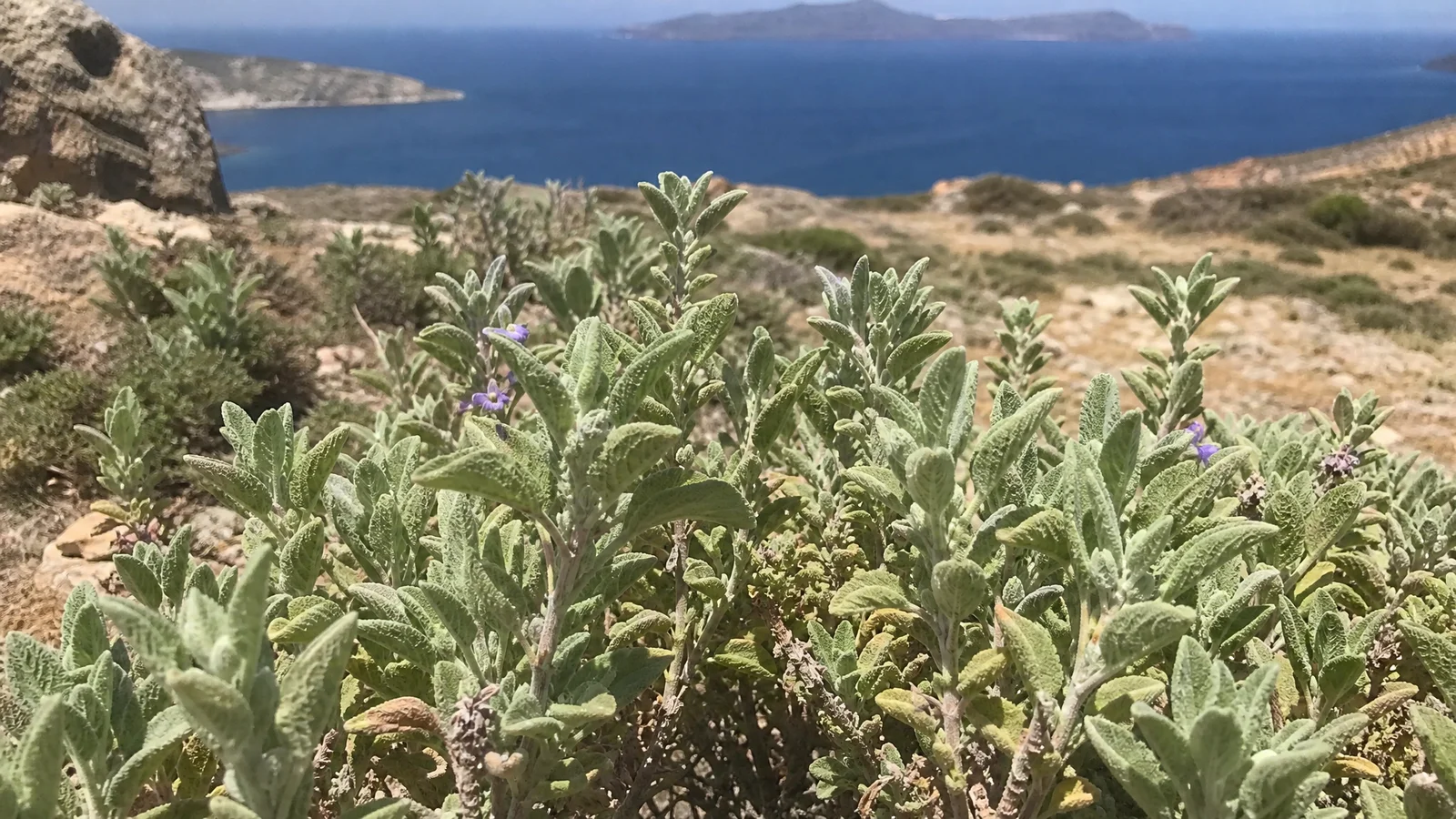
Spanish, Greek and Garden Sage Oil Compared
Walk through a few essential oil listings and you will find "sage oil" on all of them, and they are not always the same plant. Garden sage, Spanish sage and Greek sage are three Mediterranean shrubs whose oils are built differently, and the Latin name is the line on a label that tells them apart. We sell garden sage, Salvia officinalis, so this is a comparison for the curious and for anyone who buys sage oil in more than one place.
Three plants, three chemistries
Published figures come from different samples, so read the numbers as a map of the territory rather than a specification for any bottle.
| Garden sage | Spanish sage | Greek sage | |
|---|---|---|---|
| Latin name | Salvia officinalis | Salvia lavandulifolia (also written lavandulaefolia) | Salvia fruticosa (formerly S. triloba) |
| Home range | Mediterranean region | Iberian Peninsula, south-east France, north-west Africa | Sicily and southern Italy, the Balkans and Greece, east to western Syria |
| 1,8-cineole | 5.5 to 13% (ISO range) | 10 to 30% (ISO range) | 40 to 67% |
| Thujone | 18 to 43% alpha-thujone (ISO range) | not part of the ISO range | under 5% |
Taxonomy is not entirely settled either. The 2022 review by Karalija and colleagues treats Spanish sage as a subspecies of S. officinalis, while the ISO standard for its oil uses the species name lavandulifolia, so you may meet any of those spellings on a listing.
What the differences mean in practice
The big story is cineole against thujone. Garden sage is a thujone oil. Greek sage swings the other way, with EMA's draft report putting 1,8-cineole at 40 to 67% and thujone under 5%. Spanish sage sits in between, with a good deal of cineole and camphor. PubChem describes 1,8-cineole's odour as camphor-like, so it is reasonable to expect the cineole-rich oils to lean toward a clearer, more eucalyptus-adjacent camphor note than garden sage does. That is reasoning from the chemistry, not a scent panel.
The chemistry also changes the sums that keep a formulation sensible. IFRA caps thujone rather than oil, so an oil with less thujone can be used at a higher oil percentage before reaching the same cap. In a rinse-off cleanser category (0.13% thujone), garden sage at about 30.6% thujone, the average EFSA found across five batches of one oil, reaches the cap at roughly 0.43% oil. Greek sage at the 5% ceiling would reach it at about 2.6%. Low thujone does not mean free of other considerations, though: cineole and camphor have their own handling notes, and EMA's draft report also says the data are insufficient to state the safety of Greek sage in pregnancy and lactation. It simply moves the number around.
Every sage oil also moves within its own species. The EMA report on garden sage calls its composition very variable depending on source and harvest time, and Karalija reports that thujone levels differ significantly within garden sage depending on where it grew, so only some oils meet the ISO range for Dalmatian sage. A Latin name narrows the field. It does not hand you a number.
Why this matters to a maker
If you make soap, candles or body products, the name on the bottle is the first thing you plan around. A recipe built for one sage will not automatically suit another, and a scent you loved in one bottle may surprise you in a different one. That is the reason we like to keep our own listing simple and name the plant plainly.
When you try a new sage oil from any seller, smell it on its own before you put it in anything. Note how it opens, how it settles after ten minutes, and whether it leans toward the cool, eucalyptus side or the dry, camphor-and-green side. Keep a small note beside the bottle with the date and the Latin name, so you can compare it with your next one.
Reading a label
Under US food rules the three oils are listed separately as sage, Greek sage and Spanish sage, but a cosmetic-oil label is not obliged to follow that, and a bottle may simply say "sage essential oil". Three questions sort most listings quickly:
- Is the botanical name printed, and is it the plant you meant to buy?
- Is there a batch GC-MS report that lists thujone and 1,8-cineole? Those two figures separate the three plants almost at a glance.
- Does the seller state the part used, such as leaf, and the origin?
Our guide to reading a sage GC-MS report shows how to read one, and buying sage oil takes the labelling questions further.
Where our oil fits
The Certificate of Analysis we publish for one batch names Salvia officinalis, leaf, steam distilled, and lists appearance, smell, density, refractive index and optical rotation. It carries no thujone or cineole figures, so it can describe the batch but cannot be used to tell garden sage from another sage by chemistry. We sell garden sage in two listings and no Spanish or Greek sage; for those, look for a supplier that prints the Latin name and a batch GC-MS report. Our process page asks you to keep the dilution low and to avoid sage oil in pregnancy and breastfeeding, around children, and with a seizure disorder. That caution is written for our garden sage.
For the scent side of the comparison, what sage oil smells like is the place to go, and clary sage versus common sage covers the sweeter relative that shares the genus.
Three sages, three personalities, and a good reason to read the label before you fall for the name.
Sage Essential Oil
Sage Essential Oil from our own shop, in sizes from 0.5 oz to bulk.
From $13.99
Shop Now →Sources & Further Reading
- Karalija E et al., 2022. Influence of Climate-Related Environmental Stresses on Economically Important Essential Oils of Mediterranean Salvia sp. Front Plant Sci. PMC9114806
- EMA/HMPC, 2015. Assessment report on Salvia fruticosa Mill., folium (draft, EMA/HMPC/599992/2014). ema.europa.eu
- EMA/HMPC, 2016. Assessment report on Salvia officinalis L., folium and Salvia officinalis L., aetheroleum (EMA/HMPC/150801/2015). ema.europa.eu
- EFSA FEEDAP Panel, 2024. Safety and efficacy of a feed additive consisting of an essential oil derived from the leaves of Salvia officinalis L. (sage oil) for use in all animal species (FEFANA asbl). EFSA Journal. PMC11656093
- IFRA, Thujone, IFRA Standard, Amendment 49 (2020). ifrafragrance.org/standards/IFRA_STD_102.pdf
- US Code of Federal Regulations, Title 21, section 182.20, Essential oils, oleoresins (solvent-free), and natural extractives (including distillates) (eCFR). eCFR
- PubChem, 1,8-Cineole (CID 2758), Odor section. pubchem.ncbi.nlm.nih.gov/compound/2758