Clary Sage vs Sage Oil: What Sets Them Apart
If you line up a bottle of clary sage oil and a bottle of garden sage oil, the labels look like cousins and the chemistry says otherwise. In the batches EFSA characterised in 2024, garden sage oil was about 30 percent thujone and 19 percent camphor, while clary sage oil was about 68 percent linalyl acetate with no thujone detected at all. We sell garden sage, so we want to be clear about what that means: these are two different oils that happen to share a first name.
What the published batches show
EFSA's feed-additive panel assessed both oils from gas chromatography results supplied by each applicant. Those are one applicant's batches rather than a statement about every bottle, but side by side they tell the story well.
| Garden sage (Salvia officinalis) | Clary sage (Salvia sclarea) | |
|---|---|---|
| Plant part | Leaves, steam distilled | Flowering stems, steam distilled |
| Main constituents | Alpha-thujone 25%, camphor 19%, 1,8-cineole 11%, beta-thujone 6% | Linalyl acetate 68%, linalool 15% |
| Thujone | About 30.6% combined | Not detected |
| Density at 20 C | 0.915 to 0.916 | 0.895 to 0.900 |
Garden sage is a camphoraceous, herbaceous oil; the panel describes its aroma as camphoraceous with a spicy note (EFSA, sage oil). Clary is an ester-rich oil led by linalyl acetate and linalool (EFSA, clary sage oil). In practice that means the two oils are not substitutes in a blend, a perfume brief or a safety calculation.
Misconception one: sage is sage
The two plants share a genus, and even the regulations keep them apart. The US list of essential oils recognised for food flavouring gives garden sage, Spanish sage and clary separate entries (21 CFR 182.20). Within garden sage oil the thujone itself varies widely: the European Medicines Agency quotes literature ranges of 10 to 60% alpha-thujone and 4 to 36% beta-thujone (EMA/HMPC). So the plant name matters, and so does the batch.
Misconception two: clary must be the gentle one
Because thujone is the headline concern with garden sage, it is tempting to treat clary as the harmless version. The sources do not quite say that. EFSA's wording for both oils is that they should be considered irritants to skin and eyes and dermal and respiratory sensitisers; for clary that conclusion rests on the applicant's safety data sheet. Lacking thujone removes one specific concern. It does not turn a concentrated oil into a casual one, and the sources we read say nothing about clary in pregnancy, so anyone pregnant or breastfeeding should ask an obstetric clinician or midwife about either oil. Our own position on garden sage is to avoid it in pregnancy and breastfeeding, and the sources are in our pregnancy article.
What a certificate can and cannot tell you
Density is the quick screen. Garden sage sits at 0.915 to 0.916 in EFSA's data and clary at 0.895 to 0.900, ranges that do not overlap. The Certificate of Analysis we publish for one batch of our garden sage gives a relative density of 0.915, which sits with garden sage. Refractive index separates them less cleanly: clary's six batches ran 1.4572 to 1.4698, which includes the 1.469 on our certificate. Physical constants are a screen, not an identification. Only a gas chromatography report with a batch number shows what is in a bottle, and if you need one for our oil, ask us in writing through the contact page before ordering. Our GC-MS article shows how to read one.
Reading labels for either oil
A bottle labelled only "sage" could be garden sage, clary or Spanish sage, so a label that gives the Latin name is the one to trust. Composition also moves within a species. A 2023 study of a clary oil from a Slovak supplier found 49.1% linalyl acetate and 20.6% linalool (Kačániová et al.), lower on the first than EFSA's three batches. The right question for a seller is always what the report for this batch says. If clary is what you want, our clary buying article sets out the label checks.
Smelling the two side by side
If you ever have both bottles on the table, use paper strips: one for each, labelled, and smell them a few minutes apart rather than back to back so one does not drown out the other. Our Botanical listing is herbaceous, earthy and camphoraceous, and our Purity listing is fresh and green with a peppery edge. You'll notice that you reach for different words for each oil, and that is the clearest sign they are not interchangeable.
A note from us, as people who sell only one of them: if a recipe says "sage" and you are not sure which sage it means, check the Latin name in the recipe or ask the author before you pour anything. It is a small question that can save a whole bottle.
Which one do you want
Decide first which plant someone means. A recipe or a friend who says "sage" might mean either. If it is garden sage, the rules in our thujone article apply: a low dilution, no face, nothing for children, and no use in pregnancy or with a seizure disorder. If it is clary, buy it from a supplier who sells clary; we do not. And whichever you choose, redo the arithmetic for that oil rather than carrying a number across, because the numbers in the table above are different numbers.
Two oils, two personalities, and a good reason to read the Latin name every time.
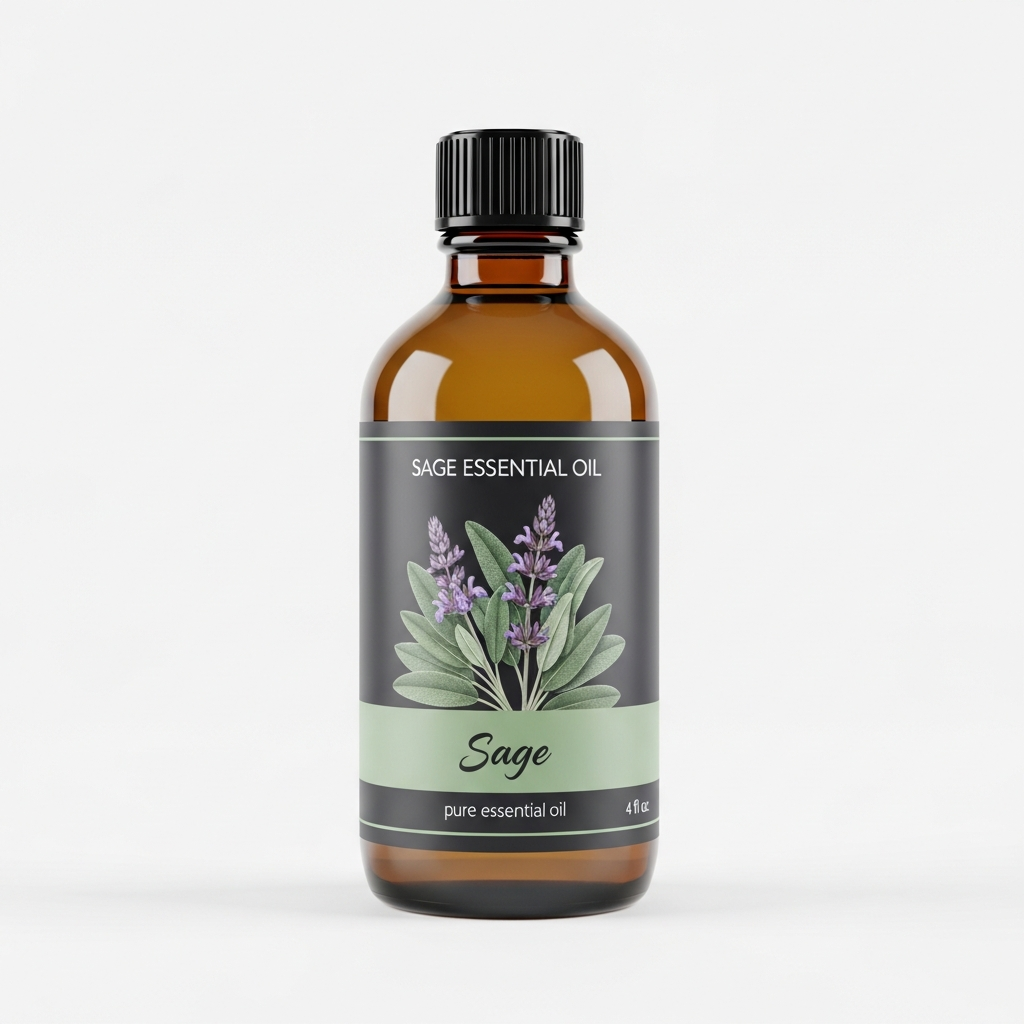
Sage Essential Oil
Sage Essential Oil from our own shop, in sizes from 0.5 oz to bulk.
From $13.99
Shop Now →Sources & Further Reading
- EFSA FEEDAP Panel, 2024, Safety and efficacy of a feed additive consisting of an essential oil derived from the leaves of Salvia officinalis L. (sage oil) for use in all animal species (FEFANA asbl)
- EFSA FEEDAP Panel, 2024, Safety and efficacy of a feed additive consisting of an essential oil derived from the flowering stems of Salvia sclarea L. (clary sage oil) for use in all animal species (FEFANA asbl)
- EMA/HMPC, 2016, Assessment report on Salvia officinalis L., folium and Salvia officinalis L., aetheroleum
- Kačániová M et al., 2023, Salvia sclarea Essential Oil Chemical Composition and Biological Activities, International Journal of Molecular Sciences
- US Government, 21 CFR 182.20: Essential oils, oleoresins (solvent-free), and natural extractives (including distillates)