GC-MS Report Explained: What the Numbers Mean for Sage
A GC-MS report is an essential oil's fingerprint: a long list of compounds, each with a percentage beside it. It looks authoritative, and it is, once you know what the numbers mean and what they do not. Sage makes a very good teaching example, because its most talked-about compound, thujone, is the one number worth finding on the page.
What the percentages are
Gas chromatography sorts an oil into its volatile compounds as they travel through a long, heated column at different speeds. A flame ionisation detector (FID) measures how much of each compound comes through, and a mass spectrometer (MS) helps identify what each one is. Many labs run both.
The percentages are usually shares of total peak area, not of weight. The Dalmatian sage standard, ISO 9909, says the proportions are those "indicated by the integrator" (ISO 9909:1997, Oil of Dalmatian sage (Salvia officinalis L.)), and the European Food Safety Authority states its own results as percent of gas chromatographic peak area, assuming all detected peaks add up to 100%. Different compounds can give a detector different signals per gram, so area percent and weight percent are close relatives, not twins. "25% alpha-thujone" is best read as "about a quarter of the peak area".
Same species, different pages
Here are the four sage markers as three published analyses report them, each as percent of peak area.
| Compound | EFSA, GC-FID (5 batches, mean) | EFSA, GC-MS (mean) | Tunisian leaf oil, GC-MS |
|---|---|---|---|
| Alpha-thujone | 24.96 | 20.48 | 18.83 |
| Beta-thujone | 5.60 | 5.61 | 4.46 |
| Camphor | 18.74 | 17.58 | 25.14 |
| 1,8-Cineole | 10.70 | 10.63 | 14.14 |
The sources are the EFSA opinion on sage oil (Safety and efficacy of a feed additive consisting of an essential oil derived from the leaves of Salvia officinalis L. (sage oil) for use in all animal species (FEFANA asbl)) and a Tunisian study (Chemical composition and biological activities of Salvia officinalis essential oil from Tunisia).
Look at the two EFSA columns. EFSA's sage oil reads about 25 for alpha-thujone by FID and about 20 by MS, a gap of several points from the detector alone. So a report that does not say which detector produced its numbers is hard to compare with another. The Tunisian oil, meanwhile, is led by camphor, and the same paper reviews earlier Tunisian sage oils whose top component was 1,8-cineole at 33%. The EMA's assessment report puts it plainly, calling the composition very variable with source and harvest (Assessment report on Salvia officinalis L., folium and Salvia officinalis L., aetheroleum). One report describes one batch.
A reading order that works
- Identity. A lot number, the Latin name and a date, so the report can be tied to a bottle.
- Method. FID, MS or both.
- How much is accounted for. That study identified 49 compounds making up 97.97% of the oil. A table that sums to 60% leaves a lot unexplained.
- The markers. For sage: both thujones, camphor and 1,8-cineole. Everything else is context.
Turning thujone into milligrams
This is the useful trick. Add alpha and beta thujone: in EFSA's GC-FID data that is 24.96 plus 5.60, or 30.56% of the oil. One drop is roughly 0.05 ml, which at a density of 0.915 (the density on the Certificate of Analysis we publish for one batch) weighs about 46 mg, so a drop holds roughly 14 mg of thujone. That is arithmetic, a rough orientation since the percentages are area-based, and it is worth weighing rather than counting drops.
The number matters because safety limits are written as thujone in the finished product. IFRA's thujone standard, for instance, allows 0.095% thujone in a body lotion (Category 5A) (IFRA Standard, Thujone, 2020 (Amendment 49)). Divide by 0.3056 and you get about 0.31% sage oil in that lotion, which is lower than our general skin range of 0.5% to 2%, so we start at the low end and ask you to check the standard for your own product. IFRA's guidance treats aromatherapy applications as out of scope, so this is a reference point rather than a permit. A report that says only "thujone present" cannot do this job. You need the percentage, the method and the unit.
One habit we recommend: when a report arrives, circle the lot number before you read anything else. If you cannot find one, nothing else on the page can be tied to the bottle in your hand.
Where our certificate fits
The Certificate of Analysis we publish is for one batch, number SAGHMCSOESC001A, and it reports physical constants: relative density 0.915, refractive index 1.469 and optical rotation of -10 degrees at 20 C, plus appearance and smell. Those are useful checks of identity and consistency. It is a different tool from GC-MS, and if you need composition data, for pregnancy, a seizure disorder or a workplace limit, please ask us in writing through the contact page before ordering and take the answer to your doctor or safety adviser.
What GC-MS cannot do
It is not a lie detector. A 2024 review of analytical methods notes that essential oils vary with harvest season and extraction, that adulteration is widespread, and that quality assessment therefore draws on several techniques (Advanced analytical techniques for authenticity identification and quality evaluation in Essential oils: A review). In practice: a report with all four sage markers in a plausible window is consistent with sage oil, and one with a marker far out of line is a reason for questions, not a verdict. Our articles on buying sage oil, thujone safety and what grade words mean pair well with this one.
Before you order from anyone, ask which lot the report covers, which detector was used and who ran it. Good suppliers enjoy those questions.
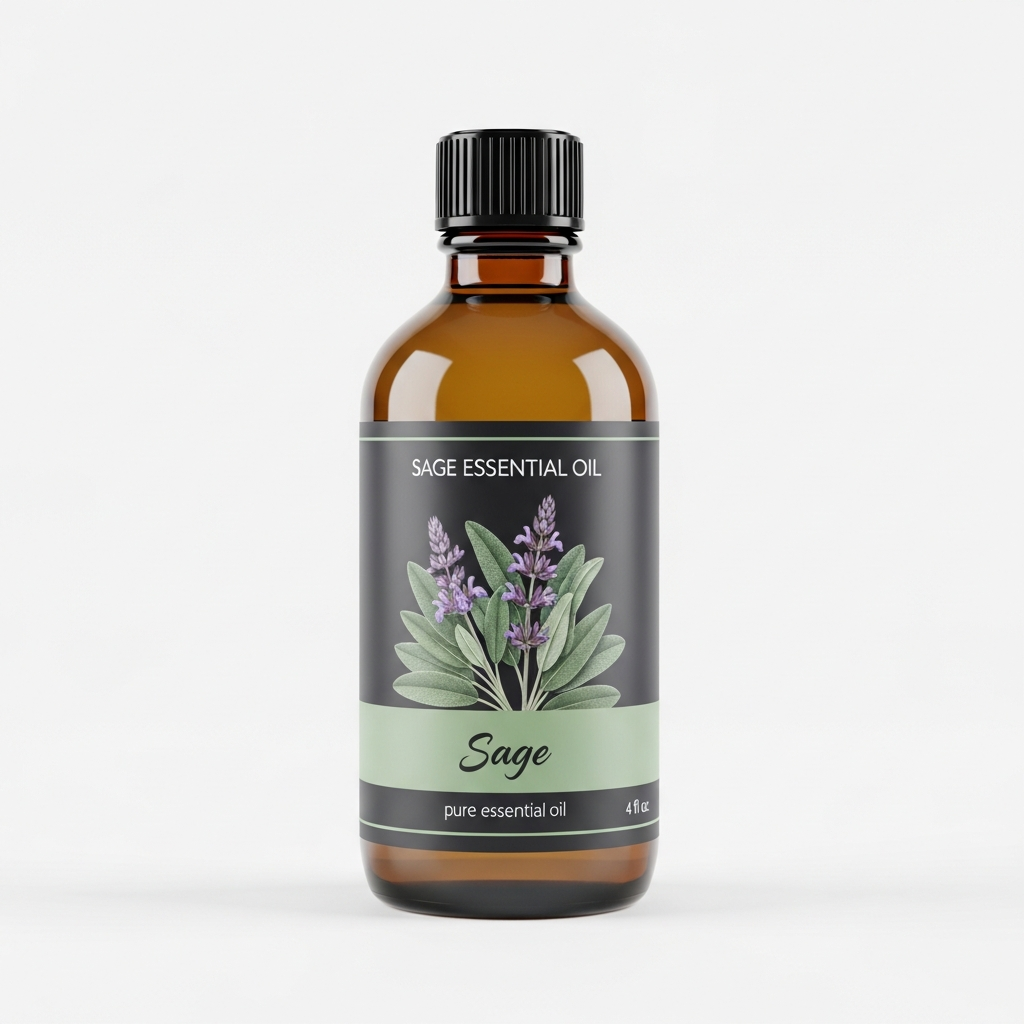
Sage Essential Oil
Sage Essential Oil from our own shop, in sizes from 0.5 oz to bulk.
From $13.99
Shop Now →Sources & Further Reading
- ISO 9909:1997, Oil of Dalmatian sage (Salvia officinalis L.) (preview copy)
- Safety and efficacy of a feed additive consisting of an essential oil derived from the leaves of Salvia officinalis L. (sage oil) for use in all animal species (FEFANA asbl) (EFSA FEEDAP Panel, EFSA Journal, 2024)
- Chemical composition and biological activities of Salvia officinalis essential oil from Tunisia (Khedher et al., EXCLI Journal, 2017)
- Assessment report on Salvia officinalis L., folium and Salvia officinalis L., aetheroleum (EMA/HMPC/150801/2015)
- IFRA Standard, Thujone, 2020 (Amendment 49)
- Guidance for the use of IFRA Standards (IFRA, 51st Amendment, June 2023)
- Advanced analytical techniques for authenticity identification and quality evaluation in Essential oils: A review (Yang et al., Food Chemistry, 2024)