Sage Oil vs Dried Sage: What Differs in Strength
The sage in your spice rack and the sage oil in a bottle come from the same plant, at wildly different strengths. A teaspoon of dried sage leaf carries roughly 1.4 to 2.0 mg of thujone; a single drop of a sage oil like the ones EFSA characterised carries about 13 to 15 mg. That gap is the whole story: the herb is for the kitchen, the oil is a concentrated aromatic, and treating one as a stronger version of the other is where things go sideways.
What is in the leaf
The European Pharmacopoeia requires whole dried sage leaf to contain at least 12 ml of essential oil per kilogram, and describes the leaf oil as rich in thujone. The oil's composition varies with source and harvest time (EMA/HMPC). Do the sum at that minimum and it takes about 83 g of dry leaf to hold 1 ml of oil, so a single drop (about 0.05 ml) is the oil from roughly 4 g of leaf. A bottle of sage oil is a lot of sage leaf, distilled down and set free of everything else in the leaf.
The numbers side by side
A German team bought 86 sage-containing foods and medicines in 2010 and measured thujone and camphor by gas chromatography with mass spectrometry. Their three dried sage samples held 944 to 1,353 mg of thujone per kilogram (Walch et al.). The oil figure comes from EFSA's five-batch analysis, which averaged about 30.6% thujone (EFSA FEEDAP), combined with the density of 0.915 g/ml printed on the Certificate of Analysis we publish for one batch. The arithmetic is ours:
| Item | Thujone |
|---|---|
| 1.5 g (about a teaspoon) of dried sage | About 1.4 to 2.0 mg |
| A cup of sage tea, food-category teas | 0.03 to 2.14 mg |
| EMA ceiling for sage leaf preparations | 6.0 mg per person per day, for at most 2 weeks |
| One drop of an oil like the EFSA batches | About 13 to 15 mg |
One drop carries about seven to ten times the thujone of a teaspoon of the herb, and more than twice the EMA's daily figure for leaf preparations. Drops are an imprecise unit, and the thujone content of any particular bottle can differ, so read the sum as a sense of scale, not a dose. The EMA's herbal committee makes the same point in its own words: using sage oil in single-ingredient products carries a high risk of exceeding the recommended daily thujone intake (EMA/HMPC public statement).
Let the herb do the cooking
NCCIH describes sage as likely safe in the amounts commonly found in foods, and notes that common sage contains thujone, which can be toxic if consumed in large amounts (NCCIH). That is about the herb. Our sage oil is for external, diluted cosmetic use only and is not for internal use. Poison Control says swallowing more than a very small amount of sage oil has caused seizures in children (National Capital Poison Center). If a recipe asks for a drop of sage oil in food, it is the wrong recipe for this bottle. We go through the ingestion question in why the herb is not the oil.
The herb deserves a little care too
The EMA assessment report records a case in which an 18-month-old developed convulsions about two hours after drinking a tea made from home-grown sage (reported there, citing Tong et al., 2003). One case does not set a rate, and tea is not cooking, but it is a reminder that thujone is thujone. NCCIH says it may be unsafe to use sage while pregnant, and that little is known about breastfeeding. Anyone thinking about sage tea for a health reason rather than flavour should ask a physician or pharmacist, especially for a child. Our children article sets out the sources.
Two ways to enjoy the same plant
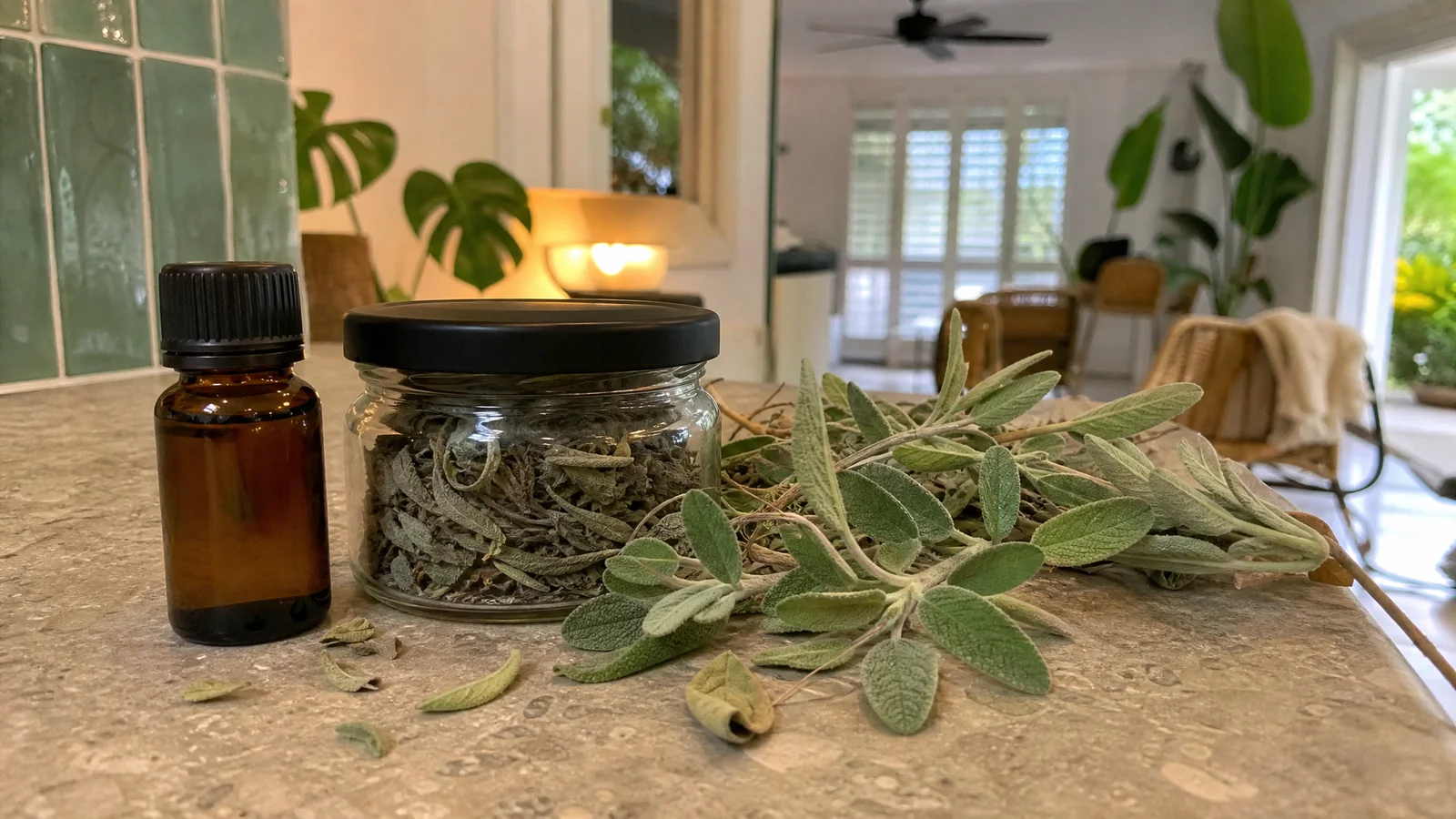
There is something nice about keeping both on hand for different reasons. A jar of dried sage sits in the kitchen, and it smells warm, a little dusty and savoury, like stuffing and roast potatoes. The oil sits in a cupboard somewhere cool, and when you open it you get the dry, camphor-edged green of the leaf with everything gentle taken out. Smell them side by side and you will notice the herb is mellow and food-like while the oil is brisk and sharp. They are connected, but they do not feel like the same thing.
If you are curious, crush a pinch of dried leaf in your palm, smell it, then wave the open bottle of oil toward you from a distance. That quick comparison teaches more about the two than any chart.
Which one answers your question
- You want flavour in food. Use the herb, fresh or dried, in ordinary culinary amounts.
- You want the smell of sage in a room. A very light hand with the oil in a diffuser works for some households, and we describe it as an oil that needs a lighter touch than a mint or a citrus. Nobody in the home should be pregnant, a young child or prone to seizures, and pets should not share the room. A bunch of the herb needs no dilution sums at all.
- You want it on skin. Only the oil is made for that, and only diluted, starting low, with a patch test. Our dilution sums are in our dilution guide.
- You want to grow it. A pot on a sunny sill gives you the herb, and our growing article shows how.
We sell the oil only, in two listings, sold neat. Dried sage, plants and tea are things for a grocery or garden centre.
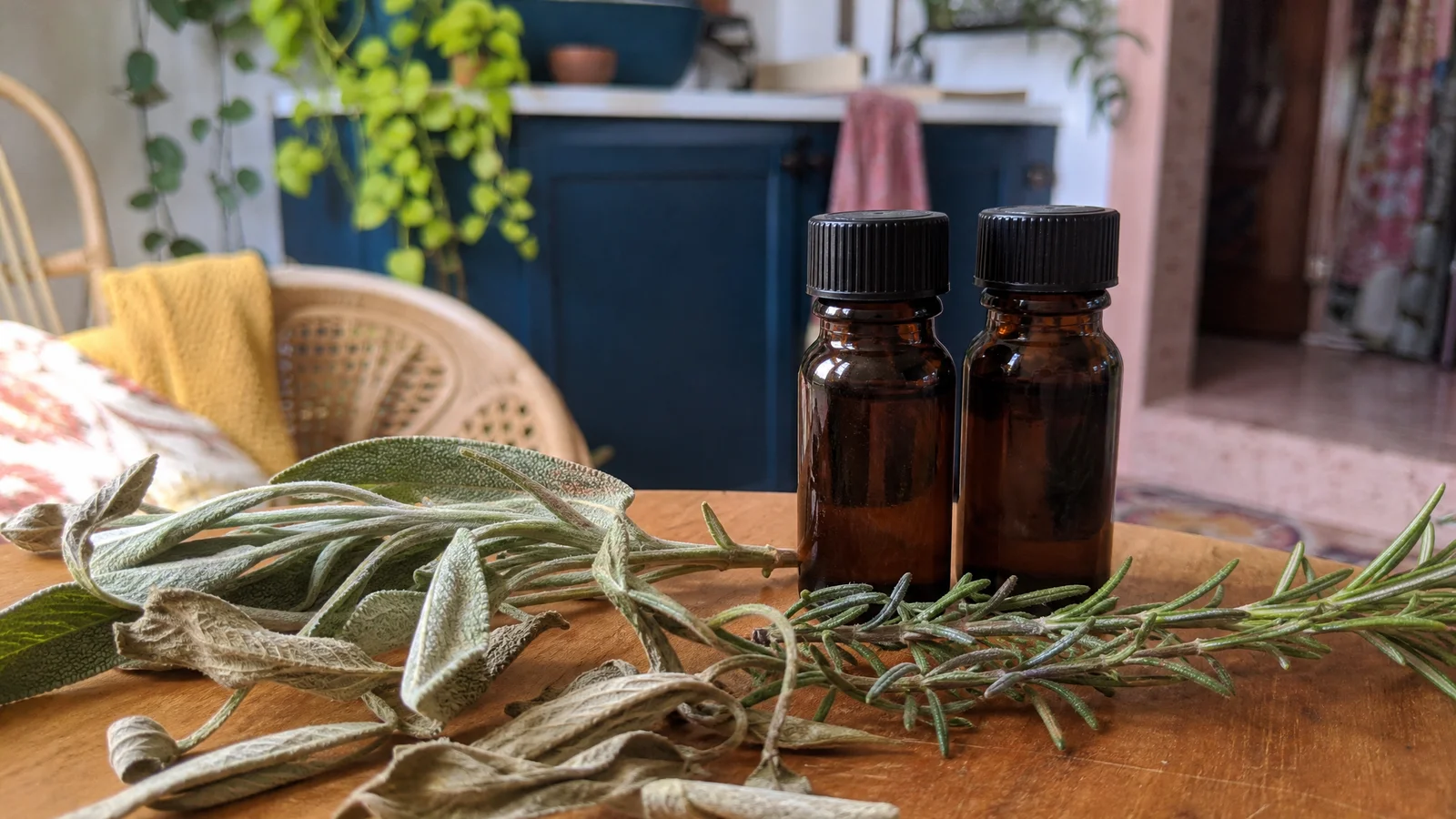
Same plant, different job: the herb flavours the stuffing, and the oil, used with care, brings that dry green sage aroma to a project.
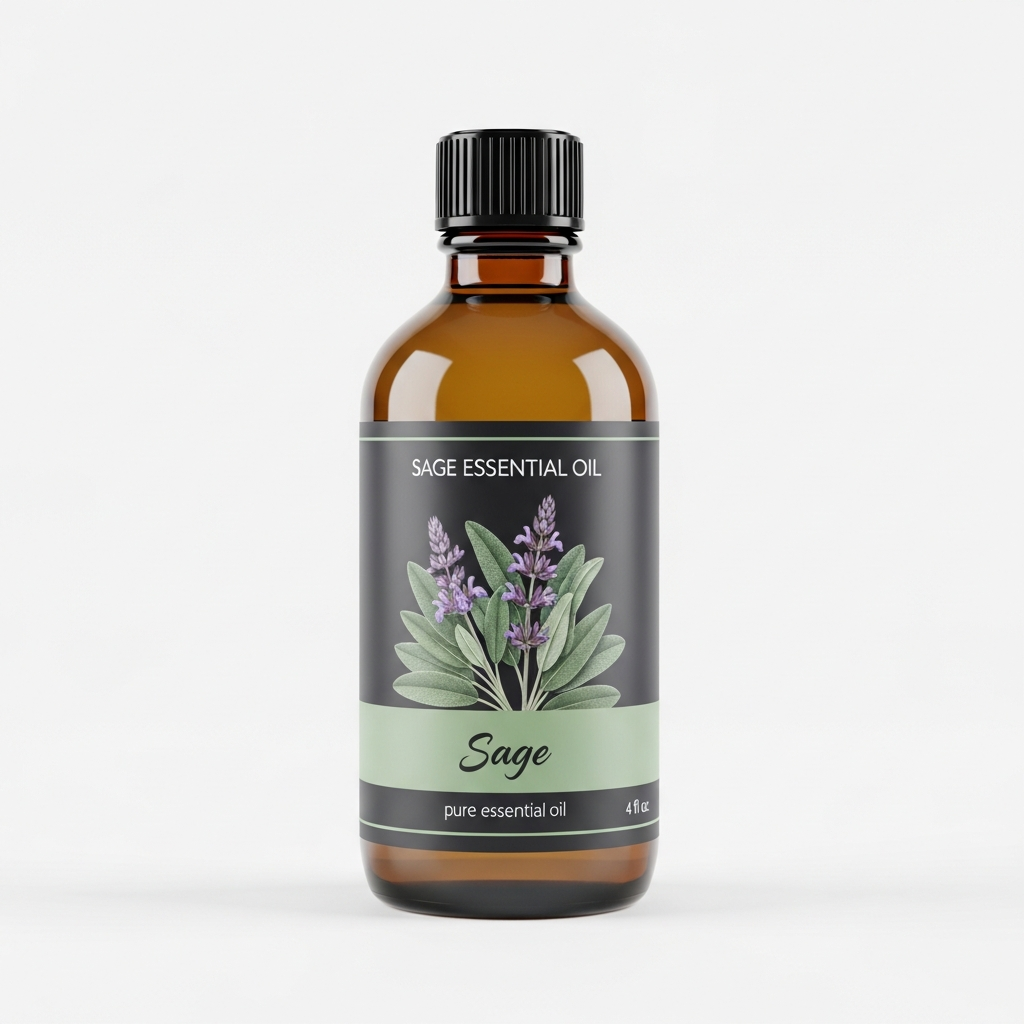
Sage Essential Oil
Sage Essential Oil from our own shop, in sizes from 0.5 oz to bulk.
From $13.99
Shop Now →Sources & Further Reading
- EMA/HMPC, 2016, Assessment report on Salvia officinalis L., folium and Salvia officinalis L., aetheroleum
- EMA/HMPC, 2016, Public statement on Salvia officinalis L., aetheroleum
- Walch SG et al., 2011, Determination of the biologically active flavour substances thujone and camphor in foods and medicines containing sage (Salvia officinalis L.), Chemistry Central Journal
- EFSA FEEDAP Panel, 2024, Safety and efficacy of a feed additive consisting of an essential oil derived from the leaves of Salvia officinalis L. (sage oil) for use in all animal species (FEFANA asbl)
- NCCIH, Sage: Usefulness and Safety
- National Capital Poison Center, Essential oils: Poisonous when misused