How to Dilute Sage Oil: Drops per Ounce Explained
Most dilution charts are built to keep a rose or a lavender from irritating your skin. Sage asks a different question, because its bigger consideration is thujone, a ketone that makes up roughly a third of a typical sage oil. That is why, when we talk about using our sage oil on skin, we start with a single drop in an ounce of carrier and treat the familiar 0.5% to 2% range as the outer edge of general skin use, not a target.
Why the usual ranges are a poor fit
The Tisserand Institute's dilution guide gives sensible ranges for common jobs: 0.2 to 1% for sensitive skin, 0.5 to 1.2% for facial products, 1 to 3% for body oils and lotions, and more for baths and spot uses. It treats them as guidelines, reminds you not to mix weight and volume in one calculation, and its limits are built around irritation and sensitisation. It does not mention thujone, which is the property behind the fragrance industry's restriction on sage.
That restriction is the IFRA standard on thujone. It caps thujone in a finished product, with neurotoxicity as the driver, at 0.095% for body products such as lotions and oils (category 5A) and 0.032% for facial moisturiser (5B). IFRA's standards are written for commercial fragrance mixtures, and its guidance says aromatherapy applications fall outside the assessments behind them, so applying the numbers to a home blend is our arithmetic and not IFRA's instruction. We use them because nothing more specific exists for this oil.
From a thujone cap to drops
To turn a cap on thujone into a cap on oil, you need the oil's thujone share. One analysis of a commercial sage oil, five batches reported in a European Food Safety Authority opinion, found about 30.6% thujone in total. The European Medicines Agency's assessment report cites literature ranges that work out to roughly 14% at the low end and 96% at the high end. Dividing the body-product cap by each share gives the most oil the blend can hold: about 0.31% at the average, 0.68% at the low end and 0.099% at the high end.
In practical terms, a single drop (about 0.05 mL) in a 1 oz bottle of carrier (29.57 mL) is 0.17%. That sits under the cap at the average and the low end, and above it only if the oil sits near the top of the published range (about 1.7 times the cap there). For a leave-on face product the same arithmetic gives only about 0.1% at the average, so one drop per ounce is already above it, and we would not put sage in a face moisturiser at all. Our certificate of analysis for one batch lists density, refractive index and optical rotation but not thujone, so we cannot tell you where our own oil falls. If you need that figure for a formula, ask us in writing through the contact page before ordering.
For comparison, 0.5% in an ounce is about three drops and 2% is about twelve, which is roughly one and a half to six times the body-product cap at the average. We include the 0.5% to 2% line on our product pages as the general figure for a diluted skin oil, but for sage we start at the lower number and suggest you do too.
Drops by container size
| Carrier | Drops at about 0.17% |
|---|---|
| 10 mL roller bottle | 0.3 (not measurable) |
| 1 oz (29.57 mL) | 1 |
| 2 oz (59 mL) | 2 |
| 100 mL | 3.4 |
| 8 oz (237 mL) | 8 |
Drops are approximate, since droppers differ (we use 20 to the mL as the convention), which is why the Tisserand Institute prefers percentages. The roller bottle row tells its own story: a third of a drop cannot be dispensed, so sage oil in a small roller is a recipe for guessing. Our roller blend article goes into that. Carrier oils themselves are not something we sell, so look for them at a craft shop, pharmacy or grocery; our carrier oil comparison helps you pick one.
Why we would skip the stock solution
A popular fix for tiny amounts is a 10% stock: 1 mL of oil in 9 mL of carrier, measured out later. With sage we would not. At the average, a drop carries about 14 mg of thujone, so a 10 mL bottle of stock holds around 20 drops and roughly 280 mg of thujone in something that looks exactly like carrier oil. The Poison Control page on essential oils says they must be locked up, out of the sight and reach of children and pets. A bottle of strong, unlabelled stock is the hardest thing to keep that way. Counting the drops into a single bottle for a single use is simpler.
A tidy workspace helps
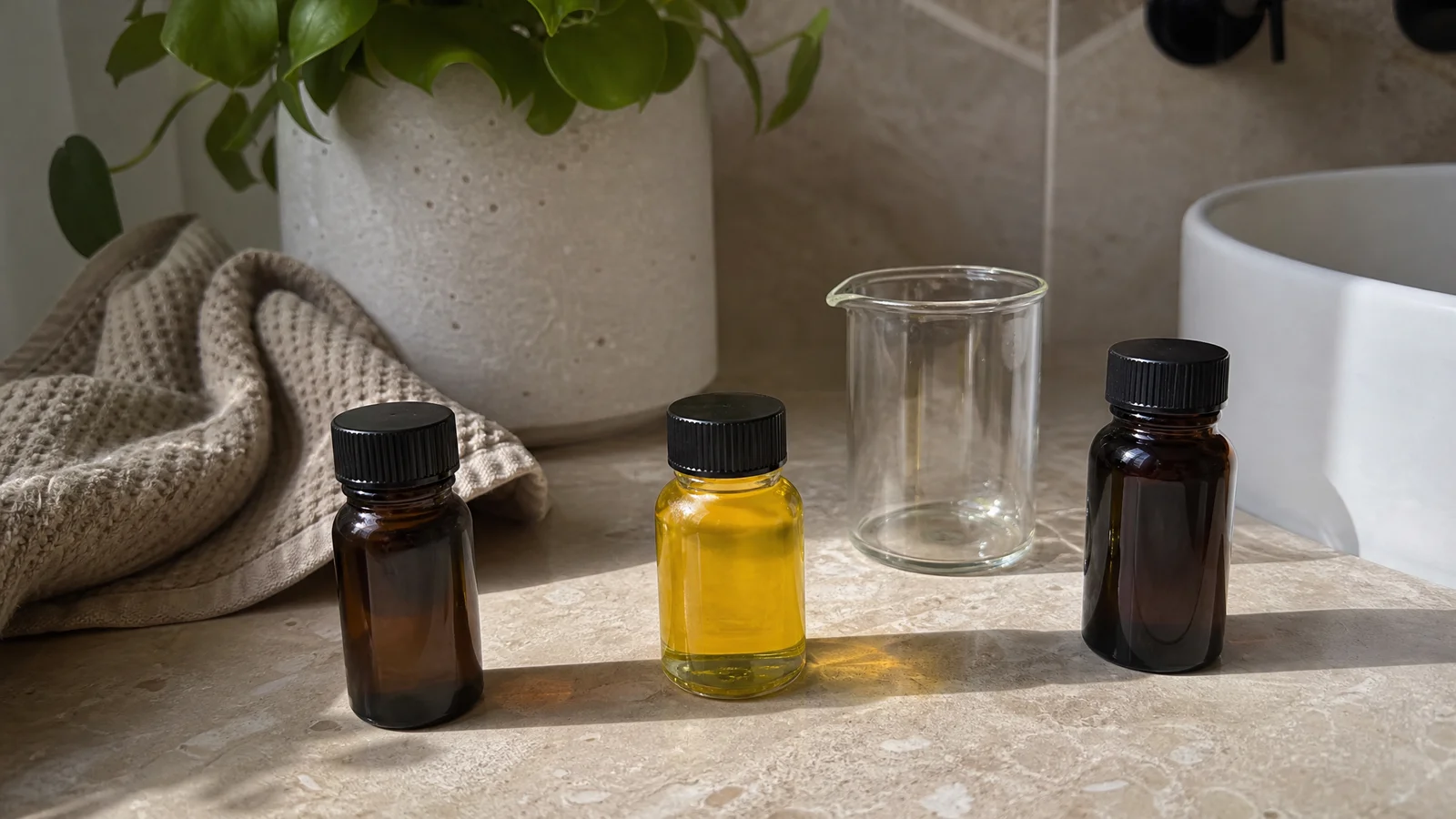
Dilution goes better with a clean setup. Use a dry glass or dark bottle, measure the carrier first, then add the sage last, a drop at a time, holding the dropper over the bottle rather than your open hand. Cap it, roll it gently between your palms, and label it with the date and what is inside. A blend with no label is a blend nobody remembers. When you smell it, you'll notice the sage sits very softly behind the carrier at this strength, which is exactly the point.
Then patch test
A dilution is only half of the answer. Test the blend you intend to use on a small area before you use it more widely; our guide to patch testing sage oil explains what a home test can and cannot show. And if you are pregnant or breastfeeding, or the oil is for a child, sage is not the oil to dilute at all: that is our position, and our guide to thujone says more.
Sage Essential Oil
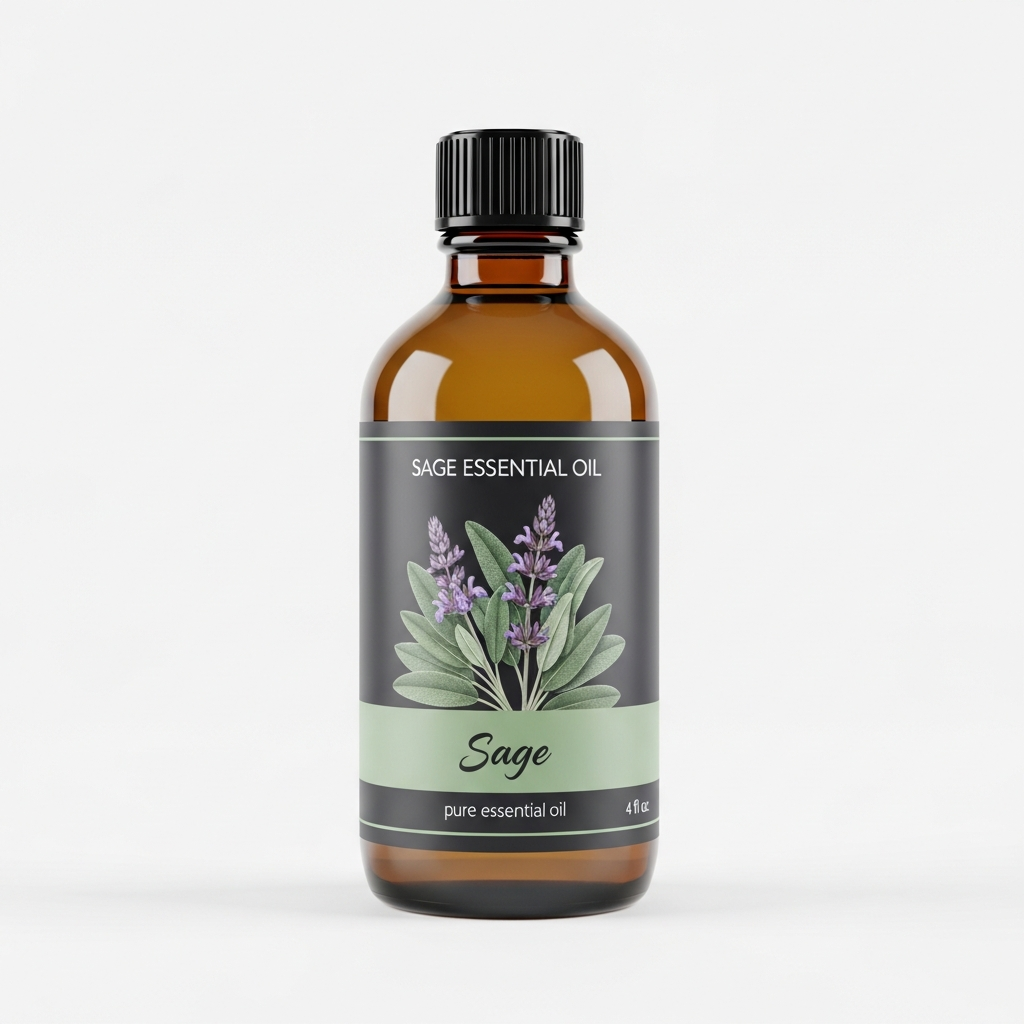
Sage Essential Oil from our own shop, in sizes from 0.5 oz to bulk.
From $13.99
Shop Now →Sources & Further Reading
- Dilution for essential oils (Tisserand Institute)
- IFRA Standard: Thujone, 2020 (Amendment 49)
- Guidance for the Use of IFRA Standards (51st Amendment)
- Safety and efficacy of a feed additive consisting of an essential oil derived from the leaves of Salvia officinalis L. (sage oil) for use in all animal species (FEFANA asbl)
- Assessment report on Salvia officinalis L., folium and Salvia officinalis L., aetheroleum (EMA/HMPC/150801/2015)
- Essential oils: Poisonous when misused | Poison Control