Sage Oil in Face Cleansers: How Much Is Too Much?
Adding a little sage to a cleanser is a charming idea: a fresh, green, herbaceous note at the sink in the morning. It can be done, but sage asks for far less oil than most scents do, and it belongs in rinse-off products, not in anything that stays on your face. Here is the arithmetic, so you can check it for yourself.
The limit behind the advice
About a third of a typical sage oil is thujone, and the fragrance industry limits thujone in finished products because of neurotoxicity. The IFRA standard allows 0.13% thujone in category 9, which IFRA's guidance defines to include rinse-off face cleanser, bar soap, body wash and shampoo. It allows only 0.032% in category 5B, which covers facial moisturiser and toner. That gap is the reason we place sage in the rinse-off group and would keep it out of leave-on face products altogether.
One honest caveat: IFRA's guidance lists aromatherapy applications as outside the assessments behind its standards. The numbers were written for commercial fragrance mixtures, so we use them as a yardstick for a home project, not as a legal threshold, because nothing more specific exists for this oil.
From thujone to drops
To convert a thujone limit into an oil limit, you need the oil's thujone share. A European Food Safety Authority analysis of one sage oil found about 30.6% thujone in five batches, and the European Medicines Agency's assessment report cites literature ranges that work out to roughly 14% to 96%. Dividing the category 9 limit by each gives the most oil a rinse-off cleanser can hold: about 0.43% at the average, 0.93% at the low end and 0.135% at the high end. For the face-moisturiser category the equivalents are about 0.1%, 0.23% and 0.033%.
Our certificate of analysis for one batch covers density, refractive index and optical rotation, and it carries no thujone figure, so we cannot tell you which column our oil belongs in. If you need a figure for a formula, ask us in writing through the contact page before ordering. Until then, the careful column is the high-thujone one.
A worked example with a bought cleanser
Suppose you want to scent 100 g of an unscented rinse-off cleanser you bought ready-made. A drop is about 0.05 mL, which at the 0.915 g/mL density printed on our certificate is about 0.046 g. At the average column, 0.43% of 100 g is 0.43 g, around nine drops. At the high-thujone column, 0.135% is 0.135 g, around three. With no figure in hand, three drops per 100 g is where we would begin, and there is nothing to gain from rounding up. The thujone limit counts every source in the product, so if the base already contains a sage-derived ingredient, the allowance shrinks. This is arithmetic from published limits, offered as a starting point for your own formulation.
Our shop guidance for a diluted skin oil is 0.5% to 2%, and the face-wash numbers show why we begin lower with sage: 0.5% is already above the rinse-off limit at the average and several times above it at the high end. Making a cleanser from scratch, with surfactants and a preservative, is a job for an experienced formulator, so we recommend starting from a ready-made base from a craft or supply shop.
Making the sink a nicer place
Scent at the sink is brief. A cleanser is on your hands or face for a minute and then gone, so the aroma works as a first impression: a faint, green whiff when you pump the bottle, and then nothing. That is a good reason to keep the amount small. If you can smell sage strongly from across the bathroom, there is too much in the bottle.
Look for an unscented base labelled as fragrance-free, and make a small amount at a time, around 100 g, so you can adjust. Write the date and the amounts on the container. Keep your eyes closed while you wash and rinse well, and put the bottle somewhere out of reach of children.
Oil and water still do not mix
Drops of essential oil float. The Tisserand Institute notes that essential oils are not water soluble and recommends dispersing them with Solubol or polysorbate 20 or 80 when they go into water. In a gel or lotion base, undispersed droplets can reach the skin at far more than the average you calculated. Our reasoning is simple: stir thoroughly, and if you cannot get it evenly mixed, use less or leave it out.
Skin comes first, scent second
The European Medicines Agency's report records that sage oil is reported to be a moderate skin irritant. Keep suds out of the eyes, and test any new product on a small patch of skin first; our guide to patch testing sage oil explains how. Our dilution guide shows the numbers by container size. If you are pregnant or breastfeeding, or the product is for a child, sage is not the oil for the job.
A few drops, mixed well, go a long way with sage.
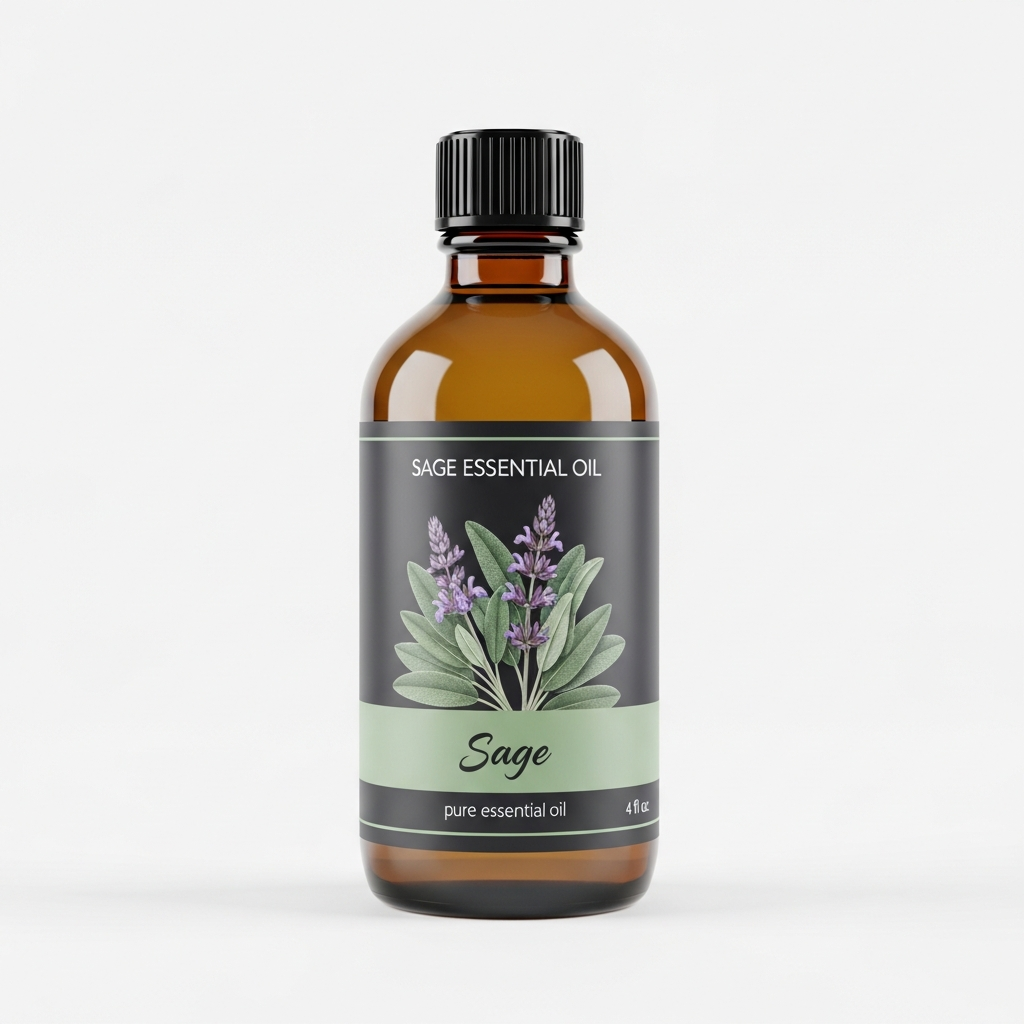
Sage Essential Oil
Sage Essential Oil from our own shop, in sizes from 0.5 oz to bulk.
From $13.99
Shop Now →Sources & Further Reading
- IFRA Standard: Thujone, 2020 (Amendment 49)
- Guidance for the Use of IFRA Standards (51st Amendment)
- Safety and efficacy of a feed additive consisting of an essential oil derived from the leaves of Salvia officinalis L. (sage oil) for use in all animal species (FEFANA asbl)
- Assessment report on Salvia officinalis L., folium and Salvia officinalis L., aetheroleum (EMA/HMPC/150801/2015)
- Bath Safety: how to use essential oils safely in the bath (Tisserand Institute)