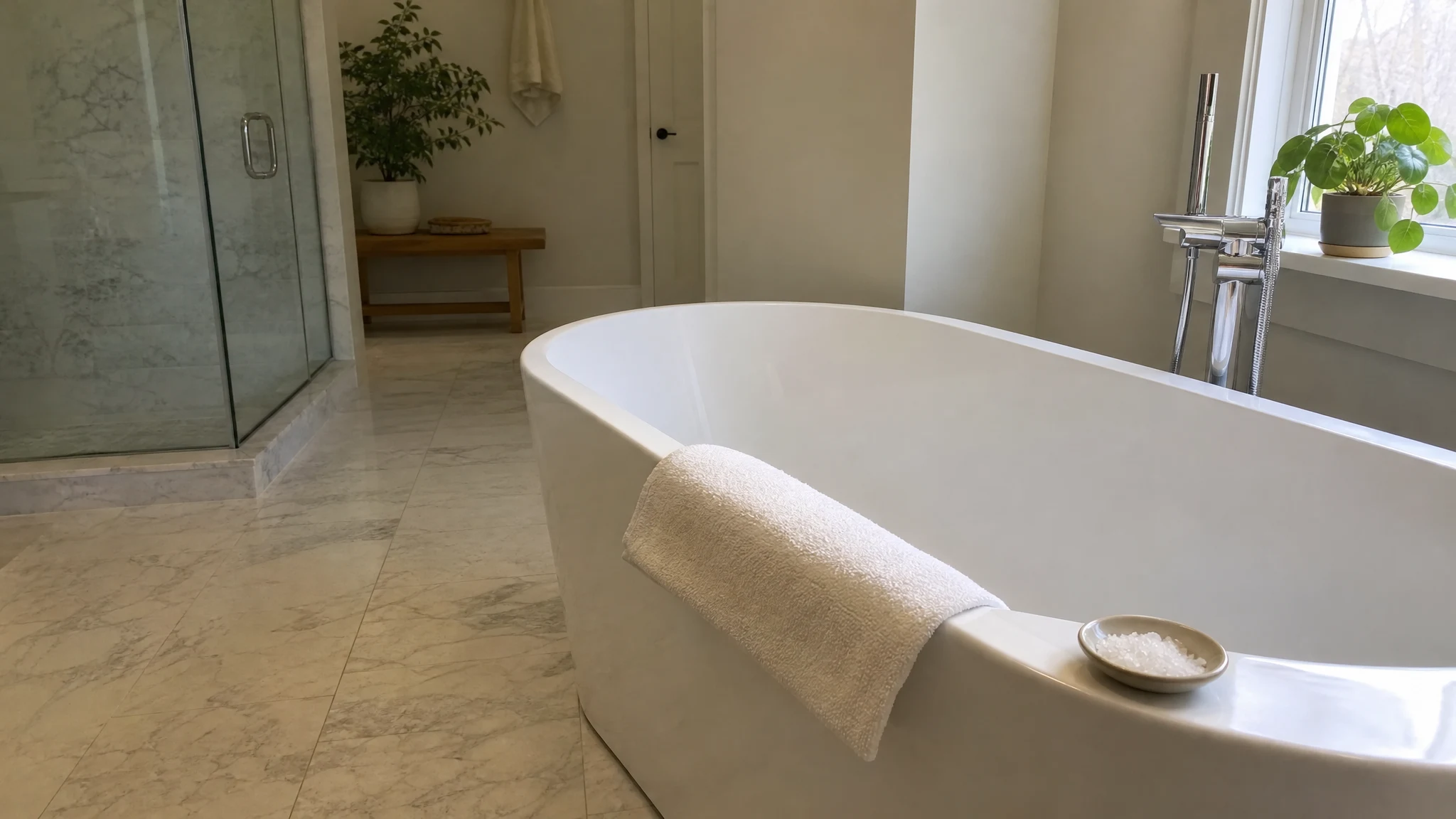
Essential Oils in the Bath: Why They Float and What to Do
Essential oil dropped into a running bath does not mix with the water. It floats as undiluted droplets and coats the skin that touches them, which is the opposite of what most people picture. Our position is that the fix is a dispersant measured in advance, and that for sage oil specifically the better answer is to leave it out of the bath.
What actually happens to the drop
The Tisserand Institute's bath page states it flatly: essential oils are not water soluble. Pour them straight in and, in its words, you get "a film of undiluted essential oils sitting on top," and "much of that fine film is now attached to your skin" when you get in (Tisserand Institute, undated). Its general safety page is blunter still: "Do not put drops of essential oil into a bath and then step into it," and says oils must be fully dispersed in a suitable base before they go into a bath (Tisserand Institute, undated).
That is a dilution problem, not a fragrance problem. A bath of 150 litres (our assumption, a typical full tub) holding one drop of oil is, on paper, extremely dilute: one drop of an oil at the 0.915 g/ml measured on the batch on our published COA is about 0.046 g, and 0.046 g in 150,000 g of water is roughly 0.00003%. But paper concentration is irrelevant when the drop has not dispersed. Skin meets the droplet at close to 100%, and the film is what you wade through.
The things people use that do not solve it
| Added to the bath | What the Tisserand Institute says |
|---|---|
| Oil dropped straight in | Floats; undiluted film clings to skin and tub |
| Milk | "Virtually undiluted essential oils" still reach the skin; oils float, "perhaps slightly more dispersed, but not much" |
| Epsom or other salt | "Salt is not a carrier for essential oils"; stirring oil into salt does not dilute or solubilise it |
| Vegetable carrier oil (coconut, olive, sunflower) | Dilutes the oil but still floats on the surface and makes a "pretty slippery, greasy" bath; fractionated coconut or jojoba is less greasy |
The slipperiness is a practical hazard on its own: a tub already coated in carrier oil is hard to climb out of. That is a reason to pick a dispersant over a carrier when you can.
Dispersants and the ratios their supplier guidance gives
The same page lists three routes, each from the viewpoint of someone making a bath product at home. These are the published ratios for essential oils in general, not limits for any particular oil.
- Foaming base (shower gel, unscented shampoo base): "In ½ ounce of base, 1-4% is about 5-20 drops of essential oil."
- Solubol (a solubiliser): stir in until the oil is fully incorporated; this "may require a dilution ratio of 1 part essential oil to up to 8 parts solubol."
- Polysorbate 20: "best used for adding small amounts of essential oils - 2-3% is ideal." The page gives polysorbate 80 as "up to 20% max with carrier oils and 5% max for just essential oils," though its how-to text for polysorbate 80 appears to have a copy error, so read that section twice before relying on it.
We sell none of these. Solubol, polysorbates and foaming bases come from soap-making and aromatherapy supply shops; ask for the product's own usage sheet and read its hazard page, because a dispersant is a chemical with its own limits, which we have not reviewed.
Why sage oil is the wrong oil for this
The sage reasoning is separate from the floating problem. The EMA's herbal committee describes sage oil as "characterised by high levels of thujone," says thujone "is toxic and may cause seizures at high doses," and limits sage leaf preparations to 6.0 mg of thujone per person per day for at most two weeks (EMA/HMPC, public statement EMA/HMPC/41843/2009, adopted 2010, corrected 2016). That limit is for oral dosing and says nothing directly about skin in warm water. EFSA's 2024 opinion on a sage oil feed additive also classes the oil as "an irritant to skin and eyes and as a dermal and respiratory sensitiser" (EFSA FEEDAP, 2024).
To get a sense of the scale, take the Tisserand starting ratio of 5 drops in half an ounce of base. EFSA reports the sage oils it assessed averaging about 25% alpha-thujone and 5.6% beta-thujone, about 30.6% together. Five drops is about 0.23 g of oil, and 30.6% of that is about 70 mg of thujone; 20 drops is about 0.92 g oil and about 280 mg. Set that against the EMA's 6.0 mg oral figure and you see why this is orientation only: the routes differ, and our own oil has no thujone figure published (the COA we publish gives density, refractive index and optical rotation for one batch, nothing about constituents). It is also variable between oils. A Romanian group's in-house sage oil measured 8.74% alpha-thujone and 1.34% beta-thujone, with 1,8-cineole and borneol making up more (Mot et al., Antioxidants 2022). Without a figure for the bottle you hold, you cannot do the thujone arithmetic for it.
So the plain recommendation: do not put sage oil in a bath. Our process page says to avoid it entirely in pregnancy and breastfeeding, not to use it on or around children, and to leave it alone with a seizure disorder; a bath shared with a child, or taken by someone who is pregnant, is the setting that advice is meant to rule out. If an adult with none of those reasons still wants sage in the water, our stated ceiling is one drop (about 0.046 g by weight, which is what to measure) dispersed fully into the base before it goes in, for the whole tub, and a patch test first (see patch tests and skin reactions). That figure is our position, reasoned from the thujone sources above and the 0.2% adult body ceiling we use elsewhere (about one drop per ounce of carrier); we have not made or tested a sage bath formula, and nothing in a bath formula should be assumed to work until you have run a small test of the base alone.
A worked bath formula (not for sage)
For any other oil, here is how to size the dispersant by weight rather than guessing. This is a formulation worked out from the Tisserand ratios, not something we have made or tested.
- Pick the base amount: ½ ounce (about 15 ml) of unscented foaming base is the Tisserand reference.
- Pick the oil amount inside the Tisserand 1% to 4% range. At 1%, 15 ml of base holds about 0.15 ml of oil, roughly 3 drops at 20 drops per ml (weigh instead; droppers vary).
- Stir the oil into the base for a full minute, then check no oil film is visible before it goes into the water.
- Run the water, add the mix, swirl, and test one small patch of skin first.
People with a skin condition, pregnancy, epilepsy or asthma are listed by the Tisserand Institute as needing a doctor's or suitable practitioner's advice before using essential oils at all. For bath products without any oil, a supply shop's unscented base is the product to ask for.
If you want to understand why we are cautious here, our posts on sage and thujone and diluting sage oil go through the numbers, and carrier oils covers what the slippery part of the bath is made of. For pregnancy, see our pregnancy and breastfeeding post, and ask your midwife or physician before using any oil.
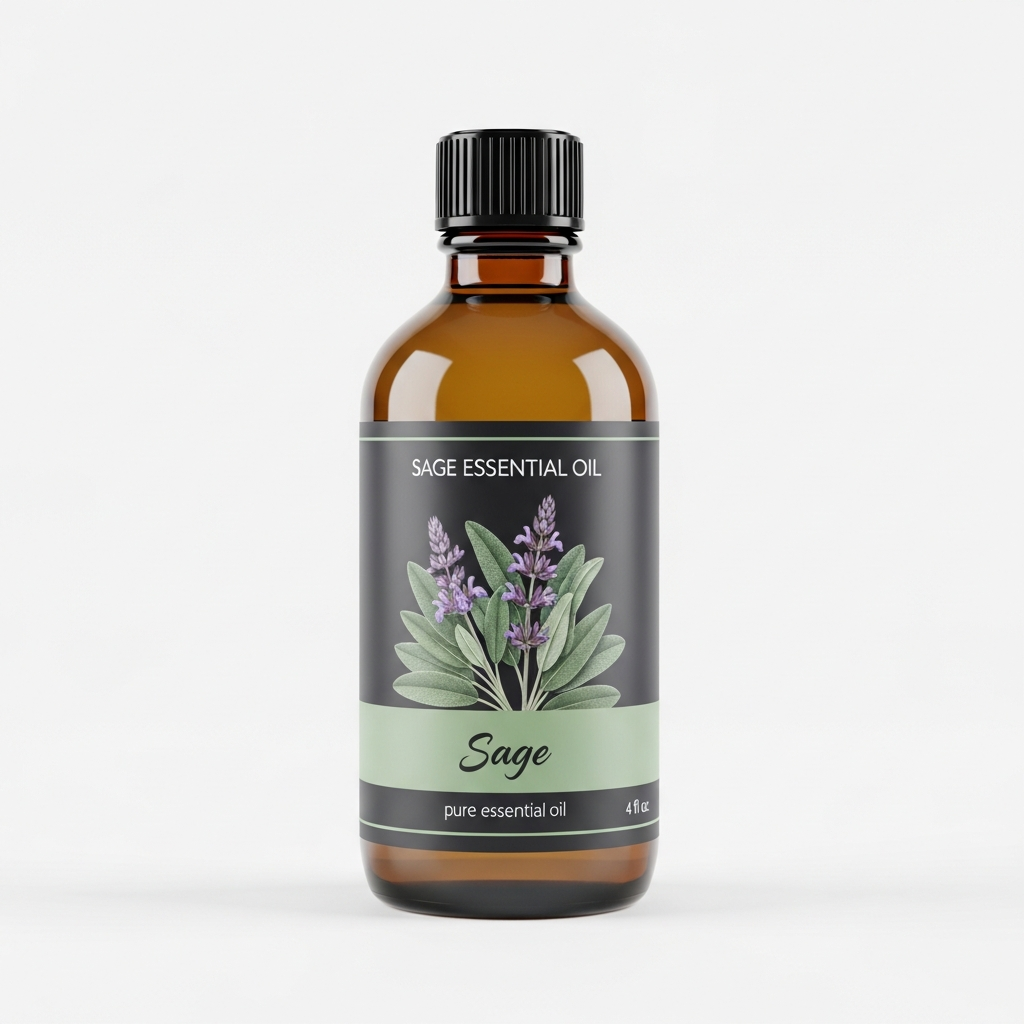
Sage Essential Oil
Sage Essential Oil from our own shop, in sizes from 0.5 oz to bulk.
From $13.99
Shop Now →Sources & Further Reading
- Tisserand Institute, undated. Bath safety. tisserandinstitute.org/safety/bath-safety
- Tisserand Institute, undated. Safety guidelines. tisserandinstitute.org/safety-guidelines
- EMA/HMPC, 2016 (adopted 2010). Public statement on Salvia officinalis L., aetheroleum, EMA/HMPC/41843/2009. ema.europa.eu/EMA/HMPC/41843/2009
- EFSA FEEDAP Panel, 2024. Safety and efficacy of a feed additive consisting of an essential oil derived from the leaves of Salvia officinalis L. (sage oil). EFSA Journal 22(12):e9135. PMC11656093
- Mot MD et al., 2022. Salvia officinalis L. essential oil: characterization, antioxidant properties, and the effects of aromatherapy in adult patients. Antioxidants 11(5):808. PMC9137537