Essential Oil Roller Blends: Making Sage Work
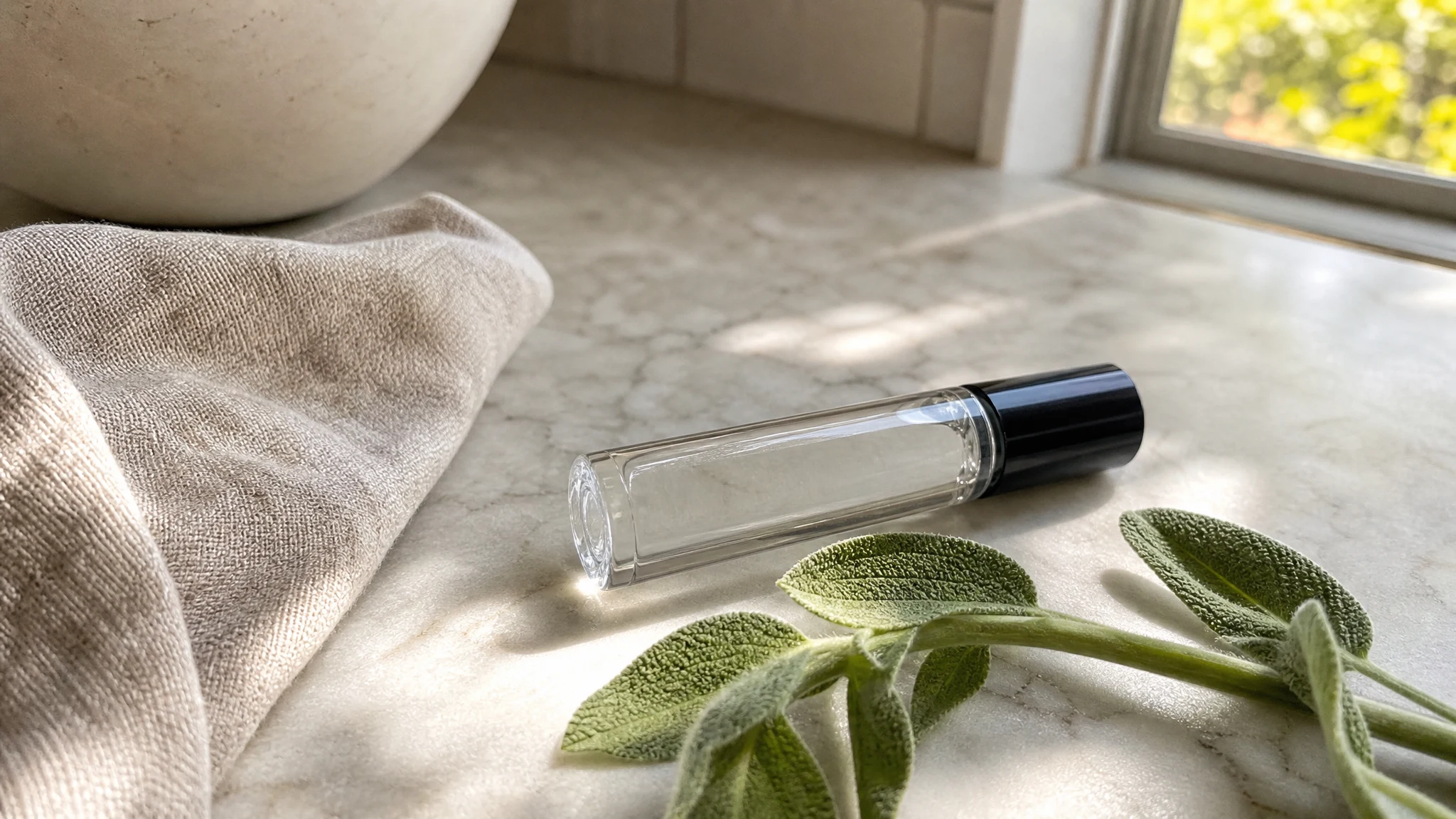
Roller bottles are charming, and they are also tiny. A standard 10 ml roller holds about two hundred drops of liquid in total, so when a recipe calls for sage at a sensible level, the answer in drops is a fraction of one. That small puzzle is the most interesting thing about a sage roller, and solving it well is what keeps the project enjoyable.
The drop problem in numbers
A drop is roughly 0.05 ml, though droppers differ, so treat this as orientation and weigh whenever you can. For the batch on our Certificate of Analysis, the measured relative density is 0.915, which puts a drop at about 0.046 g. Now set a percentage against a 10 ml roller:
| Sage in the roller | Oil in 10 ml | Drops |
|---|---|---|
| 0.17% | 0.017 ml | about a third of a drop |
| 0.5% | 0.05 ml | 1 drop |
| 1% | 0.1 ml | 2 drops |
| 2% | 0.2 ml | 4 drops |
Our general skin guidance for essential oils is 0.5 to 2 percent in a carrier, which would be 1 to 4 drops here. For sage, we think the lower end of the table is the right place to be, and the next section explains why.
Why sage gets a lower ceiling
The IFRA standard for thujone, sage oil's leading constituent, limits thujone in a leave-on body product to 0.095 percent, and in a face moisturizer to 0.032 percent, because of neurotoxicity (IFRA, 2020). It is written for fragrance makers, and we cannot say which category a roller belongs to, so read what follows as scale. If the oil is about 30.6 percent thujone, the average of five batches in one EU review (EFSA FEEDAP Panel, 2024), the body limit corresponds to about 0.31 percent sage oil, and the facial one to about 0.1 percent. The Certificate of Analysis we publish carries no thujone figure, so the true number for any bottle may differ.
The European Medicines Agency's assessment report also records sage oil as a moderate skin irritant that is not recommended for use in aromatherapy (EMA/HMPC, 2016). Taken together, we start well below the usual range for sage: our suggested ceiling is one drop in an ounce of carrier, about 0.17 percent, for adults, on the body and never on the face. We would not call 2 percent safe for this oil.
Three ways to get there
First, make a bigger batch and fill the roller from it. This is the easiest. One drop in 30 ml of carrier gives that 0.17 percent, and a 10 ml roller can be filled from it, with the rest stored tightly capped. It is a suggestion built from arithmetic, so do the patch test before the first use.
Second, weigh the oil. A 10 ml roller at 0.17 percent needs about 0.016 g of sage, and that takes a jeweller's scale reading to 0.001 g. A kitchen scale cannot do it, and a single 0.046 g drop would overshoot a roller by nearly three times. If you do not own the right scale, option one is easier.
Third, leave sage out of the roller. If you simply love a roller ritual, you can scent it with something else. We sell sage only, so carriers, roller bottles and other oils would come from a craft or supply shop. Our carrier oil guide can help you choose a carrier that keeps well in a bag, and our blending guide explains how to build a scent by ratio. Other oils carry their own limits, so check the IFRA standard or the supplier's guidance for each one you add rather than assuming they match.
Choosing and filling the bottle
A roller is only as nice as its fit. Check that the ball turns freely and the cap clicks on firmly before you fill it, and use a small funnel or a steady pour so nothing is wasted. Leave a little headroom at the top so the ball seats without overflowing. Tiny bottles are easy to mix up, so label the roller with the date and what is inside, even if it holds only a carrier and one oil. Once it is filled, roll it between your palms to mix, wait a few minutes, and check the scent at the cap rather than on your skin. At this strength you'll notice sage as a whisper, not a shout. Keep the finished roller away from heat, and out of a sunny windowsill or a warm car.
Patch test, then place
Dermatologists recommend testing a new product on a quarter-sized spot, such as the underside of the forearm or the bend of the elbow, twice a day for seven to ten days before using it more widely (American Academy of Dermatology). Our patch test article covers the details. Keep rollers off the face, neck and eyes, and off broken skin.
Who should skip a sage roller
We would leave sage out entirely during pregnancy and breastfeeding, around children, and with a seizure disorder. NCCIH notes that sage may be unsafe in pregnancy because of its thujone (NCCIH). A midwife, physician or pediatrician can advise on your situation. We offer a cosmetic oil and make no claim that a roller relieves sleep, headaches or anything else; the FDA looks at a product's labelling and marketing to decide what it is meant to do (FDA). For bigger formulas, see our massage oil and dilution articles.
A tiny roller teaches a nice lesson: with a strong oil, the interesting skill is restraint. If you would like a thujone figure before you plan anything, ask us in writing through the contact page.
Sage Essential Oil
Sage Essential Oil from our own shop, in sizes from 0.5 oz to bulk.
From $13.99
Shop Now →Sources & Further Reading
- IFRA, 2020. IFRA Standard: Thujone (Amendment 49). ifrafragrance.org
- EFSA FEEDAP Panel, 2024. Safety and efficacy of a feed additive consisting of an essential oil derived from the leaves of Salvia officinalis L. (sage oil) for use in all animal species (FEFANA asbl). EFSA Journal. PMC11656093
- EMA/HMPC, 2016. Assessment report on Salvia officinalis L., folium and Salvia officinalis L., aetheroleum. ema.europa.eu
- American Academy of Dermatology. How to test skin care products. aad.org
- NCCIH. Sage: Usefulness and Safety. nccih.nih.gov
- FDA. Aromatherapy. fda.gov