Can You Use Sage Oil in a Cleaning Spray?
Sage and a kitchen go together so naturally that a sage-scented cleaning spray feels like an obvious idea. It is a lovely one, as long as we are clear about the job each ingredient does: the base cleans, and the sage oil scents. Once you hold that thought, the rest is a matter of measuring a small amount of oil.
How much sage oil a bottle can carry
IFRA's thujone standard sets a maximum for each product category, giving neurotoxicity as the reason. Hard-surface cleaners, including kitchen and bathroom cleansers and furniture polish, are Category 10A, with a limit of 0.13% thujone in the finished product. Household sprays that may touch skin are Category 10B, at 0.22% (IFRA Standard: Thujone, 2020 (Amendment 49); Guidance for the Use of IFRA Standards). The standard is written for industry, so applying it to a home spray is our own arithmetic.
Converting needs the oil's thujone share. EFSA analysed five batches of a sage oil in 2024 and found about 30.6% thujone in total (EFSA feed additive opinion on sage oil, 2024), and the European Medicines Agency cites literature ranges that stretch much further (Assessment report on Salvia officinalis L., folium and Salvia officinalis L., aetheroleum). The Certificate of Analysis we publish for one batch lists density, refractive index and optical rotation, with no thujone figure, so we plan with the cautious end. For a 16 fl oz bottle (473 mL), taking a drop as 0.05 mL:
- Typical thujone share (30.6%), Category 10A: about 2 mL of oil, roughly 40 drops.
- Thujone-rich end of the published range, Category 10A: about 0.64 mL, roughly 13 drops.
Our suggestion is a dozen drops at most in a 16 fl oz bottle, and fewer for a small room. That is a faint herbal note, which is usually what a kitchen spray wants anyway. Our 0.5% to 2% guidance is for skin blends in a carrier, and it does not carry over: 0.5% of a 473 mL bottle would be nearly 50 drops.
Oil floats, so shake and aim at the cloth
Essential oils do not dissolve in water. The Tisserand Institute makes the point about baths, saying they float on top and need a dispersant such as polysorbate 20 or Solubol to mix (Bath Safety: how to use essential oils safely in the bath). The same physics applies in a spray bottle, which is our reasoning from that page rather than something it states. A dozen drops in a vinegar-and-water mix will sit at the surface, so the first pumps deliver more oil than the last. Two habits solve most of this: shake before each use, and spray onto a cloth rather than into the air. The cloth keeps the scent where you want it and keeps a mist out of your breathing space.
Making the wipe-down pleasant
Sage's dry, green, camphor-edged aroma sits comfortably in a kitchen, beside the smell of cooking herbs. After you wipe a counter, notice how the scent behaves: you want a faint green note that fades within a few minutes, not a cloud that is still hanging in the air an hour later. If it lingers, use fewer drops in the next bottle.
Make small batches rather than a huge one, and write the date and the number of drops on the label. When the bottle is empty, you can adjust the recipe with no waste. Keep it with your other cleaning supplies somewhere out of reach, not on the open counter.
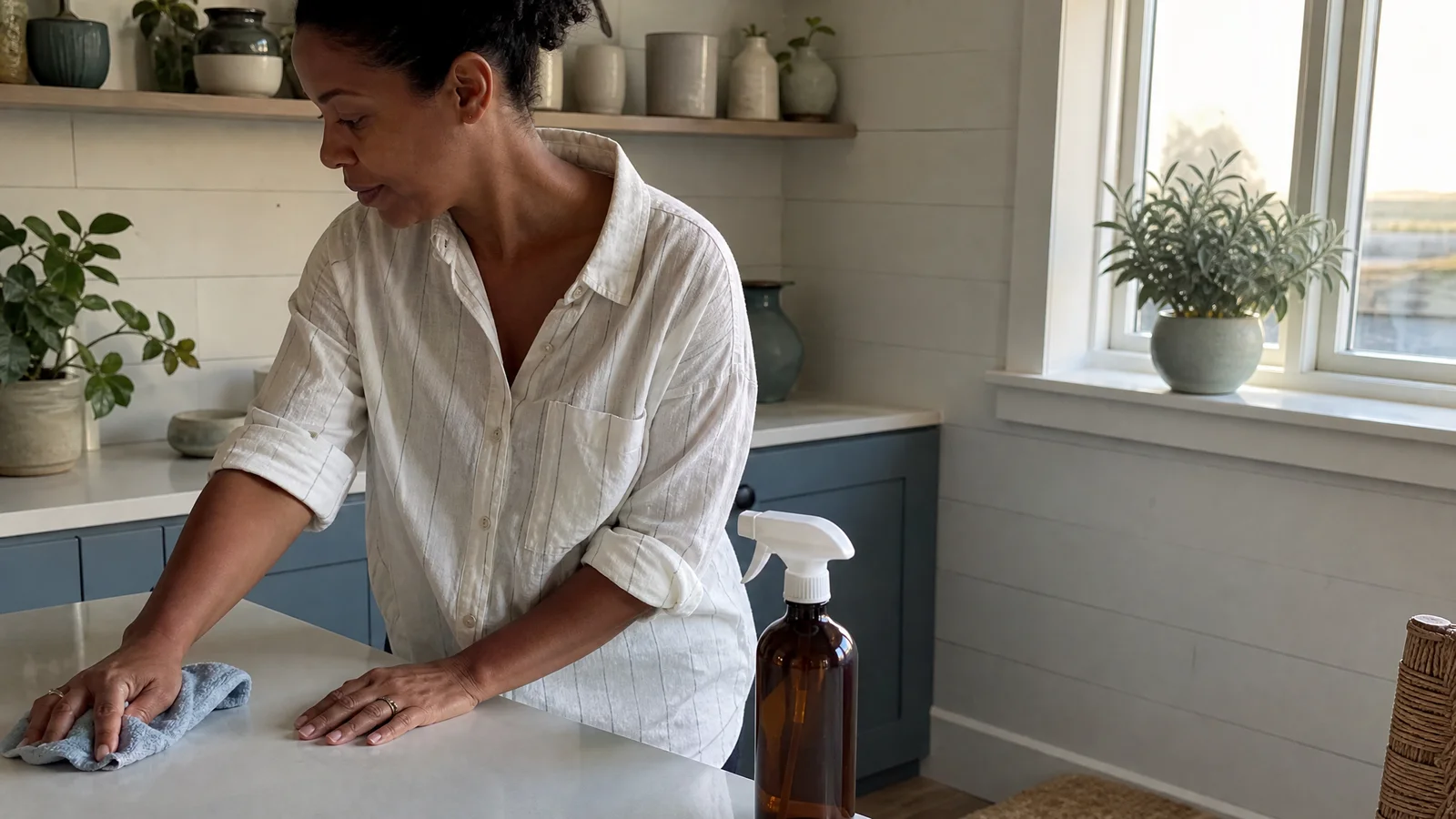
A cloth works better than you might think. Dampen it, spray it lightly, wipe in long strokes and finish with a dry cloth. The faint herbal note rides along with the wiping, which is all a kitchen spray needs.
A scent is not a sanitizer
A sage spray smells fresh, and fresh can read as clean, so it is worth separating the two. The EPA regulates disinfectants and approves their label language, and says that a product's registration number is the only accurate way to identify one (Selected EPA-Registered Disinfectants). A homemade spray has no registration number. So we call our sage spray what it is, a scented all-purpose spray for wiping surfaces, and we would not describe it as killing germs. When a surface truly needs disinfecting, use a registered product and follow its label.
The base does the everyday cleaning. A mix of water and dish soap, or whatever base you already trust, lifts the grease from a counter. Those ingredients, along with the bottle, come from a grocery or hardware store, because we sell only sage oil.
Households that should skip it
We recommend avoiding sage oil during pregnancy and breastfeeding, with a seizure disorder, and around children and pets. The National Capital Poison Center reports that swallowing more than a very small amount of sage oil has caused seizures in children, and recommends locking essential oils away from children and pets (Essential oils: Poisonous when misused). If anyone in the house is in one of those groups, a plain soap-and-water spray with no added scent is the better choice. Our pets article and pregnancy article have more.
Our thujone explainer shows where all these limits come from. For the spray itself, an open window, a shaken bottle and a damp cloth make a pleasant herbal wipe-down, and a faint scent is all it needs.
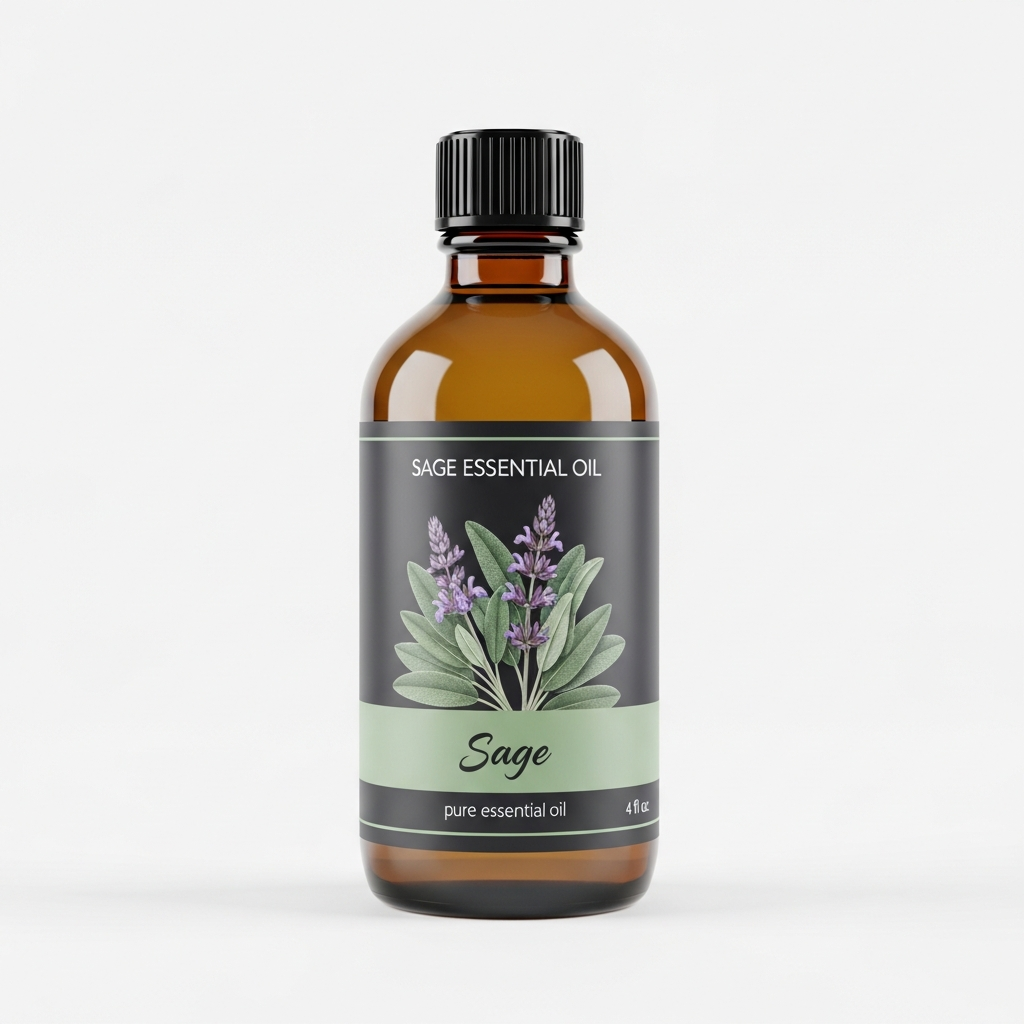
Sage Essential Oil
Sage Essential Oil from our own shop, in sizes from 0.5 oz to bulk.
From $13.99
Shop Now →Sources & Further Reading
- IFRA Standard: Thujone, 2020 (Amendment 49)
- Guidance for the Use of IFRA Standards (June 30, 2023)
- Safety and efficacy of a feed additive consisting of an essential oil derived from the leaves of Salvia officinalis L. (sage oil) for use in all animal species (FEFANA asbl), EFSA Journal, 2024
- European Medicines Agency, Assessment report on Salvia officinalis L., folium and Salvia officinalis L., aetheroleum (2016)
- Tisserand Institute, Bath Safety: how to use essential oils safely in the bath
- US EPA, Selected EPA-Registered Disinfectants
- National Capital Poison Center, Essential oils: Poisonous when misused