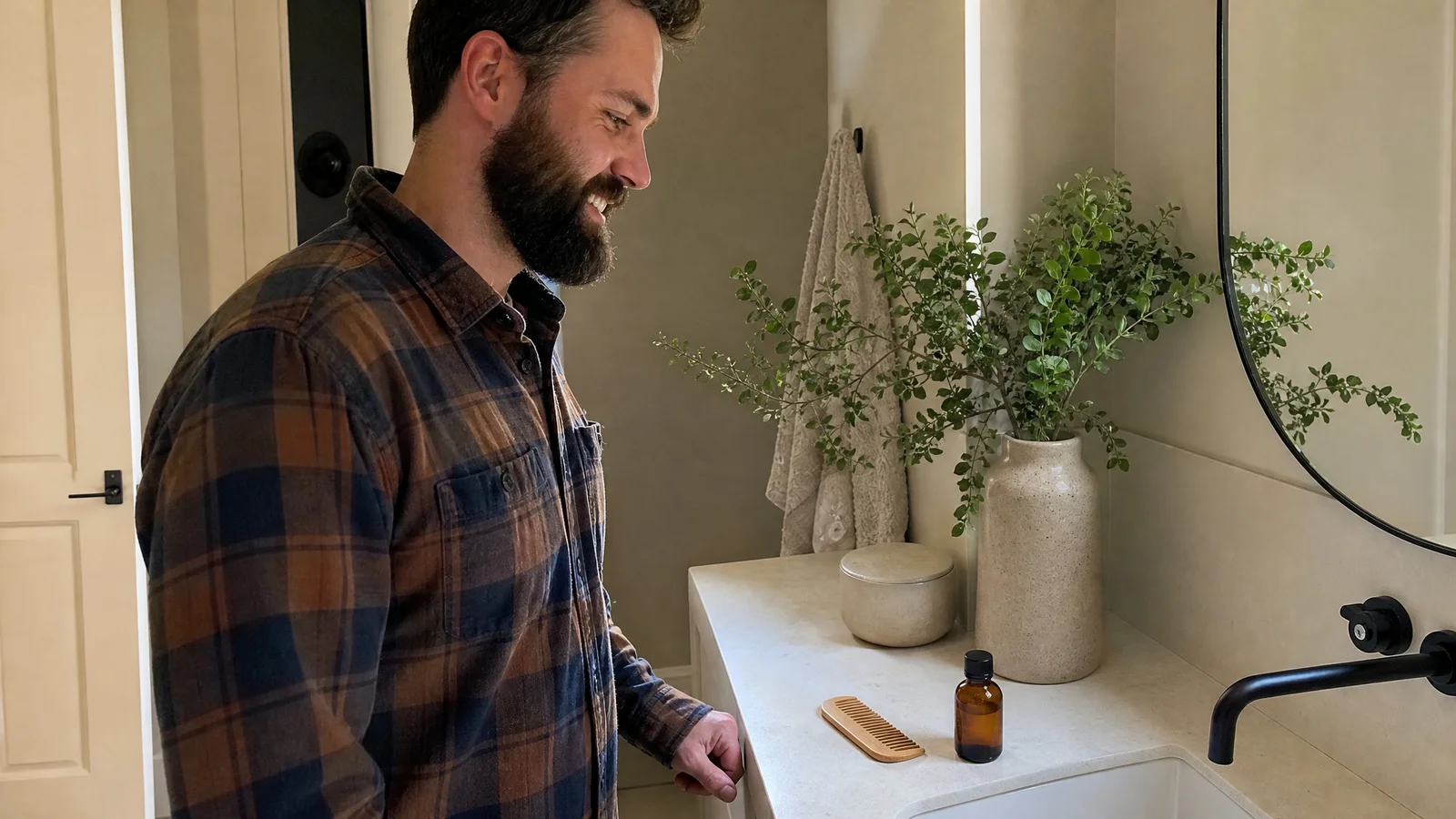
Sage Beard Oil: How Much Is Enough for a Beard?
Sage is not the first oil most people think of for a beard, which is exactly what makes it interesting. Used as a whisper, it brings a dry, green, herbaceous edge that most grooming blends never have. A whisper has to be measured, though, because the amount a face can take is much smaller than a drop-by-drop recipe suggests.
Why a beard oil gets the tightest number
The fragrance industry's standards body, IFRA, sorts products into numbered categories and sets a maximum for restricted ingredients in each. Its guidance lists care products for beard and mustache under Category 5B, the facial moisturizer group (Guidance for the Use of IFRA Standards). Sage oil is rich in thujone, and the IFRA thujone standard caps it at 0.032% of a finished 5B product, with neurotoxicity named as the reason. Body oil, in Category 5A, is allowed 0.095%, three times as much (IFRA Standard: Thujone, 2020 (Amendment 49)). The standard is written for industry fragrance mixtures, so applying it to a home batch is our own arithmetic, and putting an undiluted oil in 5B is our reading of the list.
To turn a thujone cap into an oil cap you need the oil's thujone share. The Certificate of Analysis we publish for one batch lists density, refractive index and optical rotation, so for the share we lean on published analysis. EFSA's 2024 opinion on a sage oil measured five batches and found alpha-thujone near 25% and beta-thujone near 5.6%, about 30.6% together (EFSA feed additive opinion on sage oil, 2024). Dividing 0.032 by 0.306 gives about 0.105% sage oil in the finished product.
What that looks like in a bottle
A drop is roughly 0.05 mL, though droppers vary. In a 30 mL (1 fl oz) bottle, 0.105% is about 0.03 mL, which is a little over half a drop. That is why we say a whisper. Here is how the common batch sizes land:
- 30 mL: one drop is 0.17%, about 1.6 times the cap at that typical thujone share.
- 60 mL (2 fl oz): one drop is 0.083%, just under the cap.
- 120 mL (4 fl oz): one drop is 0.042%, with comfortable room.
Published sage oils are not all alike. The European Medicines Agency's assessment report quotes literature ranges wide enough to put total thujone anywhere from about 14% to 96% (Assessment report on Salvia officinalis L., folium and Salvia officinalis L., aetheroleum). At the thujone-rich end the cap drops to about 0.033%, and one drop is comfortable only at around 150 mL. Since a thujone figure for our own oil is not on our certificate, we plan for that end: our suggestion is one drop for a 150 mL (5 fl oz) batch, and a written thujone figure from us before ordering if you want to go further. Our general 0.5% to 2% skin guidance suits body blends; for a face product the published limit is lower, so we go by it.
Making it work in a real formula
Most of a beard oil is the carrier, and the carrier does the conditioning. Pick one for how long it keeps and how it feels; our carrier oil comparison walks through the options. We sell sage oil only, so carriers, bottles and droppers come from a craft or supply shop. Because sage is so concentrated, we would make it the quiet background note rather than the headline scent. Make the batch in a clean bottle, label it with the date and the drop count, and keep it capped, cool and dark.
Beards sit near the eyes, nose and mouth, so keep sage oil away from them, and wash your hands after blending. EFSA describes sage oil as an irritant to skin and eyes and a skin and respiratory sensitiser, which is a good reason to do a patch test first. The American Academy of Dermatology suggests a quarter-sized spot on the inner arm or the bend of the elbow, repeated twice a day for 7 to 10 days, stopping at any redness, itching or swelling (How to test skin care products). Arm skin is not face skin, so our patch test guide covers what a home test can and cannot tell you.
Making it pleasant to wear
With a scent this restrained, the pleasure is in the details. Open a finished batch and sniff it before it goes anywhere near your face: you want a faint, dry, herbal breath on top of the carrier, not a cloud of sage. If you can smell it clearly from arm's length, there is too much in the bottle.
A few habits help. Warm a drop or two of the finished oil between your palms before smoothing it through, which spreads it thinly and stops you overdoing it. Start with less than you think you need, since a second pass is always possible. And write the date and drop count on the bottle, so the next batch can be the same.
Who should leave sage out
We recommend avoiding sage oil entirely during pregnancy and breastfeeding, with a seizure disorder, and around children, who might touch a bearded face and then their mouths. The National Capital Poison Center notes that swallowing more than a very small amount of sage oil has caused seizures in children, and asks that essential oils be locked away from children and pets (Essential oils: Poisonous when misused). For pregnancy questions see what the authorities say, and talk to your own doctor or midwife.
A beard oil is a small thing worn all day, so the best sage version is a subtle one. A hint of herb garden on a well-conditioned beard is plenty.
Sage Essential Oil
Sage Essential Oil from our own shop, in sizes from 0.5 oz to bulk.
From $13.99
Shop Now →Sources & Further Reading
- IFRA Standard: Thujone, 2020 (Amendment 49)
- Guidance for the Use of IFRA Standards (June 30, 2023)
- Safety and efficacy of a feed additive consisting of an essential oil derived from the leaves of Salvia officinalis L. (sage oil) for use in all animal species (FEFANA asbl), EFSA Journal, 2024
- European Medicines Agency, Assessment report on Salvia officinalis L., folium and Salvia officinalis L., aetheroleum (2016)
- American Academy of Dermatology, How to test skin care products
- National Capital Poison Center, Essential oils: Poisonous when misused