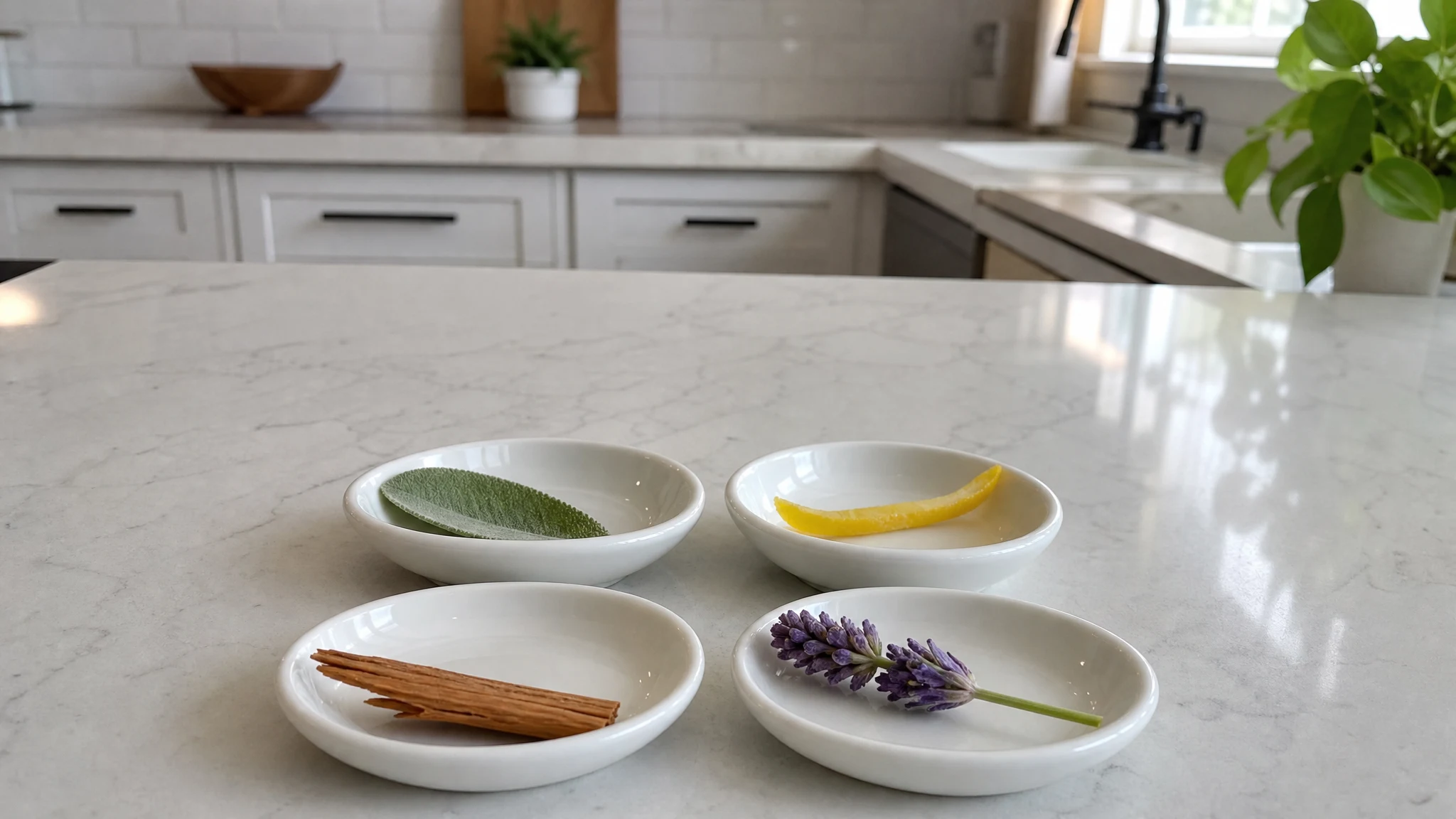
Sage Oil Blends: Best Pairings and How Much Sage
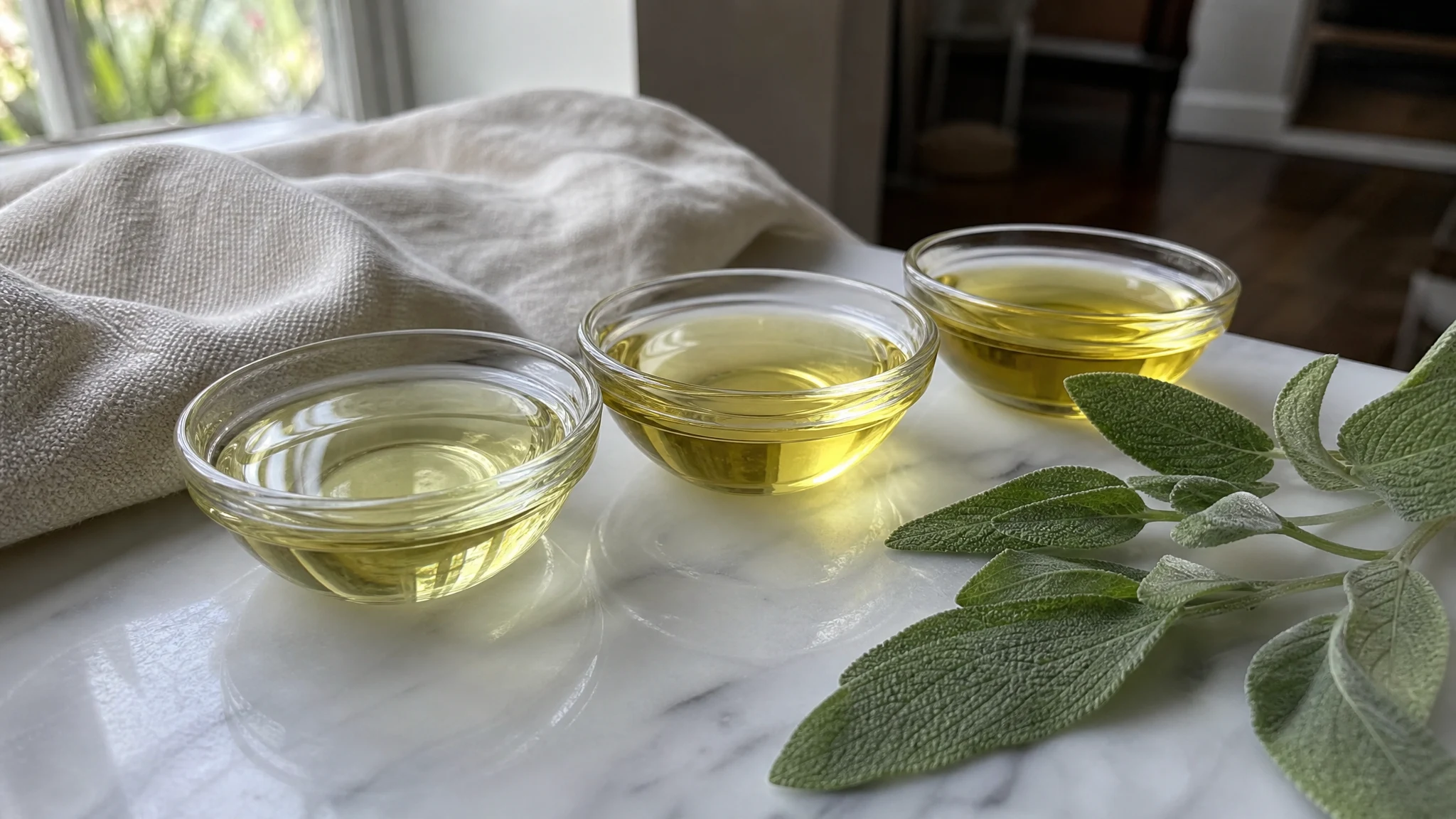
Sage is a strong personality, so it pairs best with oils that either soften its edge or lift it. Choosing the partner is the fun part, with plenty of aroma logic to guide you. Choosing how much sage goes in is the part that needs a little arithmetic, because for a body oil that number is smaller than most recipe lists suggest.
How much of a blend can be sage
The fragrance industry's thujone standard (IFRA) caps thujone at 0.095% in a body oil applied by hand. Dividing by the thujone share of the oil gives the most sage a product can hold, and the share varies: EFSA found an average of 30.56% in five batches of one sage oil, while the European Medicines Agency's ranges allow up to about 96% combined. The table shows the largest sage share of the essential oil portion for two common strengths.
| Total essential oil in the body oil | Largest sage share if thujone is 30.56% | Largest sage share if thujone is 96% |
|---|---|---|
| 1% | 31% | 9.9% |
| 2% | 15.5% | 5.0% |
In practice sage is a minor part of a 1% body oil and a trace in a 2% one. The Certificate of Analysis we publish for one batch has no thujone figure, so we plan to the cautious column unless you have a figure in writing, and our skin guidance of 0.5% to 2% in a carrier (patch test first) is a range we approach from the low end. A candle is the exception, because its 9.5% thujone cap lets sage make up around 31% of the finished product. Our autumn scents article follows that one through.
Citrus: a bright contrast with its own rules
PubChem describes limonene's odour as "pleasant lemon-like", and that brightness is the classic foil for sage's camphor, which PubChem calls "fragrant and penetrating". Citrus peel oils are worth a second look on the paperwork side. IFRA names expressed bergamot, lime, lemon and grapefruit among the oils limited because of sunlight reactions on skin, so for a blend that stays on the skin, check the citrus oil's own limit alongside sage's. Our phototoxic oils article lists the figures.
Lavender: a sweet partner
EFSA's analysis of four lavender oils put linalyl acetate at a mean of 37.05% and linalool at 31.16%. PubChem describes linalyl acetate as floral-fruity with a "bergamot-lavender odor". EFSA also reported that thujones were not detected in the lavender oil it assessed, so lavender rounds sage off with sweetness without adding to the thujone total. Both oils are classed as irritants and skin sensitisers by the same panel, so the patch test covers the pair.
Cedarwood, frankincense and pine notes
We suggest cedarwood and frankincense alongside our Botanical listing, and pine alongside our Purity listing, which we describe as having soft camphor and pine undertones. PubChem gives alpha-pinene's odour as "characteristic odor of pine", so a pine-leaning partner echoes the sage's own undertones. "Cedarwood" is sold under several botanical names, so ask any seller for the Latin name and a gas chromatography report before relying on a partner's composition.
Geranium and patchouli: a rose and a base
Geranium oil is mostly citronellol (about 32%) and geraniol (about 15%) in EFSA's analysis, both with rosy odours. Patchouli brings a leafy, humic depth and a fixative quality. Both pair nicely with sage's dry edge, and our sage, geranium and patchouli formulation weighs the three in grams.
One worked example
Say you want 100 g of a 1% body oil that pairs sage with lavender. Planning to the cautious end, sage can be at most 9.9% of the 1 g of essential oil, which is 0.099 g. Rounding down to 0.09 g keeps thujone at about 0.086% of the product, under the 0.095% cap, and it is about two drops by weight at 0.046 g a drop. The remaining 0.91 g is lavender and the other 99 g is a carrier oil from a craft supplier. If your bottle's thujone sits nearer the average, the product carries about 0.028%, well under the cap, so this plan errs toward caution. This is a suggested formulation built from the cited limits.
Thinking like a perfumer
A useful way to plan a blend is to treat sage as the accent and something else as the main voice. Open the bottle of each oil you are considering, one at a time, and notice what sage lacks: sweetness, a floral lift, a warm woody base. Then choose a partner that supplies it. Lavender brings softness, citrus brings sparkle, cedarwood and frankincense bring depth. When you find yourself reaching for a fourth oil, it is usually a sign the blend already has what it needs.
Smell the pairing before you commit. Put one drop of each oil on separate strips of plain paper, wave them together a few centimetres under your nose, and see whether the combination reads as one scent or as two arguing. Let the strips sit for a few minutes, because the top notes fade first and what remains is closer to how the blend will smell on the skin.
Keep notes as you go
Write down every blend as a weight, not a drop count: grams of sage, grams of each partner, grams of carrier. A recipe in weights can be scaled up or checked against a limit later, and it will not change when a dropper does. Make it small, label it with the date, and adjust one thing at a time.
Where these limits stop
IFRA's guidance leaves aromatherapy applications outside its scope, so a diffuser blend has no equivalent number, and our diffuser article takes that gap on. Our process page asks that sage be avoided in pregnancy and breastfeeding, kept from children, and left alone with a seizure disorder, whichever partner you pick. Our blending article covers the general method. We sell only sage, so every partner oil, carrier and bottle comes from a craft or supply shop.
Sage Essential Oil
Sage Essential Oil from our own shop, in sizes from 0.5 oz to bulk.
From $13.99
Shop Now →Sources & Further Reading
- IFRA, Thujone, IFRA Standard, Amendment 49 (2020). ifrafragrance.org/standards/IFRA_STD_102.pdf
- IFRA, Citrus oils and other furocoumarins containing essential oils, IFRA Standard, Amendment 49 (2020). ifrafragrance.org/standards/IFRA_STD_089.pdf
- IFRA, Guidance for the use of IFRA Standards, 51st Amendment (30 June 2023). IFRA guidance PDF
- EFSA FEEDAP Panel, 2024. Safety and efficacy of a feed additive consisting of an essential oil derived from the leaves of Salvia officinalis L. (sage oil) for use in all animal species (FEFANA asbl). EFSA Journal. PMC11656093
- EFSA FEEDAP Panel, 2024. Safety and efficacy of a feed additive consisting of an essential oil derived from the flowering tops of Lavandula angustifolia Mill. (lavender oil) for use in all animal species (FEFANA asbl). EFSA Journal. PMC11513610
- EFSA FEEDAP Panel, 2023. Safety and efficacy of a feed additive consisting of an essential oil from the herbaceous parts of Pelargonium graveolens L'Hér. (geranium rose oil) for all animal species (FEFANA asbl). EFSA Journal. PMC10373134
- EMA/HMPC, 2016. Assessment report on Salvia officinalis L., folium and Salvia officinalis L., aetheroleum (EMA/HMPC/150801/2015). ema.europa.eu
- PubChem, Odor sections for limonene (CID 22311), Camphor (CID 2537), Linalyl Acetate (CID 8294) and (+-)-alpha-Pinene (CID 6654). pubchem.ncbi.nlm.nih.gov