Sage Oil Uses: How Much Each One Allows
Open a jar of dried sage and you get the smell of a Sunday roast. Open a bottle of the oil and you meet the same plant in a far more concentrated form: herbaceous, earthy, camphoraceous, with a dry green edge. That intensity is exactly why the sensible question about sage oil is not "what can I do with it?" but "how much room does each use leave?"
A map of the ceilings
The fragrance industry has already drawn one. The IFRA standard for thujone, the main constituent of sage oil, sets a maximum amount of thujone allowed in a finished product, with a different limit for each product category, and names neurotoxicity as the concern it manages (IFRA, 2020). It is written for fragrance makers, not for home projects, so what follows is our own arithmetic, offered to give you a feel for scale.
To turn a thujone limit into an oil limit, you need to know how much thujone is in the oil. The Certificate of Analysis we publish does not list a figure, so we borrow a stand-in: the EU feed-additive review of one supplier's sage oil found alpha-thujone averaging about 25 percent and beta-thujone about 5.6 percent, roughly 30.6 percent together (EFSA FEEDAP Panel, 2024). Real oils vary, so the numbers are a guide and not a promise about any bottle. The product categories come from IFRA's guidance document (IFRA guidance).
| Use | IFRA category | Roughly how much sage oil it allows |
|---|---|---|
| Fine fragrance | 4 | about 4.6% |
| Rinse-off soap or cleanser; room and fabric sprays | 9, 10A | about 0.4% |
| Body oil or lotion | 5A | about 0.3% |
| Face moisturizer | 5B | about 0.1% |
The sums are the thujone limit divided by 0.306, so the 0.095 percent limit for body products gives about 0.31 percent oil, and the 0.032 percent limit for face moisturizers gives about 0.105 percent.
What that means for skin
Our general guidance for oils applied to skin is to dilute to 0.5 to 2 percent in a carrier and patch test first. For sage, the arithmetic points lower than that range, and we say so openly: at the stand-in figure, even the bottom of that range is above the body-product limit, and the top is several times over it. So with sage we start from the low end and below it. A single drop in an ounce of carrier works out to about 0.17 percent, which is our suggested ceiling for adult body use, and we would not call 2 percent safe for sage. Sage oil is also classed as an irritant and a sensitiser in EFSA's review, and the EMA's assessment report records it as a moderate skin irritant not recommended for aromatherapy (EMA/HMPC, 2016). If skin care is your main reason for buying an oil, we would honestly suggest a gentler oil from a supply shop. Our dilution guide and patch test article show the sums in detail.
Where sage has more room
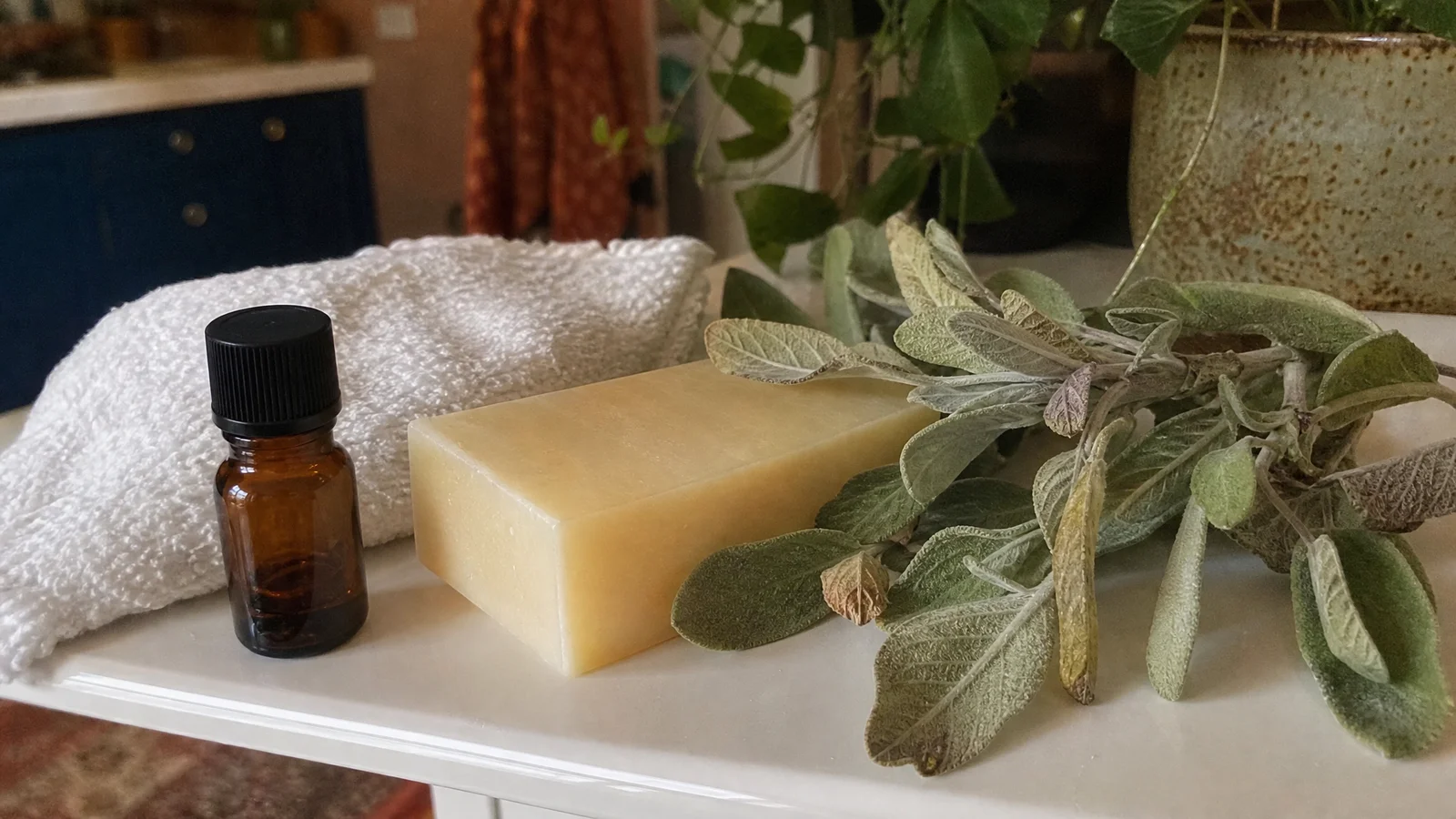
Washing it off makes a difference, which is why soap and cleansers get a bigger allowance than leave-on products. A 100 gram bar at about 0.4 percent would hold roughly 0.4 grams of oil, a handful of drops by weight, and that is a ceiling, not a target. Our soap project shows how to weigh it. Home sprays share that figure. Candles are the loosest category on paper, but there the wax maker's instructions, not the thujone limit, set the sensible load; see our candle article. Perfume has the largest allowance, and also the most arithmetic, because every other thujone-containing ingredient shares the same limit.
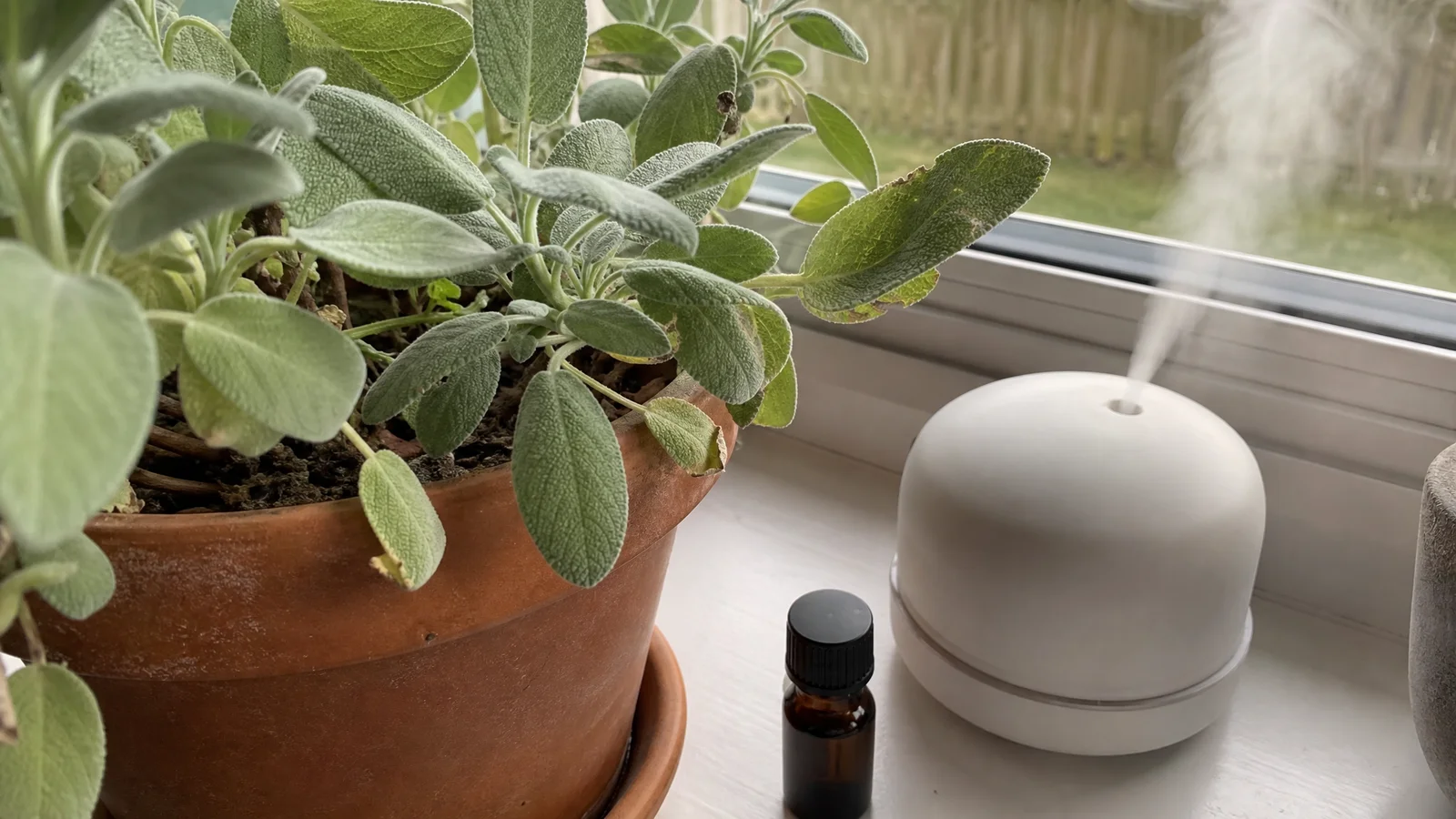
For diffusing, the IFRA guidance we read does not give a category for ultrasonic diffusers, so the sums above do not carry across. Our approach is a light hand, as we explain in our diffusing article.
Picking a first project
If you are new to sage oil, a soap bar or a small room spray is a friendly place to begin. Both let you smell the oil at work without a lot of oil on your skin, and both are easy to weigh. Pick a quantity that sounds almost too small, make the batch, and let it sit for a day before you judge it. Scent often reads quieter or rounder after a rest.
It helps to have a place to record what you did. A small notebook with the date, the weight of oil and the weight of everything else gives you something to adjust next time. The best sage recipes tend to come from patient notes.
Whichever project you choose, open the bottle in a ventilated spot, keep it capped between steps and tidy up as you go. Sage has a persistent, clinging aroma, and a spill on a worktop will be with you for a while, so a sheet of kitchen paper under your measuring cup is a good habit.
Where we would not go
Sage oil is not for swallowing. NCCIH says sage is likely safe in food amounts but may be unsafe in high doses, and the thujone is why (NCCIH). It is also best avoided in pregnancy and breastfeeding, around children and pets, and with a seizure disorder; a midwife, pediatrician, veterinarian or physician is the right person to ask. We sell a cosmetic oil and make no medical claim for it.
What is left is a short list of things sage oil does well: an herbal, camphor-edged aroma for a soap, a spray, a perfume or an occasional candle, used in small, weighed amounts. Our two listings are described as herbaceous, earthy and camphoraceous in one case, and fresh, green and peppery with soft camphor and pine in the other. If you need a thujone figure before you build anything, ask us in writing through the contact page.
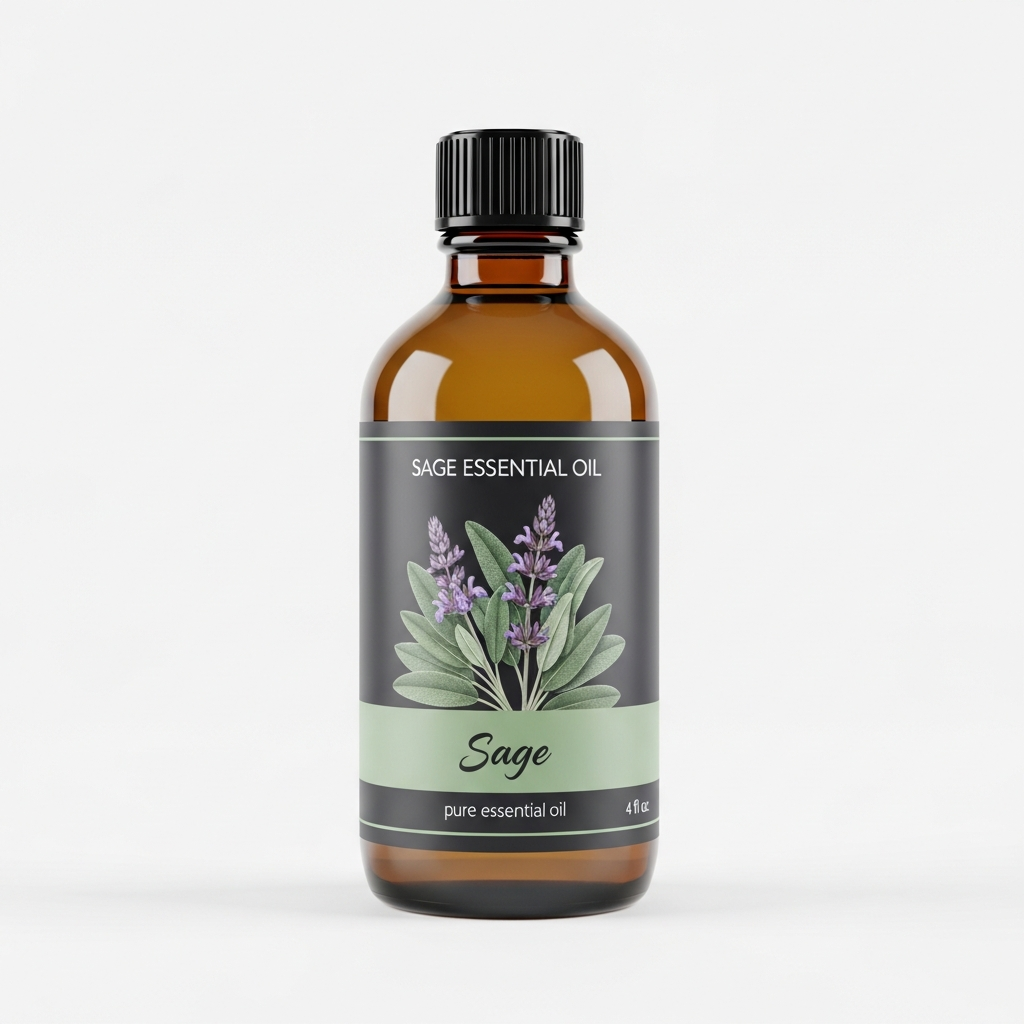
Sage Essential Oil
Sage Essential Oil from our own shop, in sizes from 0.5 oz to bulk.
From $13.99
Shop Now →Sources & Further Reading
- IFRA, 2020. IFRA Standard: Thujone (Amendment 49). ifrafragrance.org
- IFRA. Guidance for the Use of IFRA Standards (51st Amendment). IFRA guidance document
- EFSA FEEDAP Panel, 2024. Safety and efficacy of a feed additive consisting of an essential oil derived from the leaves of Salvia officinalis L. (sage oil) for use in all animal species (FEFANA asbl). EFSA Journal. PMC11656093
- EMA/HMPC, 2016. Assessment report on Salvia officinalis L., folium and Salvia officinalis L., aetheroleum. ema.europa.eu
- NCCIH. Sage: Usefulness and Safety. nccih.nih.gov