What Is Sage Essential Oil? A Plain Guide
Rub a sage leaf between your fingers and you get a sharp, green, slightly medicinal perfume that sticks to your skin for the rest of the afternoon. Sage essential oil is that smell, collected and concentrated. It is also a good deal more potent than the herb in your spice rack, which is exactly what makes it interesting, and what makes it worth understanding before you open the bottle.
From a garden shrub to a bottle
Garden sage, Salvia officinalis, is a perennial subshrub native to the Mediterranean, especially around the Adriatic, and the European Medicines Agency notes that commercial material comes from south-eastern Europe (EMA/HMPC, 2016). The oil comes from the leaves by steam distillation: steam passes through the leaf, carries the aromatic molecules with it, and the oil separates out as the steam condenses.
It takes a lot of leaf. The European Pharmacopoeia, as quoted by the EMA, expects whole dried sage leaf to contain at least 12 ml of essential oil per kilogram. By our arithmetic, at that minimum a half-ounce bottle (about 14.8 ml) represents the oil in more than a kilogram of leaf, before any loss in the still. Richer leaf gives more, and the EMA adds that the oil's composition is very variable with source, harvest time and other factors. That is why we think of sage oil as a family of related oils rather than one fixed substance.
What gives it that character
Three molecules do most of the talking. Thujone is the leading one, followed by camphor and 1,8-cineole, which smells cool and eucalyptus-like. In the EU feed-additive review, five batches of one supplier's oil averaged roughly a quarter alpha-thujone, with camphor near a fifth and cineole around a tenth (EFSA FEEDAP Panel, 2024). That mix fits the aroma people describe: camphor and cineole are both camphor-like, which is where the camphoraceous note comes from.
We describe our two listings in their own words. One is herbaceous, earthy and camphoraceous with a dry green character, a middle note that sits well beside lavender, rosemary, cedarwood, bergamot, lemon and frankincense. The other is fresh, green and herbaceous with a peppery edge and soft camphor and pine undertones. If you cook with sage, think of the leaf's scent with the volume turned up and the sweetness taken out.
Why the herb and the oil are not the same thing
Thujone is the reason. The EMA's herbal committee describes sage oil as characterised by high levels of thujone, a compound that is toxic and may cause seizures at high doses, and concluded that the benefit-risk balance of sage oil as a herbal medicine is negative (EMA/HMPC, 2016). NCCIH adds that common sage is likely safe in the amounts found in food, while its thujone can be toxic in large amounts and sage may be unsafe in pregnancy (NCCIH). A pinch of dried leaf and a drop of oil are different orders of magnitude, a point our dried sage comparison works through.
So we treat sage as an oil for people who like to measure. It is sold neat, which means the dilution sums are yours, and our uses guide shows how little room some uses leave. Our own position is to avoid it in pregnancy and breastfeeding, to keep it away from children and pets, to leave it alone with a seizure disorder, and never to take it by mouth. Our guidance for skin is to dilute in a carrier and patch test first, and for sage we start at the low end of that range and keep going lower.
What you will notice when you open the bottle
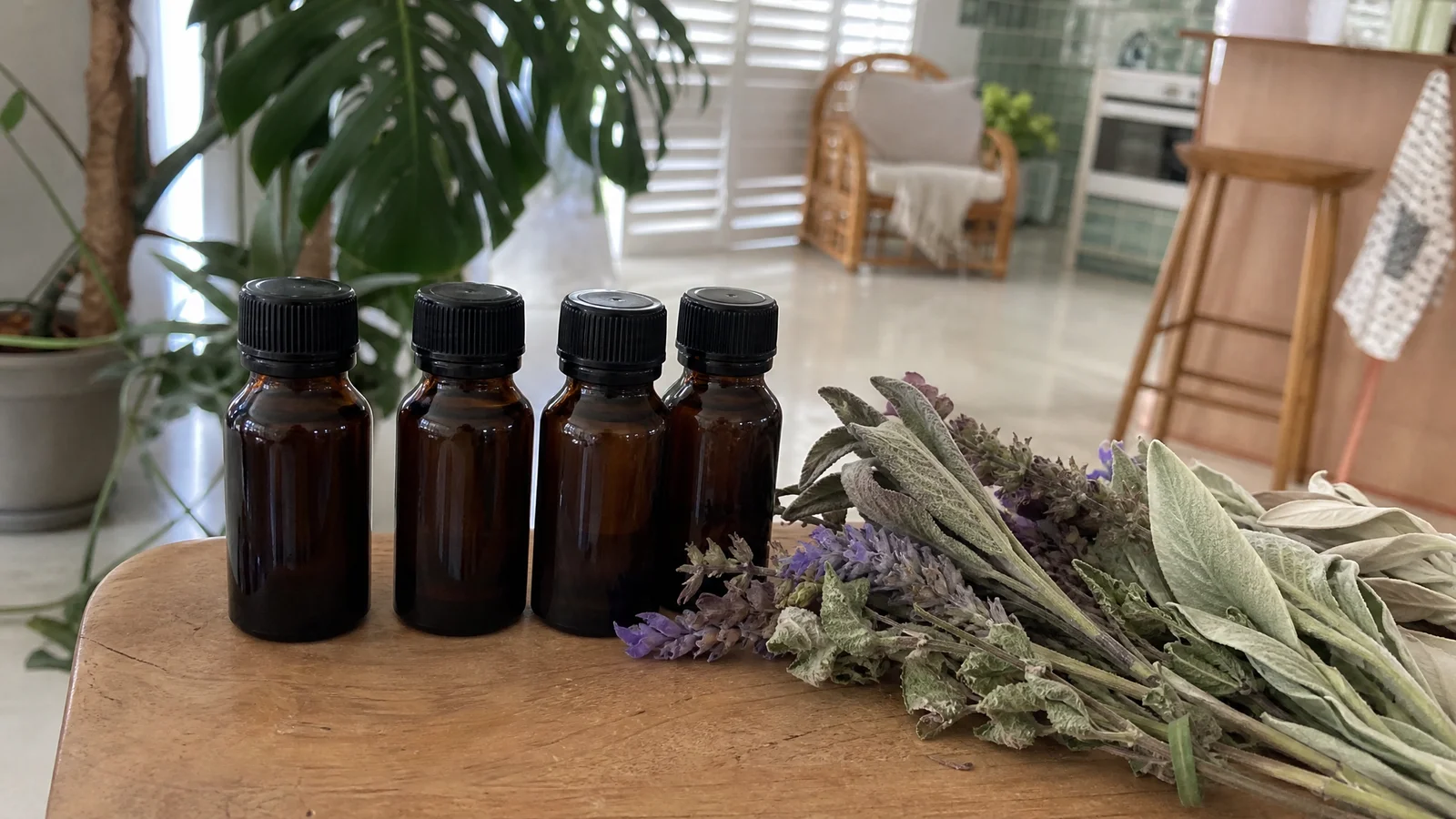
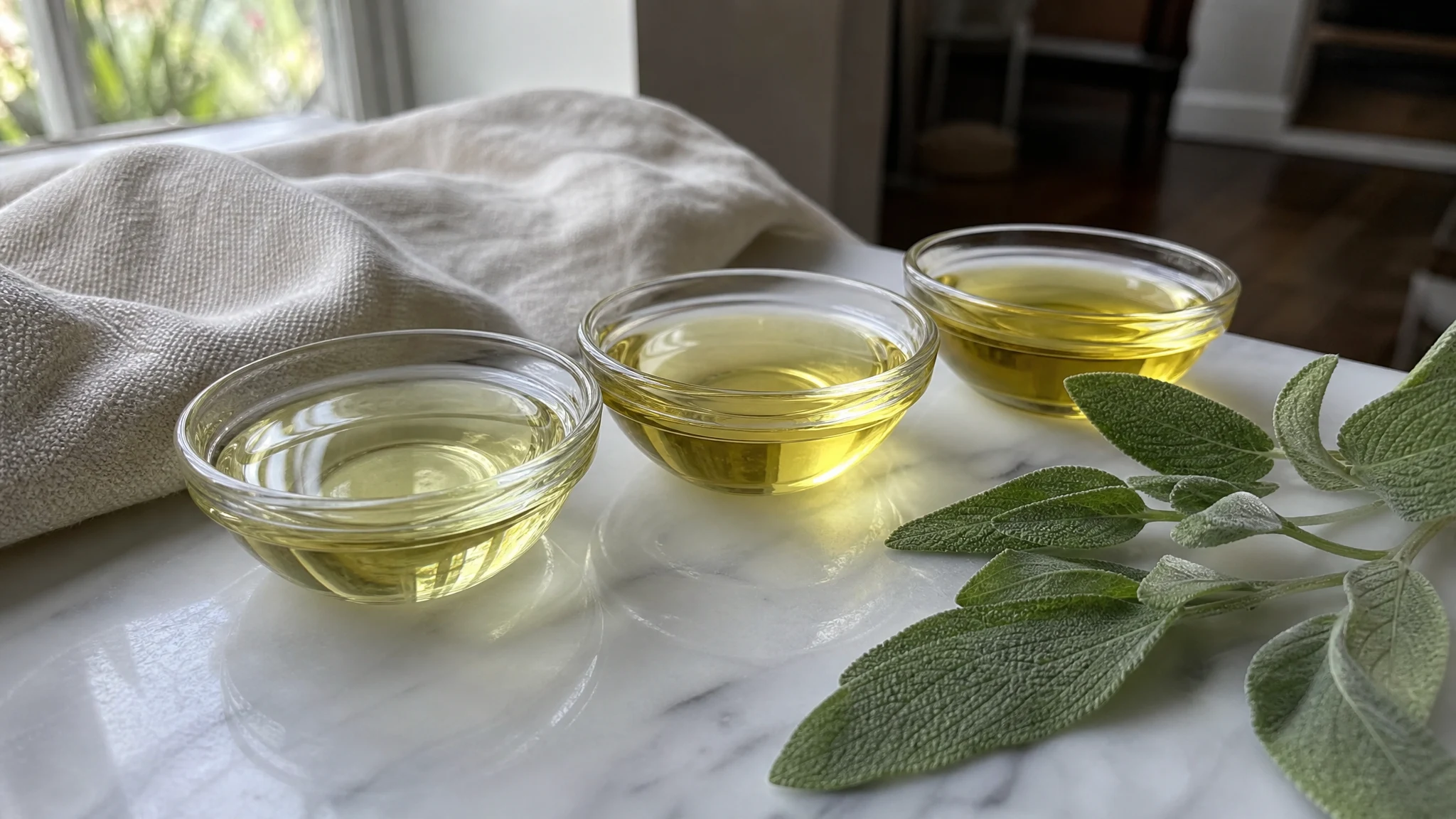
Hold the bottle at arm's length, open it and wave it gently toward you. The first thing you meet is a dry, green sharpness, then the camphor edge that makes the nose tingle, then a quieter herbal layer underneath. The colour in the bottle is a pale yellow. It pours thinly, much like water, and the scent tends to cling to the dropper, the cap and your fingertips for far longer than you expect.
That clinging quality is useful to know. Wipe the neck after each use, wash your hands before you touch your face, and keep a paper towel handy. A tiny amount goes a very long way.
What our paperwork covers
The Certificate of Analysis we publish is for one batch. It names Salvia officinalis, leaf, steam distilled, and reports appearance and smell as complying, a relative density of 0.915, a refractive index of 1.469 and an optical rotation of minus 10 degrees at 20 C, each against a printed range. It does not break the oil down by constituent, so there is no thujone number on it. If you need one, ask us in writing through the contact page before ordering, and our GC-MS article explains what to look for in a report.
Starting with a small trial
If you are meeting sage oil for the first time, begin with the smallest quantity you can. Smell it on a paper strip, then in a small, well-ventilated space, and give your nose time to get to know it. Many people find sage is a love-it-or-wonder-about-it oil, and a trial tells you quickly which side you are on before you plan anything bigger.
Keeping it well
Like most essential oils, sage prefers to be kept tightly capped in a cool, dark place away from heat and sunlight, where it typically lasts two to three years. Our storage guide has the details. That is really all you need to begin: a clear sense of what the oil is, a light hand with it, and a lot of respect for how concentrated a single leaf can become.
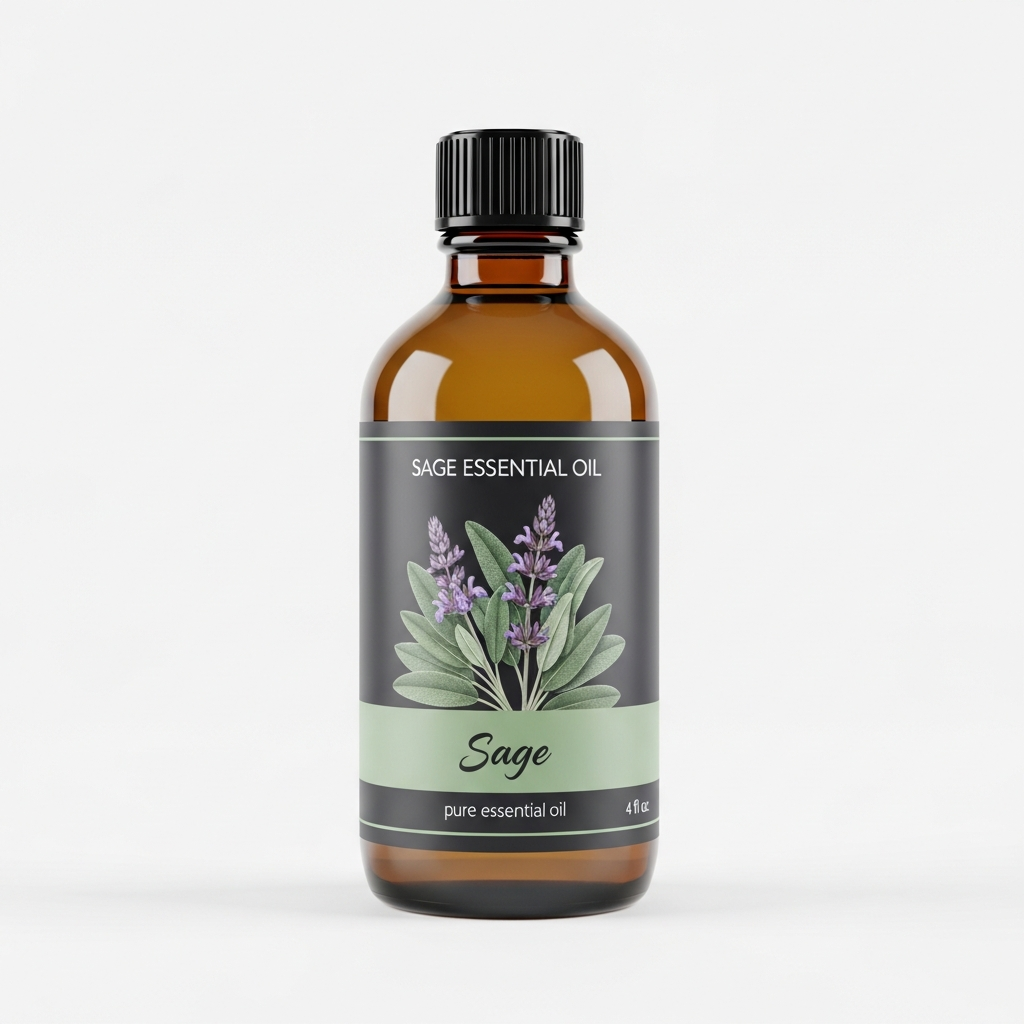
Sage Essential Oil
Sage Essential Oil from our own shop, in sizes from 0.5 oz to bulk.
From $13.99
Shop Now →Sources & Further Reading
- EMA/HMPC, 2016. Assessment report on Salvia officinalis L., folium and Salvia officinalis L., aetheroleum. ema.europa.eu
- EMA/HMPC, 2016. Public statement on Salvia officinalis L., aetheroleum. ema.europa.eu
- EFSA FEEDAP Panel, 2024. Safety and efficacy of a feed additive consisting of an essential oil derived from the leaves of Salvia officinalis L. (sage oil) for use in all animal species (FEFANA asbl). EFSA Journal. PMC11656093
- NCCIH. Sage: Usefulness and Safety. nccih.nih.gov