
Essential Oil Myths Examined: Ten Claims and Their Sources
Most essential oil myths survive because they sound plausible, not because anyone has tested them. A claim that a plant oil is natural, concentrated and ancient feels like it should be true, and the people repeating it are usually sincere. This piece takes ten common claims and sets each beside a primary source: a regulator, a poison centre, a national research agency or a standards document. We sell only sage oil, in two listings, so several of the examples come back to its thujone, and that is deliberate.
A quick way to sort any claim
Three questions do most of the work. Who would be penalised if the claim were false? A regulator's letter or a poison centre has a duty to be right in a way a product page does not. What was actually studied: a person inhaling an oil, a capsule, a cell dish or a rat? And does the claim say what the product is for? The US Food and Drug Administration states that how aromatherapy products are regulated depends mainly on their intended use, and that is why the claims below matter legally as well as factually.
Ten claims, ten sources
1. "Therapeutic grade means someone certified it"
No government grade by that name appears on the FDA's aromatherapy page, and that page says the FDA has no regulations defining "natural" or "organic" for cosmetics. In an April 2020 FDA warning letter (607088), wording that products were "tested for their . . . therapeutic quality" is listed among statements the agency treats as misleading. Real quality documents exist, such as ISO 9909 for Dalmatian sage oil, and we compare them in a separate explainer on the phrase.
2. "Natural means harmless"
Poison Control says misuse of essential oils can cause serious poisoning, that aspirating an oil can cause pneumonia, and that swallowed camphor is dangerous in small amounts. Sage is a direct example: the European Medicines Agency says sage oil is characterised by high levels of thujone, which is toxic and may cause seizures at high doses. Our process page tells readers to leave the oil alone with a seizure disorder.
3. "Oils guard against viral illness and boost immunity"
In April 2020 the FDA and the Federal Trade Commission sent warning letters to essential oil sellers whose sites said oils could address the coronavirus. One letter (606163, 6 April 2020) quoted a headline asking whether immune-building was a "coronavirus antidote" and a line about steam inhalation. The FDA concluded the products were unapproved new drugs, and the FTC said advertising a product against a disease without competent and reliable scientific evidence is unlawful. The FTC's health products guidance adds that randomised controlled human trials are the most reliable form of evidence and that animal, in vitro and anecdotal evidence alone are not sufficient.
4. "The FDA approves essential oils"
The FDA says plainly that the law does not require cosmetics to have FDA approval before they go on the market. A drug claim changes the category: it lists claims about colic, pain, muscle relaxation, depression, anxiety or sleep as drug claims. An oil sold for scent is not approved for anything, and one sold with those claims has a different problem.
5. "Food-grade oils can be swallowed"
We never advise swallowing an essential oil. Poison Control says swallowed eucalyptus oil can cause seizures and to call 1-800-222-1222 after any ingestion. For sage, the EMA statement warns that consuming sage oil in single-ingredient products carries a high risk of exceeding the 6.0 mg per person per day thujone limit it sets for sage leaf preparations, for at most two weeks. As orientation only, not a dose: one drop is about 0.05 ml, which is about 46 mg at the density of 0.915 on our published certificate. At ISO 9909's combined thujone range of 21% to 51.5%, that is roughly 9.6 to 23.6 mg of thujone per drop, which is 1.6 to 3.9 times the EMA's 6.0 mg daily ceiling for leaf preparations. The ceiling is for a different material, so the number shows scale, not a threshold. Culinary sage and sage tea are not the oil; see why culinary sage is not the oil.
6. "Oils detox the body"
The National Center for Complementary and Integrative Health, on its detoxes and cleanses page (March 2025), reports only a small number of studies on detoxification programmes in people, often poorly designed, and warns that some programmes can be unsafe and falsely advertised. That page does not discuss oils at all, which is itself the finding: no source we read provides a study showing an oil removes anything from a body.
7. "A diffuser cannot hurt pets"
The ASPCA, in an article of 4 June 2020, says cats are especially sensitive to essential oils, that inhalation could lead to aspiration pneumonia, and that because toxicity varies among oils it would not recommend using any in areas where pets have access, unless pets are supervised or a veterinarian approves. The ASPCA animal poison line is (888) 426-4435. Our process page says to keep the oil away from pets; see what poison lines say about cats, dogs and diffusers.
8. "A few drops cannot matter to a child"
Poison Control says children have thin skin and immature livers and may be more susceptible. A case series of three toddlers aged 15 to 36 months had seizures from camphor, two by swallowing and one from repeated skin rubbing. Camphor is a component of sage oil, up to 24.5% under ISO 9909. Our page says not to use sage oil on or around children.
9. "Aromatherapy is proven"
NCCIH's aromatherapy page (January 2020) says that for insomnia it is not known whether aromatherapy helps because little rigorous research has been done, and in a stress study lemon improved mood while neither scent affected stress indicators. In nausea, the Cochrane review (Hines and colleagues, 2018) found an interval of -0.63 to 0.18 around its aroma-versus-placebo result, which includes no effect. "Proven" is not the word the sources use. The broader question is taken up in what reviews of the trials conclude.
10. "Sage oil clears or cleanses a space"
We make no such claim, and no source we fetched supports one. Our shop copy uses the words "clearing" and "ritual" for atmosphere, and we do not stand behind any effect on air, a room or a person. White-sage smudging is a different plant, Salvia apiana, and a living practice of Indigenous peoples in California; an oil of garden sage does not replace or equal it. Our comparison of the two traditions goes into that.
What this means for buying
If a label or page uses a grade word, a health word or a purity word, ask what document sits behind it. For sage, the published certificate of analysis for one batch lists a measured density, refractive index and optical rotation and nothing on composition; a buyer with a safety reason should ask in writing for a thujone figure before ordering. That ask is the practical answer to nearly every myth above: replace a slogan with a document.
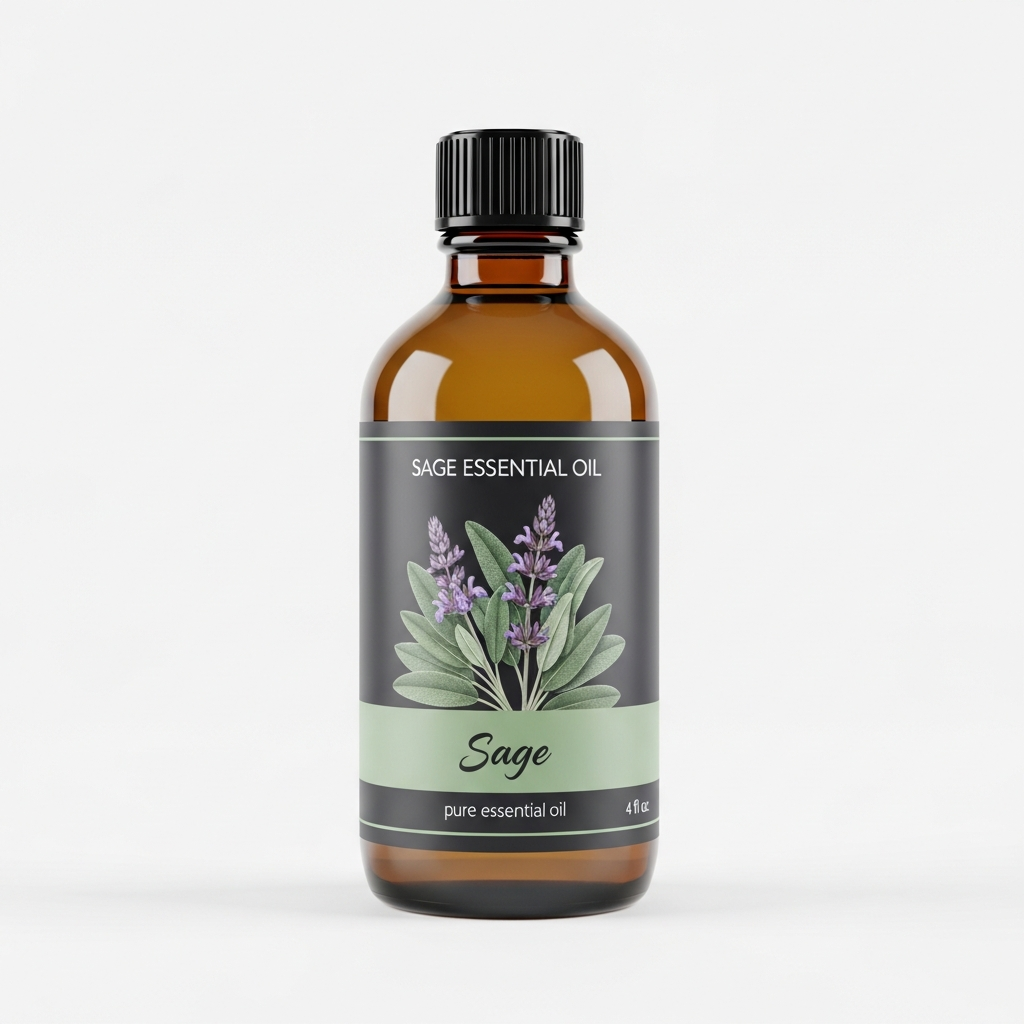
Sage Essential Oil
Sage Essential Oil from our own shop, in sizes from 0.5 oz to bulk.
From $13.99
Shop Now →Sources & Further Reading
- FDA, 2023. Aromatherapy. fda.gov/cosmetics/cosmetic-products/aromatherapy
- FDA, 2020. Warning letter 607088, 27 April 2020. fda.gov warning letter 607088
- FDA and FTC, 2020. Warning letter 606163, 6 April 2020. fda.gov warning letter 606163
- FTC. Health products compliance guidance. ftc.gov/business-guidance/resources/health-products-compliance-guidance
- Poison Control (poison.org). Essential oils. poison.org/articles/essential-oils
- EMA/HMPC, 2016. Public statement on Salvia officinalis L., aetheroleum (EMA/HMPC/41843/2009 Corr. 1). ema.europa.eu/EMA/HMPC/41843/2009
- NCCIH, 2025. Detoxes and cleanses: what you need to know. nccih.nih.gov/health/detoxes-and-cleanses
- NCCIH, 2020. Aromatherapy. nccih.nih.gov/health/aromatherapy
- ASPCA, 2020. Pet poisons: be mindful of these household products and cleaning agents. aspca.org/news/pet-poisons
- Khine H et al., 2009. A cluster of children with seizures caused by camphor poisoning (Pediatrics 123:1269-72). pubmed.ncbi.nlm.nih.gov/19403490
- Hines S et al., 2018. Aromatherapy for postoperative nausea and vomiting (Cochrane CD007598). pubmed.ncbi.nlm.nih.gov/29523018
- ISO 9909:1997. Oil of Dalmatian sage (Salvia officinalis L.), preview copy. standards.iteh.ai/ISO-9909-1997