Therapeutic Grade Essential Oils: Who Grades and What It Means
No government regulator or standards body grades essential oils as "therapeutic". The phrase is a seller's word, and the documents that do exist for sage oil are narrower, older and more forgiving than the phrase suggests. This article sets out what the US agencies say about the words, what the one international standard for Dalmatian sage oil specifies, and where the certificate of analysis we publish does and does not line up with it.
What the agencies say about grade words
The FDA's aromatherapy page (current as of 8 September 2023) says that how an aromatherapy product is regulated depends mainly on how it is intended to be used, that cosmetics need no FDA approval before sale, and that the FDA has no regulations defining "natural" or "organic" for cosmetics. The page defines no grade of essential oil. Where a seller adds a health promise to a grade word, the FDA reads the promise. In a warning letter dated 27 April 2020 (607088) the agency listed website wording that products were "tested for their . . . therapeutic quality" among statements it treated as misleadingly presenting products as safe or effective.
The Federal Trade Commission's health products guidance sets the evidence bar for health claims at "competent and reliable scientific evidence", generally studies accepted in the profession to yield accurate and reliable results, with randomised controlled human trials the most reliable form. A grade word that implies a health result inherits that bar. We did not find, in the pages we fetched from either agency, a definition of "therapeutic grade" or any scheme for awarding it.
What an actual standard looks like: ISO 9909
For sage there is a real document. ISO 9909:1997, first edition, covers "oil of Dalmatian sage (Salvia officinalis L.)" and says its purpose is to specify certain characteristics "in order to facilitate assessment of its quality". It defines the oil as steam-distilled from the leaves. It is a specification you can measure against, not a ranking. The requirements, as printed in the 1997 edition (the one we could read):
| Characteristic (20 C) | ISO 9909 requirement |
|---|---|
| Colour | Colourless to yellow |
| Relative density | 0.910 to 0.930 |
| Refractive index | 1.4580 to 1.4740 |
| Optical rotation | +2 to +30 degrees |
| Carbonyl value | 103 to 288 (28% to 78% as thujone) |
| Alpha-thujone | 18% to 43% |
| Beta-thujone | 3% to 8.5% |
| Camphor | 4.5% to 24.5% |
| 1,8-Cineole | 5.5% to 13% |
The chromatographic profile in the standard is normative, and its proportions are those "indicated by the integrator", that is, gas-chromatography peak areas. Notice what the numbers allow. Adding the two thujones gives a permitted combined range of 21% to 51.5%, so two oils can both meet the standard with the thujone content differing by a factor of about 2.5. That matters because thujone is the compound behind the safety limits described in what the thujone number means. "Meets ISO 9909" is therefore a statement about a window, not about where in the window an oil sits. As a worked case, one drop is about 0.05 ml, or about 46 mg at a density of 0.915 (the density on our published certificate, for one batch). Alpha-thujone alone at ISO's 18% is about 8 mg per drop and at 43% about 20 mg per drop, before adding the beta isomer. The grade word never tells you which end you bought.
How wide the window is in practice
Published batches show the spread. An EFSA opinion on a sage oil feed additive (2024) reports five batches by GC-FID, as percentage of peak area: alpha-thujone averaging 24.96 (23.54 to 26.00), camphor 18.74, 1,8-cineole 10.70 and beta-thujone 5.60. The applicant's own specification window for alpha-thujone was 18 to 27, narrower than ISO's 18 to 43. The EMA assessment report, citing Bradley (2006), gives wider literature ranges for the leaf oil: alpha-thujone 10% to 60%, beta-thujone 4% to 36%, camphor 5% to 20%, and describes the composition as "very variable" with source and harvest time.
Even a paper that says its oil fits the standard can sit at the edge. A Tunisian study of hydrodistilled leaf (Khedher and colleagues, 2017) reported camphor at 25.14% and alpha-thujone at 18.83%, and states that its main constituents fit the ISO 9909 profile. By our reading of Table 1 above, 25.14% is 0.64 points over the 24.5% camphor maximum. We do not draw a conclusion about that paper, only a practical one: check the number against the table yourself rather than accept "meets the standard" as a phrase.
Where our own wording and certificate sit
The shop sells one of our two sage listings as "botanical grade". That is the shop's descriptor. It is not an external standard and no outside body awards it. The certificate of analysis we publish is for one batch (SAGHMCSOESC001A, best by 02/19/2027). It names Salvia officinalis and steam distillation, and reports three measured values at 20 C: relative density 0.915, refractive index 1.469, optical rotation -10 degrees. It contains no gas chromatography, so no thujone, camphor or cineole figure.
Set beside ISO 9909 as a factual comparison: the density of 0.915 and refractive index of 1.469 fall inside ISO's ranges. The optical rotation of -10 degrees falls outside ISO's range of +2 to +30. The certificate's own stated acceptance range for rotation is -10 to +29, which is not ISO's range, and its stated density and refractive index ranges (0.903 to 0.925 and 1.457 to 1.469) begin below ISO's lower limits of 0.910 and 1.458. We cannot say why from a physical-constants certificate; a gas-chromatography report would be the document to ask. The same EFSA opinion printed optical rotations for its five commercial batches as "between 7.0 and -8.44", so negative values appear in commercial sage oil, though -10 is beyond that printed range. One batch is one batch: nothing here describes every lot.
That is what the paperwork supports, and why we would rather you read it than rely on a label word. If species, thujone or origin matter to you, how to read a gas chromatography report sets out the questions, and our buying guide covers the other labelling points. The certificate itself is linked so you can check each number above against the page.
Four questions that replace a grade word
- Which document sits behind the word, and does it name a standard (such as ISO 9909) and a batch?
- Does it include a gas-chromatography table with the compounds you care about, or only physical constants?
- Who ran it, and can you get the report in writing?
- Does the seller attach a health promise to the word? If so, the FDA and FTC material above applies to them, not to you.
For anyone buying for a safety reason, such as pregnancy, a seizure disorder or a workplace limit, ask for the thujone figure in writing before ordering and take the answer to the professional who needs it.
Sage Essential Oil
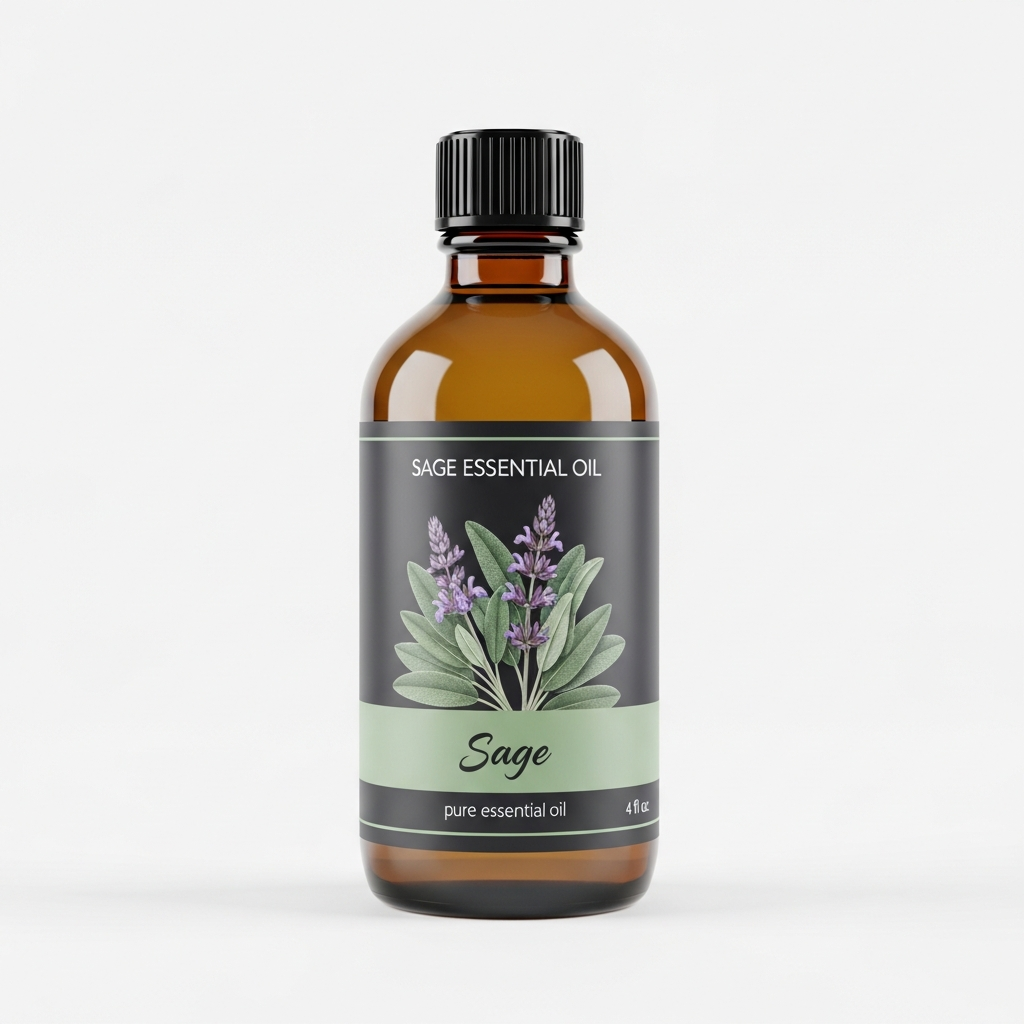
Sage Essential Oil from our own shop, in sizes from 0.5 oz to bulk.
From $13.99
Shop Now →Sources & Further Reading
- FDA, 2023. Aromatherapy. fda.gov/cosmetics/cosmetic-products/aromatherapy
- FDA, 2020. Warning letter 607088, 27 April 2020. fda.gov warning letter 607088
- FTC. Health products compliance guidance. ftc.gov/business-guidance/resources/health-products-compliance-guidance
- ISO 9909:1997. Oil of Dalmatian sage (Salvia officinalis L.), preview copy. standards.iteh.ai/ISO-9909-1997
- EFSA FEEDAP Panel, 2024. Safety and efficacy of a feed additive consisting of sage oil (EFSA J 22:e9135). pmc.ncbi.nlm.nih.gov/articles/PMC11656093
- EMA/HMPC, 2016. Assessment report on Salvia officinalis L., folium and aetheroleum (EMA/HMPC/150801/2015). ema.europa.eu/EMA/HMPC/150801/2015
- Khedher MRB et al., 2017. Chemical composition and biological activities of Salvia officinalis essential oil from Tunisia (EXCLI J 16:160-173). pmc.ncbi.nlm.nih.gov/articles/PMC5427463