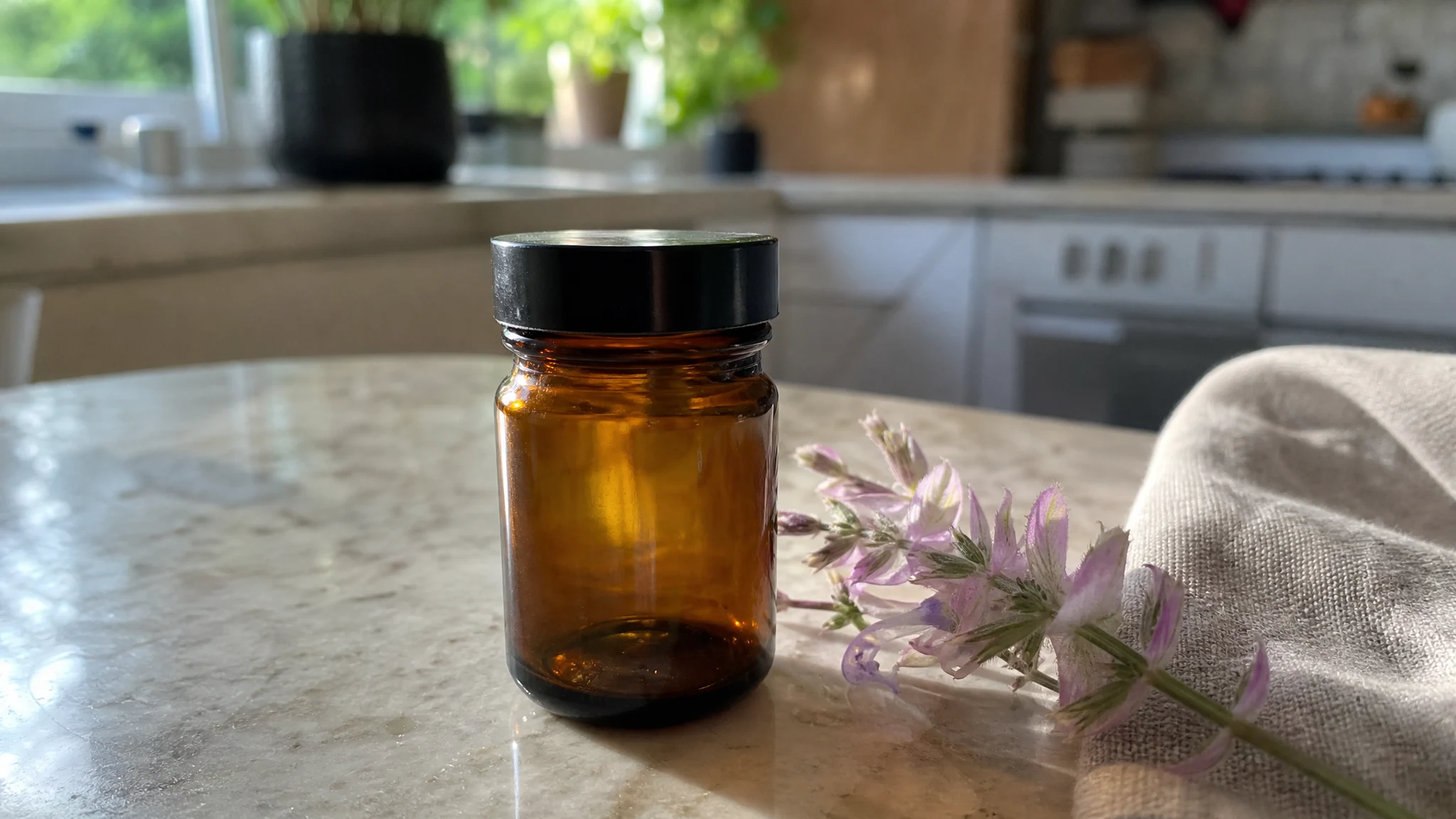
Sage, Geranium and Patchouli Body Oil Formula
Sage, geranium and patchouli read like a well-built perfume: a dry herbal opening, a rosy heart and a dark, leafy base. They also happen to be a trio where one member, sage, has a much smaller allowance than the other two, and that shapes the whole formula. Here is how the three fit together, worked out in grams.
What each oil brings
Sage gives the opening. EFSA analysed five batches of one sage oil and described it as having a characteristic camphoraceous odour with a spicy note, built on alpha-thujone (24.96%), camphor (18.74%), 1,8-cineole (10.70%) and beta-thujone (5.60%).
Geranium gives the heart. In EFSA's analysis of five geranium rose oil batches, citronellol averaged 32.3% and geraniol 15.1%, which PubChem describes as "fresh rosy" and "sweet rose".
Patchouli gives the base. EFSA describes its odour as leafy and humic and notes that its value lies in its fixative properties when blended with other essential oils, helping to reduce evaporation and promote tenacity. In a blend, that means patchouli helps the lighter notes last.
EFSA classes sage and geranium as skin sensitisers, and patchouli as a skin irritant and respiratory sensitiser, so the patch test belongs to the whole blend and not only to the sage. Our patch test article explains what a home test can and cannot show.
Sage sets the ceiling
IFRA caps thujone in finished products by category: 0.095% in a body oil applied by hand, 0.032% in a facial moisturiser. Dividing by the average 30.56% thujone from those sage batches gives the most sage oil the product may hold, about 0.31% for the body oil and 0.1% for the face. If an oil sat at the top of the European Medicines Agency's ranges, about 96% thujone combined, those fall to roughly 0.1% and 0.03%.
The Certificate of Analysis we publish for one batch has no thujone figure, so a formula should work at the cautious end. Our skin guidance for sage alone is 0.5% to 2% in a carrier with a patch test first. That range sits above these ceilings, so we begin at the bottom of it and do not treat 2% as a goal.
The formula, weighed for 100 g of body oil
This is arithmetic from the cited limits. A drop of our sage weighs about 0.046 g at the 0.915 relative density printed on the certificate, though droppers vary, so a scale reading to 0.001 g is better than counting.
| Ingredient | Grams | Share | Role |
|---|---|---|---|
| Sage oil | 0.092 | 0.092% | dry herbal opening |
| Geranium oil | 0.35 | 0.35% | rosy heart |
| Patchouli oil | 0.25 | 0.25% | leafy base and fixative |
| Jojoba or another stable carrier | 99.31 | 99.31% | carrier |
The sage is about two drops by weight. Its thujone contribution is 0.092% times the thujone share of the oil: 0.028% at 30.56% and 0.088% at 96%, both under the 0.095% cap. Making a kilogram puts the sage at 0.92 g, which is easier to weigh.
If you want sage to speak louder, the arithmetic says to turn the geranium and patchouli down rather than turn sage up. Doubling the sage to 0.184% stays under the cap only when the oil's total thujone is about 51% or lower, which holds at the average and not at the 96% end. Carrier, bottles and scales come from a craft supplier, as we sell only the sage.
This is a body formula and not a face one: if the oil sits at the 96% end, 0.092% sage would carry 0.088% thujone, nearly three times the 0.032% facial moisturiser cap. Geranium and patchouli also have components with their own IFRA entries. The index of standards lists restrictions on citronellol and geraniol, so check those for your final blend.
As a perfume oil instead
IFRA's guidance places non-hydroalcoholic fine fragrance, solid perfume and fragrancing creams in category 4, where the thujone cap is 1.4%. That allows about 4.6% sage oil at the average share. This is why a small roll-on can hold much more sage than a body oil. The total essential oil on a small patch of skin and the sensitiser status of all three oils still deserve attention, and our roller blend article covers the small-bottle arithmetic.
Smelling it before you commit
Before you weigh anything into a carrier, put a drop of each oil on its own paper strip and wave them under your nose one at a time. Sage will feel dry and sharp, geranium rounder and rosy, patchouli dark and earthy. Then hold sage and geranium together, and then all three, and write down what you notice.
Because the sage share is so small, you may find it nearly disappears next to the other two. That is by design: it should be a faint herbal lift at the start, not the headline. Many makers like to let a finished blend rest for a day, then smell it again with fresh eyes before deciding whether it needs adjusting.
Who should leave it out
Our process page asks that sage be avoided during pregnancy and breastfeeding, kept away from children, and left alone with a seizure disorder. If any of that applies at home, choose a different scent. Our look at what aromatherapy trial reviews conclude is worth a read before attaching any mood or focus idea to a blend: we describe how it smells and nothing more.
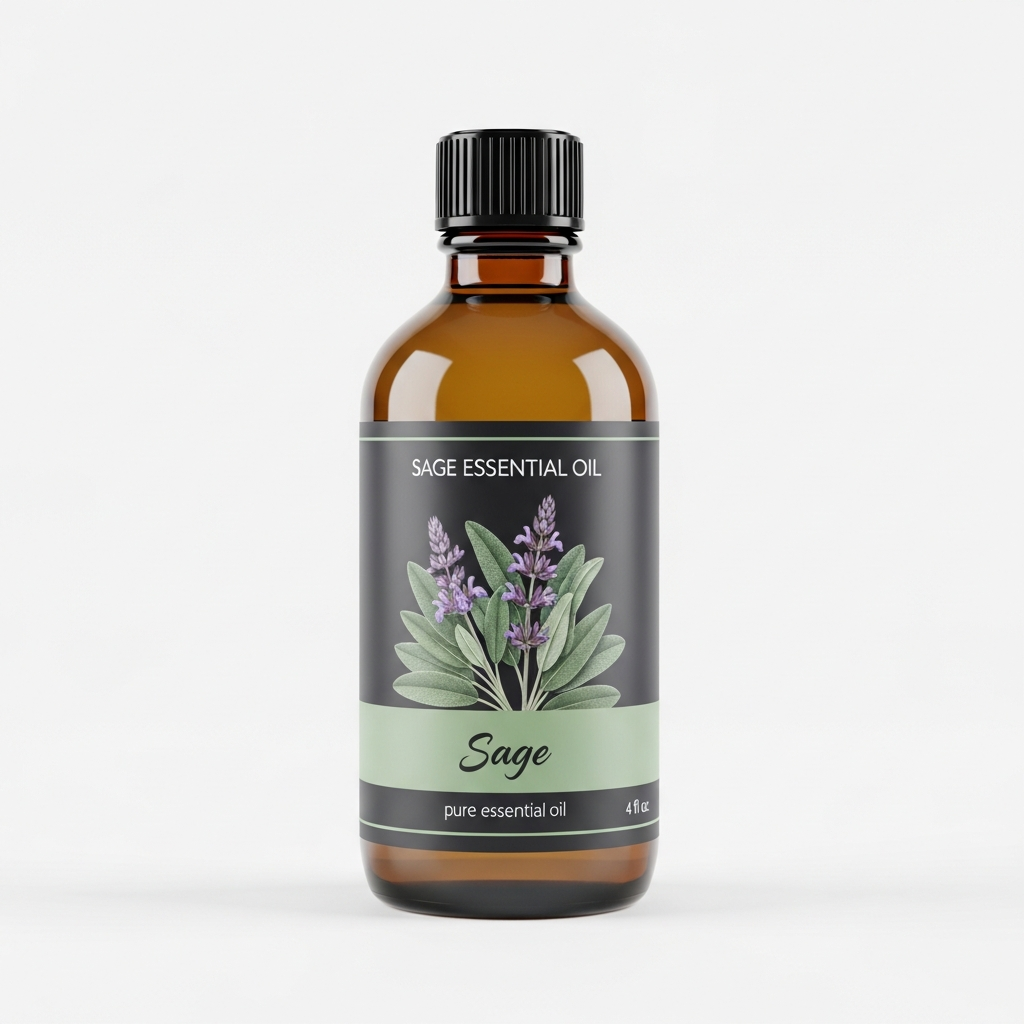
Sage Essential Oil
Sage Essential Oil from our own shop, in sizes from 0.5 oz to bulk.
From $13.99
Shop Now →Sources & Further Reading
- EFSA FEEDAP Panel, 2024. Safety and efficacy of a feed additive consisting of an essential oil derived from the leaves of Salvia officinalis L. (sage oil) for use in all animal species (FEFANA asbl). EFSA Journal. PMC11656093
- EFSA FEEDAP Panel, 2023. Safety and efficacy of a feed additive consisting of an essential oil from the herbaceous parts of Pelargonium graveolens L'Hér. (geranium rose oil) for all animal species (FEFANA asbl). EFSA Journal. PMC10373134
- EFSA FEEDAP Panel, 2025. Safety and efficacy of a feed additive consisting of an essential oil derived from the leaves of Pogostemon cablin Benth. (patchouli oil) for use in all animal species (FEFANA asbl). EFSA Journal. PMC12004087
- IFRA, Thujone, IFRA Standard, Amendment 49 (2020). ifrafragrance.org/standards/IFRA_STD_102.pdf
- IFRA, Guidance for the use of IFRA Standards, 51st Amendment (30 June 2023). IFRA guidance PDF
- IFRA, Index of IFRA Standards - 51st Amendment. IFRA index PDF
- EMA/HMPC, 2016. Assessment report on Salvia officinalis L., folium and Salvia officinalis L., aetheroleum (EMA/HMPC/150801/2015). ema.europa.eu
- PubChem, Odor sections for Citronellol (CID 8842) and Geraniol (CID 637566). pubchem.ncbi.nlm.nih.gov