Diffuser Types Compared: Which One Suits You?
Walk down the diffuser aisle and every box promises the same thing: a soft cloud of scent. What the boxes do not tell you is how different the machines are once they are on your counter. One needs water and a rinse every day, one runs on undiluted oil, one is a warm dish, and one has no switch at all. The right choice comes down to how much upkeep you will actually do and whether you can turn it down.
Ultrasonic: the familiar misting bowl
An ultrasonic diffuser vibrates a small pool of water so that it breaks into fine mist, and you add a few drops of oil to that water. Because the oil is diluted so heavily, this design tends to be the easiest to keep light, and most models have a timer or an automatic shut-off.
The trade is water care. The US EPA, writing about home humidifiers, notes that ultrasonic and impeller models can disperse minerals and microorganisms from their tanks into the air, and its advice is simple: empty the tank, dry the surfaces and refill daily, use low-mineral water such as distilled water, and clean the unit every third day (EPA). The page is about humidifiers, but a diffuser that mists water is the same kind of machine, so we follow the same habits. Our guides to cleaning a diffuser and setting one up walk through the routine.
Nebulizing: oil only, no water
A nebulizing diffuser skips the water. In one maker's manual, you pour 20 to 25 drops of essential oil straight into a glass reservoir and a pump atomizes it. The same manual asks for undiluted oil only (no water, no carrier oils), warns that thick resin and root oils such as frankincense, patchouli and vetiver can dry inside and clog the tubes, and recommends a small isopropyl alcohol rinse plus a deeper monthly clean (Organic Aromas).
At about 20 drops to the millilitre, that reservoir holds around a millilitre of neat oil. That is simple arithmetic, and it is why a nebulizer suits people who want a strong, undiluted scent and are happy to maintain it. It is also the design where you have the least say over how much oil ends up in the air.
Heat and evaporative: simple, but warm
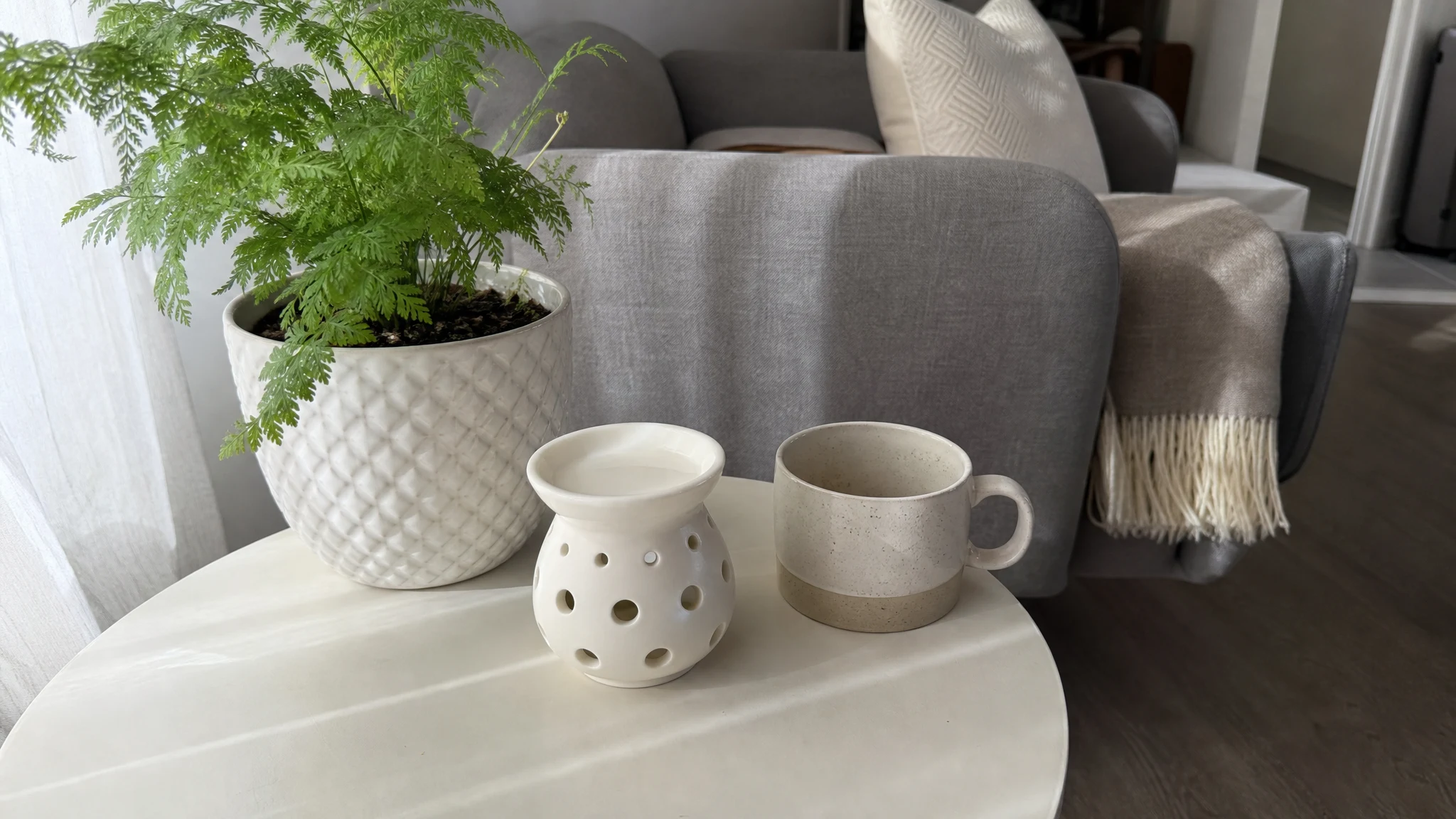
Candle warmers, plug-in heaters and fan pads gently evaporate the oil. They are simple and quiet, and there is not much to clean. They also change what the air carries. A pilot household study with tea tree oil compared an ultrasonic diffuser with a heat diffuser, and the terpene levels measured with the heat unit were roughly an order of magnitude higher; several exceeded long-term reference levels, while the ultrasonic unit stayed below its limits (Zisook et al., 2025). It was one oil, one set-up and one machine of each type, so treat it as a useful pointer toward moderation rather than a verdict.
Reed: no power, no off switch
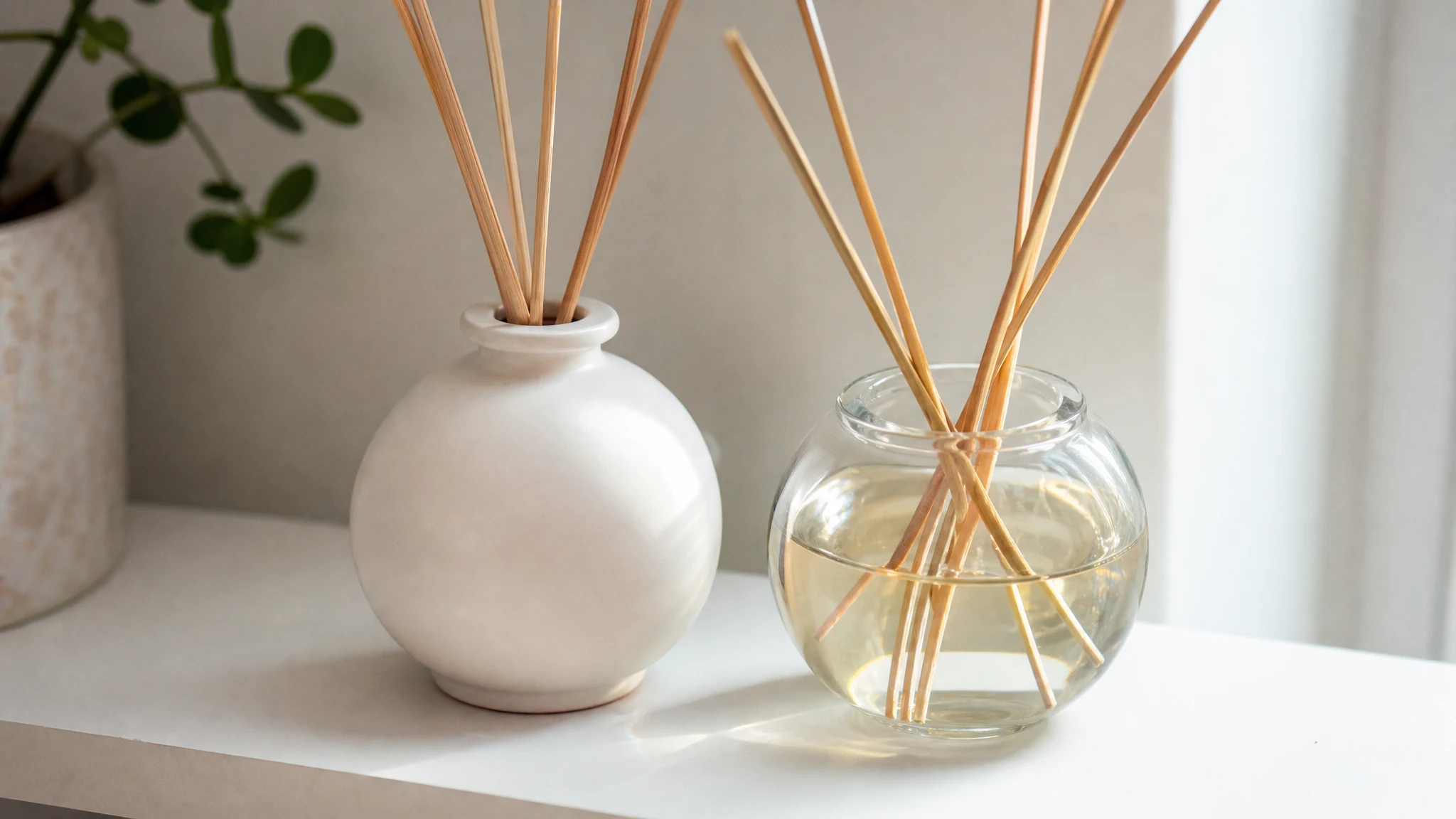
A reed diffuser is a jar of scented liquid with rattan sticks that draw it up and release it. It is lovely on a hall table and needs no cord. What to know is built into its charm: once the reeds are in, the scent keeps going, and the only way to turn it down is to take some reeds out. We would think of a reed diffuser as a decorative background scent rather than something you dial in.
Where it sits in the room
Wherever you put a diffuser, give it a flat, stable surface with a little space around it, away from the edge of a shelf and off anything that does not like a splash. Scent drifts, so a spot a step or two from where you sit usually feels gentler than one right beside your chair. A small tray or saucer underneath catches drips and makes cleaning tidier. Listen to it, too: some machines are nearly silent and some hum, and a hum you notice every minute will bother you more than any aroma. And keep it where children and pets cannot knock it over or reach the bottle.
Which one for sage oil
Our sage oil is garden sage, and it behaves differently from a citrus or a mint. It is rich in thujone, and our guidance is to use a lighter hand with it than you would with other oils, to avoid it in pregnancy and breastfeeding, to keep it away from children and pets, and to leave it alone if you have a seizure disorder. The European Medicines Agency describes thujone as toxic at high doses and could not find a positive benefit-risk balance for sage oil as a herbal medicine (EMA/HMPC, 2016). That statement is about taking the oil, not diffusing it, and we are not aware of measurements of inhaled sage oil from any design.
So we reason from control. If you diffuse sage at all, the design that lets you keep the amount lowest is an ultrasonic unit with a timer: a very small number of drops in the water, a short session and a window or door open nearby. Our drops-in-a-diffuser piece shows how to do the arithmetic, and is diffusing safe covers what air studies have measured. If a household includes anyone pregnant, a child, a pet or someone with seizures, skipping sage in the diffuser is the simple answer.
We sell the oil, not the equipment, so any diffuser will come from a home-goods or aromatherapy supply shop. If you need a thujone figure for your own reasons, ask us in writing through the contact page before ordering. Whichever machine you pick, a clean tank and a timer will do more for your enjoyment than a longer feature list.
Sage Essential Oil
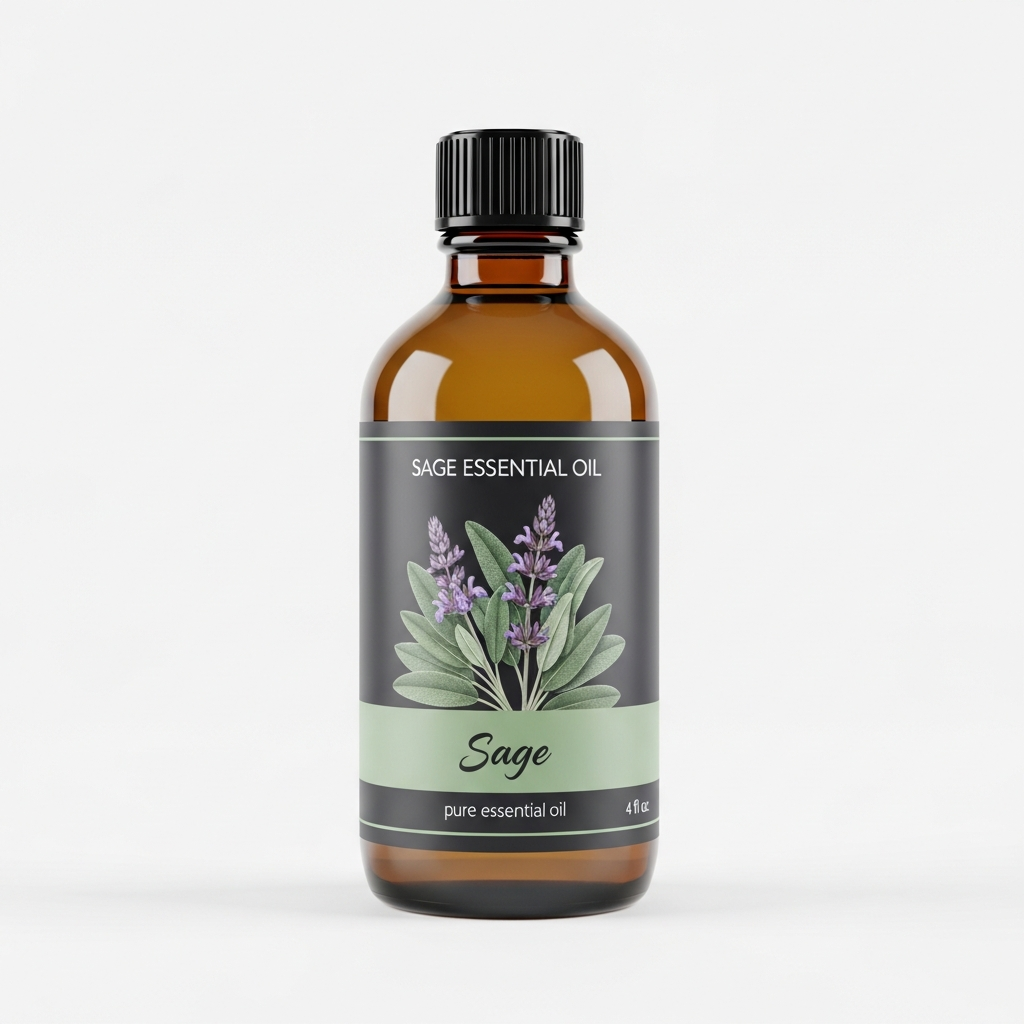
Sage Essential Oil from our own shop, in sizes from 0.5 oz to bulk.
From $13.99
Shop Now →Sources & Further Reading
- US EPA. Use and Care of Home Humidifiers. epa.gov
- Organic Aromas. Mobile-Mini Nebulizing Diffuser Instruction Manual. organicaromas.com
- Zisook RE, Nembhard MD, Bandara SB, Gaffney SH, 2025. Volatile organic compound and particle emissions from the use of tea tree oil in essential oil diffusers. J Occup Environ Hyg. PubMed 41004428
- EMA/HMPC, 2016. Public statement on Salvia officinalis L., aetheroleum. ema.europa.eu