Sage Oil Room Spray: Drops, Mixing and Safety
Picture the scene: a quiet evening, a tidy room, and a wish to make the air feel fresh. Many people reach for a bundle of smoking sage to do it, and that tradition belongs to white sage (Salvia apiana), a different plant with a living place in Indigenous practice. Garden sage oil is something else. What it offers a room is an aroma: dry, green, herbaceous and a little camphoraceous. Treated that way, it makes a lovely mist or diffuser oil, in modest amounts.
The mist: how much oil can a bottle hold?
A manual room spray falls in IFRA's category 10B, air freshener sprays. The IFRA standard on thujone allows 0.22% thujone in finished 10B products, with neurotoxicity as the reason for the limit. About a third of a typical sage oil is thujone, so the limit becomes a limit on oil. One European Food Safety Authority analysis of a sage oil found about 30.6% thujone; the European Medicines Agency's assessment report cites literature ranges of roughly 14% to 96%. Dividing gives a cap of about 0.72% oil in the bottle at the average, 1.6% at the low end, and 0.23% at the high end.
For a 100 mL bottle of mostly water, treat 1 mL as 1 g. A drop is about 0.05 mL, or around 0.046 g at the 0.915 g/mL density on our certificate of analysis. That puts the average cap at about 16 drops, and the high-end cap at about 5. Our certificate covers density, refractive index and optical rotation for one batch and carries no thujone figure, so we start from five drops per 100 mL and go no higher unless you have a written thujone figure. If you want one, ask us through the contact page before ordering. These are numbers worked out from published limits, offered as a starting point. IFRA's guidance lists aromatherapy applications as outside its assessments, so treat the limit as a yardstick for a home project.
Making it stay mixed
This is the step where room sprays most often go wrong. The Tisserand Institute states that essential oils are not water soluble. Oil that goes into a bottle of water rises to the top, so the first sprays after a pause are far stronger than the average you calculated, and later ones are nearly plain water. Shake the bottle every time, or use a dispersant such as Solubol or polysorbate, which you will find at a cosmetic supply shop since we do not sell them. Make a small bottle at a time, spray into the air and away from skin, eyes, pets and bedding, and keep surfaces in mind, since oil can mark finishes.
Setting up a small bottle
Choose a bottle that suits a small batch. A fine-mist spray bottle in dark glass or opaque plastic keeps light off the oil, and one that holds 100 mL or less means you finish it before it grows tired. Rinse it well before you start and let it dry fully, since stray water is the main thing that makes a homemade spray go off. Bottles and dispersants come from a craft or cosmetic supply shop; we sell the oil only.
Add the oil to the bottle first and the water after, then shake. Label it with the date and the number of drops, and keep it in a cupboard rather than on a sunny shelf. A spray you mix in small amounts is easy to remake, which is a kinder habit than stretching one batch for months.
What you will notice
A mist of this kind is a light, brief scent. Spray once into the air and step out of the way, and you will notice the dry, herbal green of sage arrive first and thin out within minutes. If you find yourself wanting several sprays to catch it, the usual answer is to wait, leave the room and come back, because your nose adjusts quickly to a scent it has been sitting in.
The diffuser
An ultrasonic water diffuser does not appear by name in the IFRA guidance tables we read, so we do not assign it a category. Our process page says diffusing sage needs a lighter hand than you would use with a mint or a citrus, which is a good rule: start low, run in short spells and keep the room ventilated. Stop if anyone gets a headache, cough or watery eyes. Our guides to drops in a diffuser and whether diffusing is safe explain the numbers and what air studies measured. A reed diffuser is a separate case: the Poison Control page on essential oils notes that the liquid is essential oil in isopropyl alcohol and must be kept out of reach of children.
Who shares the room
This is where sage differs from most oils. Our position is to avoid sage oil during pregnancy and breastfeeding, never to use it on or around children, and to leave it alone if there is a seizure disorder in the household. The Poison Control page also notes that swallowing more than a very small amount of sage oil has caused seizures in children, so the bottle itself belongs well out of reach. If that describes your home, a different aroma will serve better, and a window open for a few minutes is a fine way to refresh the air.
For anyone drawn to the ritual side of things, our article on sage oil and white sage smudge explains how the two differ. The oil gives you a scent to enjoy; the plant tradition is a different practice and deserves respect.
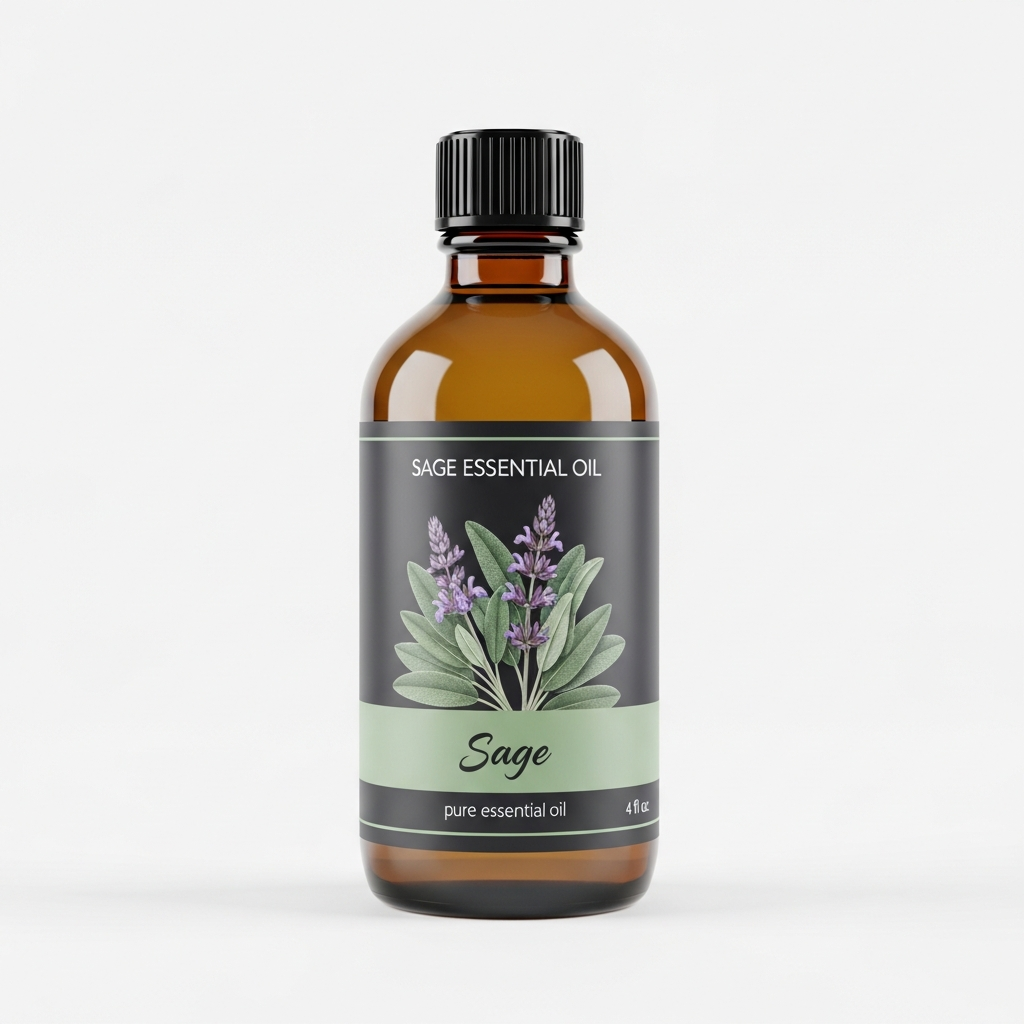
Sage Essential Oil
Sage Essential Oil from our own shop, in sizes from 0.5 oz to bulk.
From $13.99
Shop Now →Sources & Further Reading
- IFRA Standard: Thujone, 2020 (Amendment 49)
- Guidance for the Use of IFRA Standards (51st Amendment)
- Safety and efficacy of a feed additive consisting of an essential oil derived from the leaves of Salvia officinalis L. (sage oil) for use in all animal species (FEFANA asbl)
- Assessment report on Salvia officinalis L., folium and Salvia officinalis L., aetheroleum (EMA/HMPC/150801/2015)
- Bath Safety: how to use essential oils safely in the bath (Tisserand Institute)
- Essential oils: Poisonous when misused | Poison Control