A Short History of Sage: The Garden Herb Named for Wisdom
The name says everything. Salvia derives from the Latin salvere, meaning "to be well" or "to be in good health." For a plant that has been cultivated, dried, burned, and distilled across thousands of years of human civilization, that etymology feels earned. The history of sage is, in many ways, a history of how people have understood the relationship between plants and daily life.
This article focuses on the aromatic and cosmetic legacy of Salvia officinalis, commonly called garden sage or common sage. It traces the herb from its Mediterranean origins through medieval herb gardens and into the modern distillation industry. Along the way, we will look at what the plant is actually made of, what researchers have observed about its key compounds, and what you should know before incorporating sage essential oil into your personal care or aromatic rituals.
Origins: A Mediterranean Native
Salvia officinalis is native to the northern coastal regions of the Mediterranean, particularly the Dalmatian coast (present-day Croatia), southern France, and northern Italy. The genus Salvia is enormous, comprising somewhere between 900 and 1,000 species worldwide, but garden sage is the one that shaped Western botanical tradition most directly.
The ancient Greeks used sage in religious and domestic contexts. Theophrastus, writing in the fourth century BCE, described it among his catalog of useful plants in Historia Plantarum. Roman physicians and naturalists, including Pliny the Elder, documented sage extensively. Pliny noted its use in Roman kitchens and household practices, and the plant was considered important enough that Roman tradition developed specific protocols around its harvest, including the avoidance of iron tools when cutting it. Whether this was practical advice or ritual observance is now difficult to say. Likely both.
The officinalis in the species name is itself a piece of history. It signals that this plant was formally recognized and stocked by apothecaries, the medieval equivalent of a pharmacy. Plants carrying the officinalis designation were considered established enough to be part of official commerce. Garden sage earned that designation centuries ago and has held it ever since.
Sage Through the Medieval Period
After the fall of Rome, much of the accumulated knowledge of classical botany was preserved in monasteries across Europe. Benedictine monks maintained elaborate physic gardens, and sage was a standard resident. The famous ninth-century poem Hortulus, written by the monk Walafrid Strabo at the monastery on Reichenau Island, includes an affectionate passage on sage and its place in the garden.
The Salerno medical school in southern Italy, active from roughly the tenth through twelfth centuries and considered one of the earliest formal centers of medical learning in Europe, produced the Regimen Sanitatis Salernitanum. This widely copied text included sage among plants associated with longevity and vitality. A frequently quoted line from the text translates roughly as: "Why should a man die while sage grows in his garden?" The statement reflects the enormous esteem the herb commanded at that time, not a scientific claim by today's standards, but evidence of how deeply woven sage was into the fabric of European botanical culture.
Hildegard of Bingen, the twelfth-century German abbess and naturalist, also wrote about sage in her botanical writings. Her descriptions tend toward the aromatic and restorative properties of herbs encountered in daily monastic life, which aligns closely with how we now understand sage essential oil in a cosmetic and aromatic context.
From Dried Herb to Distilled Oil: The Shift to Essential Oil Production
Steam distillation as a refined technique became more widely documented in Europe through the work of scholars like Hieronymus Brunschwig, whose 1500 book Liber de Arte Distillandi described distillation processes for a range of aromatic plants. Sage was among them. The essential oil of sage, separated from the plant's water-soluble components, represented a more concentrated aromatic product than dried herb or infused preparations.
By the seventeenth and eighteenth centuries, sage oil had become part of the European perfumery and apothecary trade. Dalmatian sage oil, sourced from the Croatian coast, developed a particular reputation for quality that persists in the industry today. If you are curious about how the essential oil form differs from the dried culinary herb in practical use, the article Sage Oil vs. Dried Sage: Cooking Herb or Aromatic Oil covers that distinction in helpful detail.
Chemical Composition: What Is Actually in Sage Essential Oil
Understanding the history of sage essential oil means understanding its chemistry. The aromatic profile you detect when you open a bottle of Salvia officinalis oil is the combined result of dozens of volatile compounds, each present in varying proportions depending on geography, climate, harvest time, and distillation method.
The primary constituents identified in most analyses of Salvia officinalis essential oil include:
- Alpha-thujone and beta-thujone: Ketone compounds that contribute sage's distinctive sharp, slightly camphoraceous top note. These compounds are also the primary reason sage essential oil carries significant safety considerations (more on that below).
- Camphor: A bicyclic monoterpenoid with a cool, penetrating aroma. It contributes to sage oil's recognizable herbal sharpness and is also found in related plants such as rosemary and spike lavender.
- 1,8-Cineole (eucalyptol): A fresh, clarifying compound present in many aromatic plants. It softens the overall scent profile of sage oil and is associated with the cleaner, more breathable quality of the aroma.
- Borneol: An earthy, slightly woody compound that adds depth and complexity to the bottom of the scent.
- Beta-caryophyllene: A sesquiterpene found widely in the plant kingdom, contributing subtle spice and warmth.
- Linalool: Present in smaller amounts in sage compared to lavender, but it contributes a mild floral softness that balances the more aggressive aromatic notes.
The exact percentages of each compound vary meaningfully by origin. Dalmatian sage typically shows higher thujone content than French or Spanish sage. This is one reason sourcing transparency matters so much when purchasing sage essential oil. A quality supplier will share gas chromatography and mass spectrometry (GC/MS) reports showing the full chemical breakdown of a specific batch.
It is also worth noting that Salvia officinalis is a distinct species from the Spanish sage (Salvia lavandulifolia) and Greek sage (Salvia fruticosa) that appear in some commercial blends. Those related species have meaningfully different chemical profiles and different safety considerations. For a closer look at how they compare, see Spanish Sage and Greek Sage: Lesser-Known Salvias Worth Knowing.
What Research Observes About Sage Compounds
Modern laboratory research on Salvia officinalis and its constituents is active and ongoing. It is important to frame these findings accurately. Research observations made in laboratory or controlled settings do not translate directly into claims about what sage essential oil will do for any individual person in everyday use.
With that framing clearly in place: some research suggests that the aromatic compounds in sage essential oil, particularly 1,8-cineole and camphor, are associated with interesting olfactory effects that researchers have studied in the context of cognitive performance and mood. Some laboratory studies have observed interactions between sage compounds and acetylcholinesterase, an enzyme involved in neural signaling. These are early-stage observations, not established conclusions, and they relate to specific chemical extracts under controlled conditions rather than to aromatherapy use of the whole oil.
Researchers studying sage constituents in topical applications have noted observations related to skin surface interactions, though again, these findings are preliminary and apply to cosmetic contexts only. The scientific literature on sage is genuinely interesting and continues to develop. A good general-interest starting point for understanding the oil from a beginner's perspective is the article What Is Sage Essential Oil? A Complete Beginner's Guide.
Safety Profile and Contraindications
This section deserves careful attention, because the history of sage essential oil includes a history of its misuse. The thujone content in Salvia officinalis essential oil is the critical safety factor.
Thujone is a neurotoxic compound at sufficient concentrations. This is not alarmist. It is straightforward chemistry. The key points for anyone working with sage essential oil are:
- Dilution is essential. For topical use, sage essential oil should be diluted well below the thresholds used for less potent oils. A dilution of 0.4% to 0.5% in a carrier oil is a commonly cited guideline for leave-on skin products, though individual sensitivity varies. Always perform a patch test before broader application.
- Avoid during pregnancy. Salvia officinalis essential oil is contraindicated during pregnancy. This is a firm guideline, not a cautious suggestion.
- Avoid with certain health contexts. People with a history of seizure-related conditions should avoid sage essential oil. Consult a qualified healthcare provider before use if you have any ongoing health considerations or take any medications.
- Not for internal use. This article addresses aromatic and topical cosmetic applications only. Do not ingest sage essential oil.
- Keep away from children and pets. The thujone content makes sage oil particularly inappropriate for use around young children or household animals.
None of these cautions diminish sage essential oil's value as an aromatic and cosmetic ingredient. They simply clarify that it is a potent plant extract with a specific safety profile that rewards respect and informed use.
Sourcing and Quality Indicators
The salvia officinalis history of cultivation is geographically anchored. The best-regarded sources for Salvia officinalis essential oil today remain:
| Origin | Notes |
|---|---|
| Dalmatia (Croatia) | Long-established reputation; typically higher thujone content; considered a benchmark by many perfumers |
| France (Provence) | Well-regarded for aromatic quality; thujone levels often slightly lower than Dalmatian; good availability |
| Albania and North Macedonia | Growing presence in the market; quality varies by producer; third-party testing essential |
| United States (Pacific Northwest) | Small-scale domestic production exists; chemical profile may differ from European sources |
When evaluating any sage essential oil for purchase, look for these quality indicators:
- Full botanical name on the label (Salvia officinalis, not just "sage")
- Country of origin clearly stated
- GC/MS testing report available, either on request or publicly posted
- Harvest date or production year listed (essential oils are not infinitely shelf-stable)
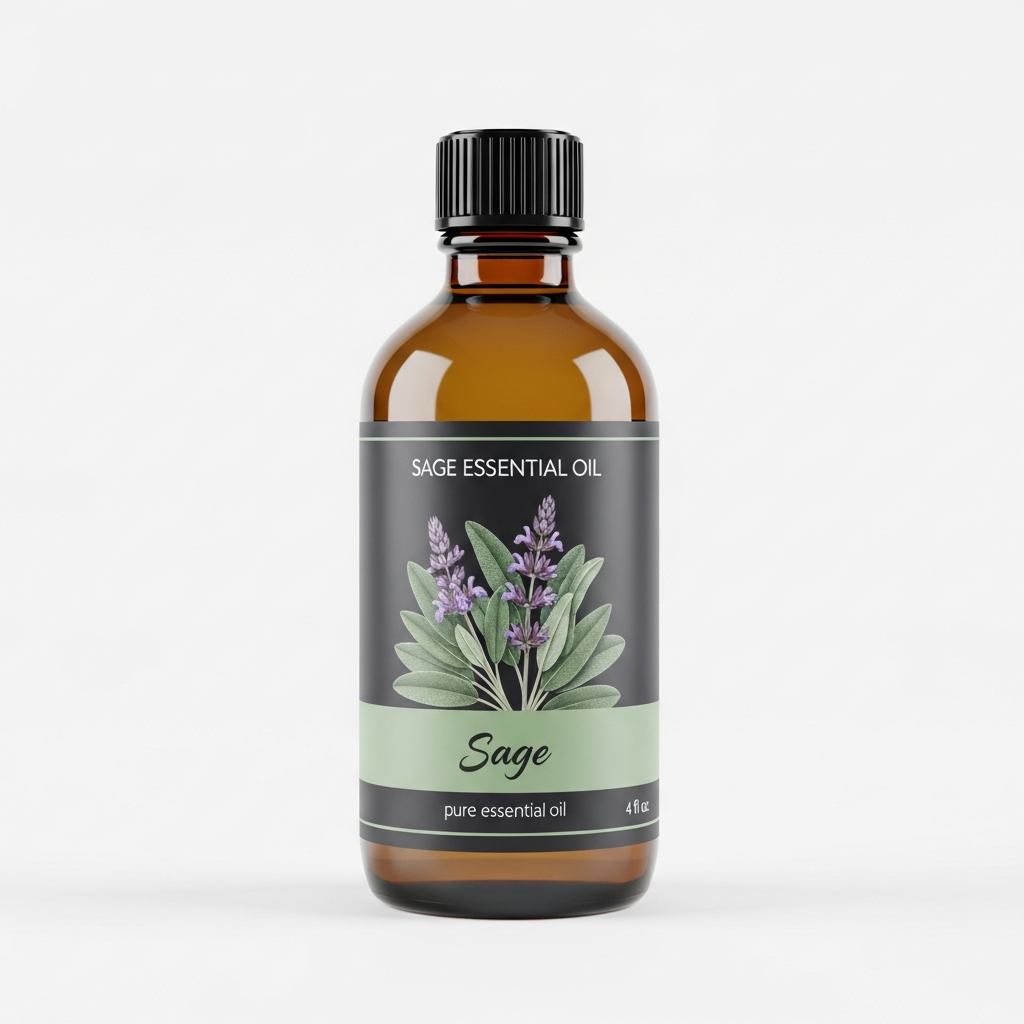
- Dark glass packaging (amber or cobalt), stored away from heat and light
- No added carriers, diluents, or synthetic extenders
"The sage herb tradition is long enough that shortcuts and adulterations have also had centuries to develop. A GC/MS report is the clearest way to verify that what is in the bottle matches what is on the label."
Sage in Modern Aromatic Practice
Today, Salvia officinalis essential oil holds a recognized place in natural perfumery, cosmetic formulation, and home aromatherapy. Its scent profile, herbal, sharp, slightly camphoraceous, with earthy and woody depth, makes it a valued middle and top note in complex blends. It pairs well with lavender, clary sage, rosemary, cedarwood, and citrus oils.
In cosmetic formulations, sage oil appears in hair care products, facial toners, and botanical colognes. Its aromatic complexity gives natural fragrance formulas a quality that synthetic alternatives often struggle to replicate.
The sage herb tradition, running from Pliny's Roman garden through monastic herb beds and into contemporary distilleries, represents one of the more continuous threads in Western botanical history. Few plants have retained such consistent recognition across such a long span of time. That staying power reflects something real about sage's aromatic character and its particular ability to anchor a space, a product, or a ritual with clarity and depth.
Working with sage essential oil now means participating in a very long conversation. The chemistry is specific, the sourcing geography matters, and the safety profile deserves careful reading. But the reward, for those who approach it with the right information, is an oil with genuine historical weight and a scent that earns its place in any serious aromatic collection.