
Organic vs Conventional Essential Oils: What the Seal Covers
An organic claim on an essential oil is a statement about how the plant was grown and how the oil was handled, backed by a certificate you can ask to see. It is not a statement about potency, species, or what is in the bottle, and for sage it says nothing about thujone. Our process page describes the leaf behind our sage oils as organic but no certificate is published, and the shop pages do not claim it, so we treat organic as unverified for our own oils and show below what to ask for.
What the word commits a seller to
Under US rules, an operation that sells products as organic must be certified unless it qualifies for an exemption. The rule is 7 CFR 205.100, and the regulations define "handle" as to sell, process or package agricultural products (205.2), which means a reseller or private-label filler that sells an oil as organic is itself a handler (retail stores that do not process are exempt under 205.101). That is our reading of the definitions, and a certifying agent or a product-regulation attorney is the person to confirm how it applies to a given business.
What certification involves, per 7 CFR 205.400: a written organic system plan sent to an accredited certifying agent and updated every year, on-site inspections including non-certified areas, records kept for at least five years, and prompt notice to the certifier about any contact with a prohibited substance. Under 205.406, the operation must also pay fees and submit updates each year, with at least one on-site inspection every calendar year. That is a paper trail, which is what makes the claim checkable.
The four label categories, and what a single-ingredient oil does with them
7 CFR 205.301 sets the composition tiers, counted by weight or fluid volume and excluding water and salt:
| Label wording | Organically produced ingredients |
|---|---|
| 100 percent organic | 100% |
| Organic | Not less than 95% |
| Made with organic (named ingredients) | At least 70% |
| Under 70% | May describe organic content only as 205.305 allows |
For a single-ingredient oil the tiers collapse. By our reading, there is no 70% or 95% case to argue about: either the leaf the oil came from was organically produced and the oil was handled under certification, or it was not. A blend or a product with a carrier changes that, because the carrier counts toward the percentage. If an oil is bought and sold as organic, ask which tier the label claims.
The certifier line
Under 7 CFR 205.303, a packaged product labelled organic must name, on its information panel, the certifying agent that certified the handler of the finished product, placed below the handler or distributor information. The USDA seal is permitted and a certifier's own seal may appear but not more prominently than the USDA seal. So the seal alone is not the test. The test is the certifier's name next to a certificate you can request, with the product and the operation's scope on it. Reasoning from that wording, a farm's certificate does not stand in for the bottler's, and the bottler's does not stand in for the farm's, so ask which operations are covered.
The small-seller exemption
7 CFR 205.101 exempts an operation whose gross income from organic sales is five thousand dollars or less a year from certification. Such an operation must still follow the production and labelling requirements, and must keep records for at least three years and provide them on request. That is a rule about paperwork, not about quality: a very small producer can sell as organic without being certified. For a buyer, the practical consequence is to ask whether the seller is certified or exempt, and in the second case to ask for the records the rule says must be available.
What organic does not tell you
Residues. Organic does not mean zero residue. 7 CFR 205.671 says a product is excluded from organic sale when testing finds a prohibited substance above 5 percent of the EPA tolerance for that residue (or above unavoidable environmental contamination), and 205.670 requires certifying agents to conduct periodic residue testing. Both are thresholds, not a guarantee of none. We searched for a peer-reviewed residue study of steam-distilled sage oil and could not fetch one, so we do not claim that organic and conventional sage oils differ in residues, and we do not claim they match.
Composition. The sections of Part 205 we read govern production and handling. None of them sets a thujone, camphor or cineole level for an oil, and that is the part that varies. The European Medicines Agency's assessment report calls sage oil composition very variable with source and harvest, and ISO 9909 lets combined thujone sit anywhere from 21% to 51.5%, about a 2.5-fold spread. An organic oil and a conventional one can each fall at either end. The GC-MS reading guide is the tool for that question, and the thujone safety background is in the thujone article.
Species and authenticity. A certifier checks farming and handling records; the rules we read do not say it tests that the oil is Salvia officinalis rather than another sage. Sage names are also unreliable: other sages, such as clary sage, are different oils. Our buying guide covers species labelling.
Safety. The EMA public statement says sage oil is characterised by high levels of thujone, which is toxic and may cause seizures at high doses. Organic status does not change that. The cautions on our process page, including avoiding the oil in pregnancy and breastfeeding, around children, and with a seizure disorder, apply to any sage oil.
Cosmetic rules. The FDA says it has no regulations defining "natural" or "organic" for cosmetics. An oil sold as aromatherapy or for scent is judged by its intended use, and an organic word on the label is governed by the USDA rules above, not by the FDA.
About our oils
The shop pages for our two sage listings do not say organic, and the certificate of analysis we publish reports physical constants for one batch and carries no organic certificate. Our process page describes the leaf as organic but no certifier or certificate number is published anywhere we can point you to. Until one is, please read organic as not established for our oils. If it matters to you, perhaps because you will label a finished product organic, ask in writing for the certifier's name, the certificate, the operation it covers, and its date, and check them with the certifier. We do not promise a particular document. Our wholesale page is where private-label and bulk buyers can raise it. Nothing here is a claim that our oils are certified.
A decision order
- Do you need the claim, because you will label a product organic? Then you need the certifier paperwork, and your own certification status checked.
- If you only prefer organic, ask which tier and which certifier.
- Whatever the answer, ask for composition separately: organic status is not a thujone figure.
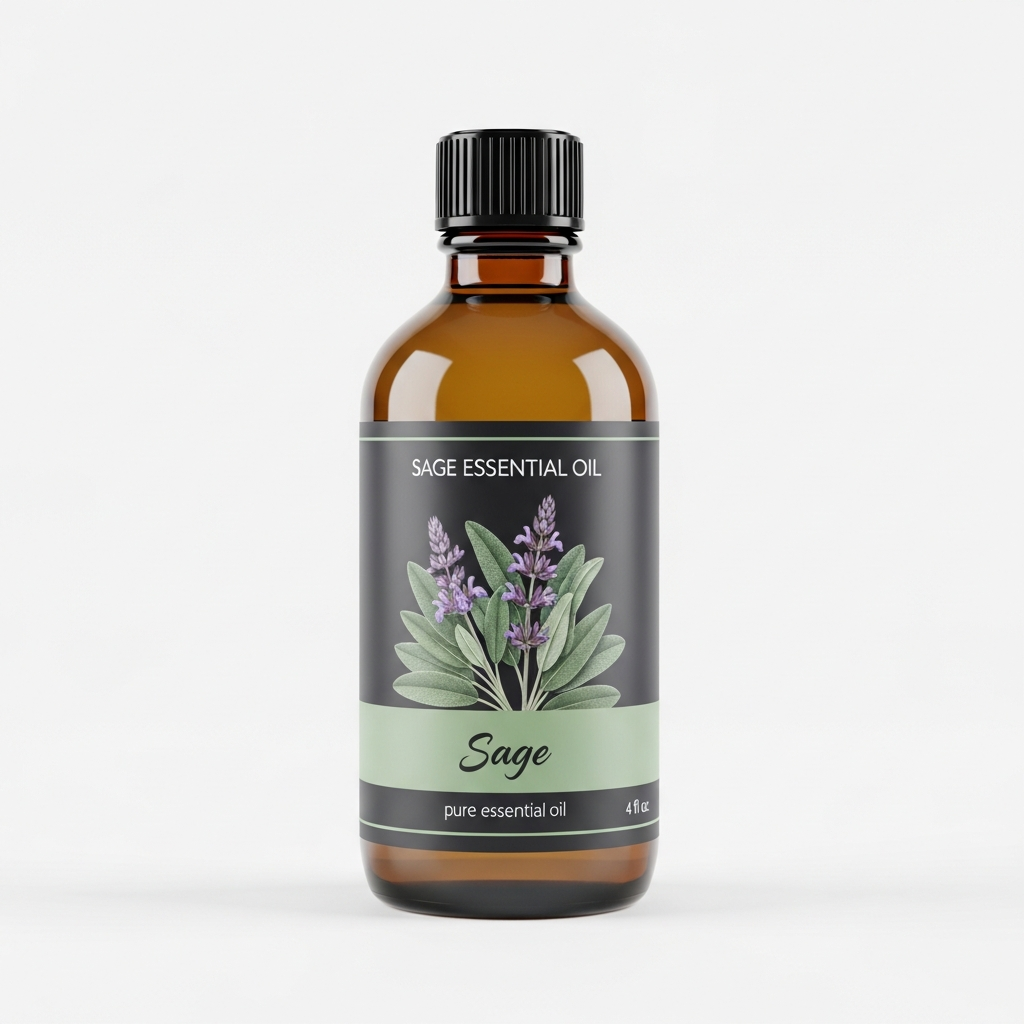
Sage Essential Oil
Sage Essential Oil from our own shop, in sizes from 0.5 oz to bulk.
From $13.99
Shop Now →Sources & Further Reading
- USDA via Cornell LII. 7 CFR 205.100, What has to be certified. law.cornell.edu/cfr/text/7/205.100
- USDA via Cornell LII. 7 CFR 205.2, Terms defined. law.cornell.edu/cfr/text/7/205.2
- USDA via Cornell LII. 7 CFR 205.101, Exemptions and exclusions from certification. law.cornell.edu/cfr/text/7/205.101
- USDA via Cornell LII. 7 CFR 205.301, Product composition. law.cornell.edu/cfr/text/7/205.301
- USDA via Cornell LII. 7 CFR 205.303, Packaged products labeled organic. law.cornell.edu/cfr/text/7/205.303
- USDA via Cornell LII. 7 CFR 205.400 and 205.406, certification requirements and continuation. law.cornell.edu/cfr/text/7/205.400
- USDA via Cornell LII. 7 CFR 205.670 and 205.671, inspection, testing and exclusion from organic sales. law.cornell.edu/cfr/text/7/205.671
- EMA/HMPC, 2016. Assessment report on Salvia officinalis L., folium and aetheroleum (EMA/HMPC/150801/2015). ema.europa.eu/EMA/HMPC/150801/2015
- EMA/HMPC, 2016. Public statement on Salvia officinalis L., aetheroleum (EMA/HMPC/41843/2009 Corr. 1). ema.europa.eu/EMA/HMPC/41843/2009
- ISO 9909:1997. Oil of Dalmatian sage (Salvia officinalis L.), preview copy. standards.iteh.ai/ISO-9909-1997
- FDA, 2023. Aromatherapy. fda.gov/cosmetics/cosmetic-products/aromatherapy