Essential Oils for Nausea: What the Peppermint Trials Measured
The trials on inhaled aromas and nausea are small, hard to blind and mostly about one oil, peppermint, in hospital patients. They report real but modest differences, and they say nothing about sage. We sell only sage oil, which is not a nausea product, so this article is a reading of what was measured, not a recipe. If you want one number to carry away: the largest pooled peppermint analysis found an average gap of 0.6 points on a 0 to 10 nausea scale, and its own authors put the smallest difference a patient would notice at about 1.5.
What the Cochrane review pooled
The Cochrane review by Hines and colleagues (2018) is the broadest check. It included 16 studies with 1,036 participants, covering inhaled peppermint, inhaled isopropyl alcohol vapour, and blended aroma products. Ginger is not among its included interventions; it appears only in the excluded list. The comparisons that matter for a peppermint buyer:
- Aroma versus placebo, nausea severity at the end of treatment: standardised mean difference -0.22 (95% CI -0.63 to 0.18), 6 studies, 241 people. The interval crosses zero, so the review could not separate it from no effect.
- Peppermint versus placebo at 5 minutes: -0.18 (-0.86 to 0.49), 4 trials, 115 people. Same story.
- Need for rescue anti-sickness medicine: risk ratio 0.60 (0.37 to 0.97), 7 trials, 609 people. This is the one result that leaned in favour of aroma, and the upper bound sits close to 1.
- Isopropyl alcohol vapour (a pad held under the nose, not an essential oil) was the intervention that did best against standard medicine, and it is a different material.
The authors graded the evidence moderate to very low and report no adverse-event data for the aroma-versus-placebo comparison. Their summary is that aroma may be about as effective as placebo for severity, which is very uncertain.
The 2025 peppermint-only pooling, and what 0.6 points means
Gergő and colleagues (2025) pooled randomised trials of inhaled peppermint only: 19 trials, 14 in the meta-analysis, three clinical settings, mostly from Iran, Turkey and the USA. Methods differed widely: diluted oil on a cotton ball, a bottle, a bowl of water, or a pharmacy peppermint spirit of about 82% ethanol. Their 0 to 10 results:
| Setting | Participants | Time point | Mean difference | Share of a 1.5-point threshold (our arithmetic) |
|---|---|---|---|---|
| After surgery | 453 (8 studies) | 2 to 6 hours | -0.60 (-0.77 to -0.44) | 40% |
| Pregnancy | 283 (3 studies) | 48 hours | -0.51 (-0.78 to -0.24) | 34% |
| Pregnancy | 283 (3 studies) | 96 hours | -0.68 (-1.09 to -0.27) | 45% |
| Chemotherapy | 264 (3 studies) | 24 to 96 hours | -1.85 to -2.41 | 123% to 161% |
The authors state that the surgical and pregnancy gaps were mostly below the minimal clinically important difference of about 1.5 points. Only the chemotherapy figures cleared it, and those come from three trials with high heterogeneity (I-squared up to 95% at several time points). Certainty was rated low for every outcome. Blinding is difficult when the active arm smells of peppermint, and control arms ranged from water to alternative oils to controlled breathing, so a peppermint-specific effect cannot be separated from expectation. Adverse events were poorly reported: in chemotherapy trials, 2 of 36 treated patients had headaches and 3 had more nausea in one trial, and 1 of 36 felt worse in another.
One trial in detail
A trial in cardiac surgery patients (Maghami and colleagues, 2020) shows what a single positive result looks like. Sixty patients, mostly bypass surgery, received nebulised peppermint essential oil before the breathing tube was removed. In the first four hours the treated group scored nausea severity 2.43 against 4.61 in controls and logged 0.17 vomiting episodes against 0.73. Those are large relative gaps in a small trial in one specialised setting, recorded on a checklist. Nothing in it describes a bottle on a nightstand, and it was run on one oil by one route.
Pregnancy: the setting with the most caution
Pregnancy appears in the peppermint pooling (three studies, 283 women) but it is the setting where the plain advice is to ask a professional. The NHS page on morning sickness lists resting, avoiding trigger smells, small plain meals, sipping fluids, ginger and wrist acupressure, adds that evidence for acupressure is limited, and says to check with a pharmacist before taking ginger supplements. Sage is a separate matter. The European Medicines Agency's assessment report says sage is contraindicated in pregnancy and lactation and describes the thujones in the oil as abortifacient and emmenagogic. The NCCIH sage page (April 2025) says it may be unsafe to use sage during pregnancy because of thujone. Those sources mostly concern leaf preparations taken by mouth, so they do not measure what a diffuser delivers, but our own process page draws the same line: avoid it entirely during pregnancy and while breastfeeding. For the full list of what authorities say, see sage oil in pregnancy and breastfeeding.
Where sage fits: it does not
None of the reviews above includes sage oil, and the one regulatory body that assessed the oil reached a negative conclusion. In its public statement (2 February 2016) the EMA committee says sage oil is characterised by high levels of thujone, that thujone is toxic and may cause seizures at high doses, and that the benefit-risk analysis for sage oil as a traditional herbal medicine is negative. The assessment report adds that sage oil is reported to be a moderate skin irritant and is not recommended for aromatherapy. Our oils are sold neat, our process page says sage is not a beginner's oil, and the shop states they are not for internal use. If your question is how to settle a stomach, the oil we sell is not the answer. For the wider evidence on aroma, our piece on what reviews of aromatherapy trials conclude is the place to read next, and the sage oil safety basics cover handling if you already own a bottle.
The US Food and Drug Administration also draws a regulatory line here. Its aromatherapy page (current as of 8 September 2023) says how aromatherapy products are regulated depends mainly on intended use, and lists claims about colic, pain, muscle relaxation, depression, anxiety or sleep as drug claims. For that reason we do not describe any oil of ours as helping with any condition, and an article about nausea can report trials without implying the shop sells a result.
When nausea needs a clinician, not a bottle
The NHS advises seeing a GP if you feel sick and do not feel better in a few days, or if it keeps coming back, and calling 999 if sudden sickness comes with tight chest pain, pain spreading to the arms, back, neck or jaw, or shortness of breath. In pregnancy the NHS says to contact your midwife, GP or 111 if you are vomiting and have very dark urine or have not passed urine in more than 8 hours, cannot keep food or fluids down for 24 hours, feel very weak, dizzy or faint on standing, have tummy pain or a high temperature, vomit blood, or have lost weight. Those thresholds belong to a physician, midwife or pharmacist, not to anyone selling an oil. In the US, the equivalent is your doctor or pharmacist, and Poison Control at 1-800-222-1222 if any oil has been swallowed.
Hold onto two numbers: 0.6 points against a 1.5-point threshold, and a Cochrane interval that includes no effect. Our shop pages describe sage oil as herbaceous and earthy, and nothing more is claimed for it. For headaches, which draw on a different set of peppermint studies, see what the peppermint ethanol trials tested.
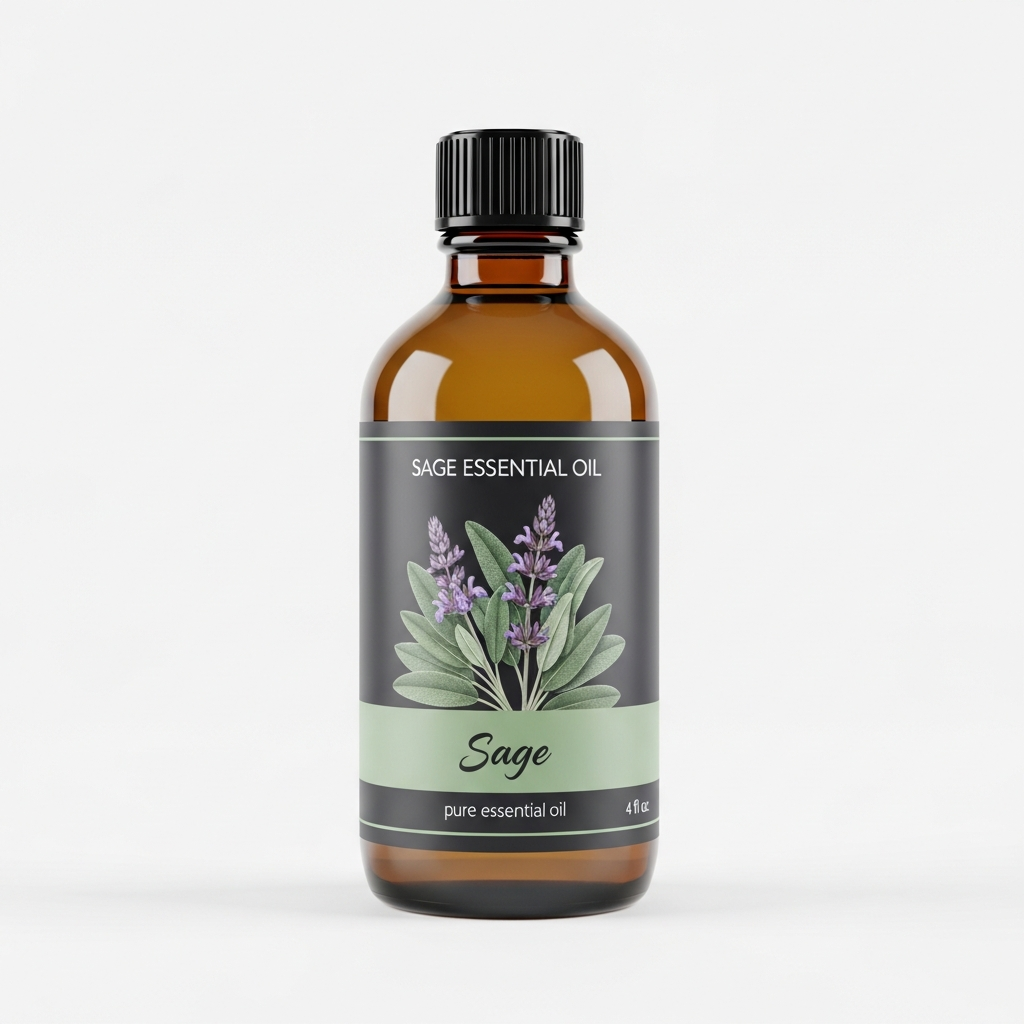
Sage Essential Oil
Sage Essential Oil from our own shop, in sizes from 0.5 oz to bulk.
From $13.99
Shop Now →Sources & Further Reading
- Hines S, Steels E, Chang A, Gibbons K, 2018. Aromatherapy for treatment of postoperative nausea and vomiting (Cochrane Database Syst Rev CD007598). pubmed.ncbi.nlm.nih.gov/29523018
- Gergő D et al., 2025. Inhaling peppermint essential oil as a promising complementary therapy in the treatment of nausea and vomiting (J Clin Med 14:5069). pmc.ncbi.nlm.nih.gov/articles/PMC12294836
- Maghami M et al., 2020. Peppermint aromatherapy for nausea and vomiting after cardiac surgery (Complement Ther Clin Pract 40:101199). pubmed.ncbi.nlm.nih.gov/32891278
- NHS. Feeling sick (nausea). nhs.uk/conditions/feeling-sick-nausea
- NHS. Vomiting and morning sickness in pregnancy. nhs.uk/pregnancy/.../vomiting-and-morning-sickness
- EMA/HMPC, 2016. Public statement on Salvia officinalis L., aetheroleum (EMA/HMPC/41843/2009 Corr. 1). ema.europa.eu/EMA/HMPC/41843/2009
- EMA/HMPC, 2016. Assessment report on Salvia officinalis L., folium and aetheroleum (EMA/HMPC/150801/2015). ema.europa.eu/EMA/HMPC/150801/2015
- NCCIH, 2025. Sage. nccih.nih.gov/health/sage
- FDA, 2023. Aromatherapy. fda.gov/cosmetics/cosmetic-products/aromatherapy