
Essential Oils for a Blocked Nose: Menthol, Cineole, Children
Three different things get filed under "essential oils for a blocked nose": menthol, which changes how airflow feels without changing how much air moves; cineole, which was tested as a pharmaceutical capsule rather than as an aroma; and steam, which has its own trial history and its own scald risk. Each has a source behind it, and none of the three studies was run on sage oil. We sell only sage oil, which is not a congestion product, so what follows is a reading of the sources and a worked reason why one of them cannot be carried over to a bottle.
Menthol: a change in sensation, measured against a ruler
The clearest primary study is Eccles and colleagues (1990). It was a double-blind, placebo-controlled trial in 62 people with a naturally acquired cold and a blocked nose. Each took a lozenge with 11 mg of menthol or a candy placebo. Nasal airway resistance, measured by posterior rhinomanometry, rose significantly over the two-hour experiment in both groups and did not differ between them at any time point. On a visual analogue scale, only the menthol group reported a significant improvement in the sensation of airflow (P below 0.001), starting 10 minutes after dosing. The conclusion in the abstract is that menthol had no effect on measured resistance but produced a marked subjective sense of decongestion.
Two limits matter. The menthol was an oral lozenge, not an inhaled oil. And the result is a statement about sensation: people felt clearer, the instrument showed no change. That can still be a reasonable thing to want, but it is a different claim from "opens the airway", and a seller who says the second on the strength of the first would be misreporting the study.
Cineole: a capsule trial, and the arithmetic that stops it transferring
The most-cited positive result for cineole is Kehrl and colleagues (2004): a randomised, double-blind trial in 152 adults with acute non-purulent rhinosinusitis, 76 per group. The treated group took two 100 mg cineole capsules three times daily (600 mg a day) for 7 days. The symptom-sum score started at 15.6 in both groups and fell to 3.0 on cineole against 9.2 on placebo by day 7. Two cineole patients had mild effects possibly linked to the capsules, heartburn and a rash. The authors concluded that early cineole treatment was effective in this condition.
That is a swallowed, measured dose of a single compound. Sage oil contains 1,8-cineole too, and ISO 9909:1997 allows 5.5% to 13% of it in Dalmatian sage oil (a general standard, not a figure for our oils, whose cineole content is not published). So here is the arithmetic of trying to match the trial through the oil, using that range:
| Cineole share of the oil | Oil needed for 600 mg cineole | Roughly, in drops (about 20 per ml, density 0.915) |
|---|---|---|
| 13% | 4.6 g | about 100 |
| 5.5% | 10.9 g | about 240 |
The same oil carries thujone. ISO 9909 allows alpha-thujone 18% to 43% and beta-thujone 3% to 8.5%, so a combined 21% to 51.5%. At the corners of those ranges, 4.6 g of oil holds about 970 mg of thujone and 10.9 g holds about 5.6 g. The European Medicines Agency's ceiling for sage leaf preparations is 6.0 mg of thujone per person per day for at most two weeks. That is an oral limit and it is not a skin or inhalation limit, so the comparison is orientation, not a safety threshold, but a factor of roughly 160 to 940 shows why a capsule result cannot be read as a result for the contents of a bottle. The capsule trial supports one conclusion only: cineole capsules, in 152 adults, scored better than placebo on a symptom score. It says nothing about an oil with a different mixture.
Steam: a Cochrane review that could not find a benefit or a harm
The Cochrane review of heated, humidified air for the common cold (Singh and colleagues, 2017) found 6 randomised trials with 387 participants. A fixed-effect analysis favoured the treatment (odds ratio 0.30, 95% CI 0.16 to 0.56, 2 studies, 149 people), while a random-effects analysis did not (0.22, 0.03 to 1.95). One trial found worse nasal resistance, another found better. The authors' conclusion is that the evidence does not show any benefits or harms, and some studies reported minor nasal discomfort. The device was a specific heated-air unit, and no essential oil was involved.
The NHS cold page suggests breathing in steam by sitting in a bathroom with a hot shower running, and says not to let children breathe steam from a bowl of hot water because of the risk of scalding. Adding oil to a bowl of hot water adds a scald hazard and a spill hazard to a mix that the evidence has not shown to be better.
Children: the line that does not move
Poison Control's essential oils article says children have thin skin and immature livers, which might make them more susceptible than adults, that swallowed eucalyptus oil can cause seizures, and that even a small amount of swallowed camphor is dangerous with seizures that can begin within minutes. A Pediatrics case series (Khine and colleagues, 2009) describes three children aged 15 to 36 months in the Bronx who had seizures from camphor, two by swallowing and one from repeated rubbing on the skin; all three needed medication to stop the seizures. Three children is an anecdote, not an incidence, but it is why the mild-sounding word "vapour rub" does not settle the question for a toddler.
Sage oil carries camphor too: ISO 9909 allows 4.5% to 24.5%. Our process page says not to use sage oil on or around children, and we agree and keep that line. If a child has a blocked nose, the NHS lists a worry about your child's cold symptoms as a reason to see a GP, and says decongestants should not be used by children under 6. A paediatrician or pharmacist is the person to ask which products suit a given age. The related questions are covered in our page on sage oil around children.
Where sage fits: it is not a congestion product
The regulatory frame is simple. The FDA's aromatherapy page (current as of September 2023) says regulation depends mainly on intended use, and it lists claims about pain, sleep, anxiety and similar problems as drug claims. A scented oil sold for atmosphere has to stay an atmosphere product. Sage oil is, per the shop, herbaceous, earthy and camphoraceous, and for scent that is all we claim. Our safety basics piece covers dilution and household handling. If you diffuse any oil near someone who is unwell, the practical question is the room, not the bottle; see time, ventilation and who else is in the room.
When a blocked nose needs a doctor
According to the NHS, see a GP if cold symptoms do not get better after 10 days, if a high temperature lasts more than 3 days, if you feel short of breath or have chest pain, if symptoms get worse, or if you have a long-term medical condition or weakened immune system. In the US, a primary care doctor or pharmacist fills that role. If anyone has swallowed an essential oil, call Poison Control at 1-800-222-1222.
The short version: menthol changes the feeling, a cineole capsule is a drug trial, heated humidified air showed neither benefit nor harm in the Cochrane review and steam carries a scald risk, and a bottle of sage oil is a scent, handled with the cautions above.
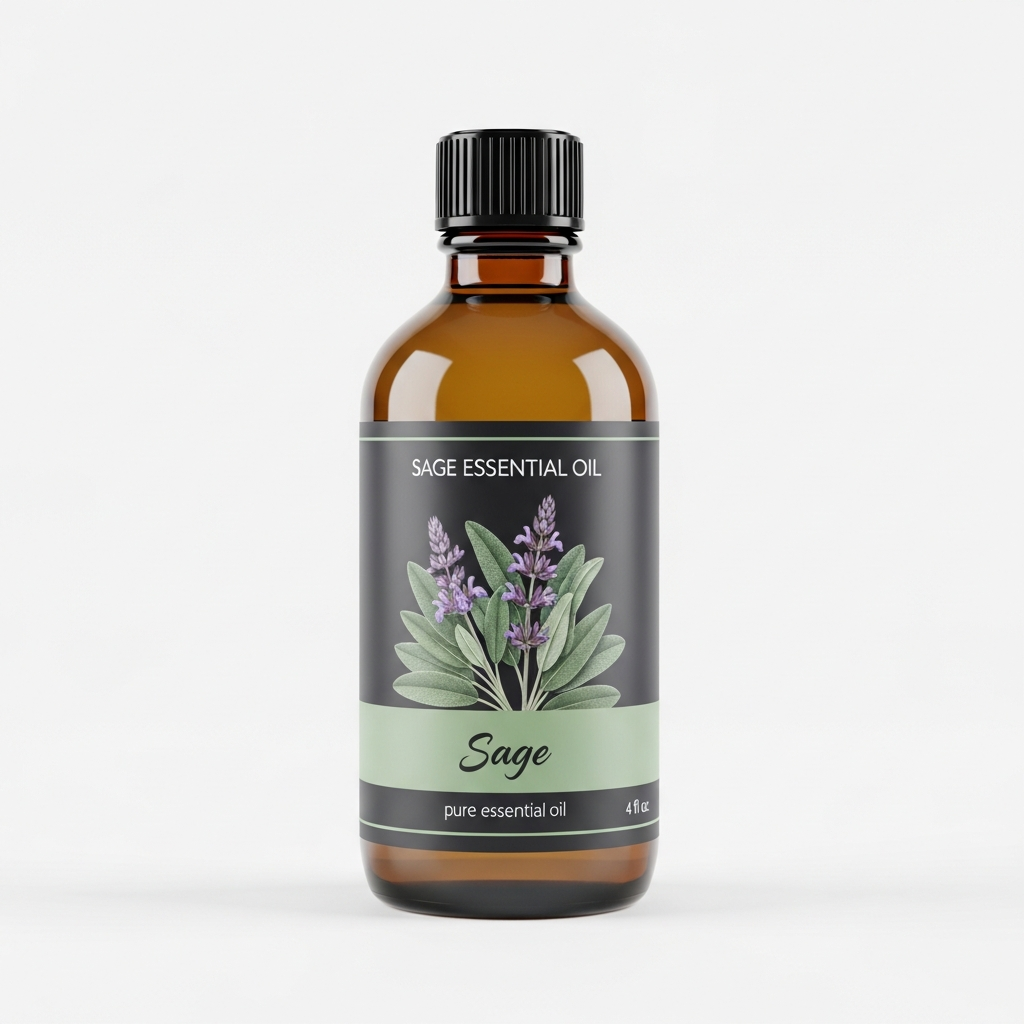
Sage Essential Oil
Sage Essential Oil from our own shop, in sizes from 0.5 oz to bulk.
From $13.99
Shop Now →Sources & Further Reading
- Eccles R, Jones AS, Morris S, 1990. Menthol lozenge and nasal airflow sensation in nasal congestion (J Pharm Pharmacol 42:652-4). pubmed.ncbi.nlm.nih.gov/1981905
- Kehrl W, Sonnemann U, Dethlefsen U, 2004. Therapy for acute nonpurulent rhinosinusitis with cineole (Laryngoscope 114:738-42). pubmed.ncbi.nlm.nih.gov/15064633
- Singh M et al., 2017. Heated, humidified air for the common cold (Cochrane CD001728). pubmed.ncbi.nlm.nih.gov/28849871
- NHS. Common cold. nhs.uk/conditions/common-cold
- Khine H et al., 2009. A cluster of children with seizures caused by camphor poisoning (Pediatrics 123:1269-72). pubmed.ncbi.nlm.nih.gov/19403490
- Poison Control (poison.org). Essential oils. poison.org/articles/essential-oils
- ISO 9909:1997. Oil of Dalmatian sage (Salvia officinalis L.), preview copy. standards.iteh.ai/ISO-9909-1997
- EMA/HMPC, 2016. Public statement on Salvia officinalis L., aetheroleum (EMA/HMPC/41843/2009 Corr. 1). ema.europa.eu/EMA/HMPC/41843/2009
- FDA, 2023. Aromatherapy. fda.gov/cosmetics/cosmetic-products/aromatherapy